CV 9030 Swedish Infantry Fighting Vehicle (IFV)
CV 9030

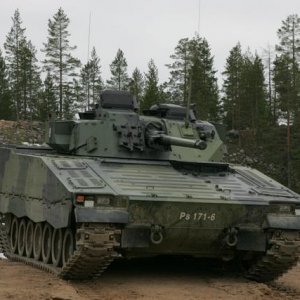
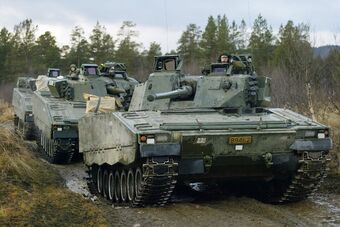
The Combat Vehicle 90 (CV90; Sw. Stridsfordon 90, Strf90) is a family of Swedish tracked combat vehicles designed by Sweden's Defense Materiel Administration (Försvarets Materielverk, FMV), Hägglunds and Bofors during the mid-1980s and early 1990s and entered service in Sweden in the mid-90s. The CV90 platform design has continuously evolved in steps from Mk0 to current MkIV with advances in technology and in response to changing battlefield requirements. The Swedish version of the main infantry fighting vehicle is fitted with a turret from Bofors that is equipped with a 40 mm Bofors autocannon. Export versions are fitted with Hägglunds E-series turrets, armed with either a 30 mm or a 35 mm Bushmaster autocannon. Developed specifically for the Nordic sub-arctic climate, the vehicle has very good mobility in snow and wetlands while carrying and supporting six to eight fully equipped dismount soldiers. Other variants include Forward Observation, Command and control, anti-aircraft, armored recovery vehicles, electronic warfare, and so forth. The CV90 and Hägglunds E-series turrets have been under continuous development with more than 4 million hours invested and are still produced with modern protection, armament, and network-enabled solutions. Currently, 1,280 vehicles in 15 variants are in service with seven user nations, four of which are NATO members, under BAE Systems Hägglunds AB. CV9030 Export version with a 30 mm Bushmaster II autocannon. Adopted by Norway, Switzerland and Finland. Within BAE Systems Hägglunds, the original version of the Norwegian CV9030N is known as the CV90 MK I. The Finnish CV9030FIN and Swiss CV9030CH vehicles are known as the CV90 MK II. The CV90 MK II is also available as CV9030 COM – Command & Control Vehicle. The recently upgraded CV9030N infantry fighting, command & control, and reconnaissance vehicles for Norway are known as CV90 MkIIIb, and this is the most advanced variant currently in service.