S-125 Neva/Pechora (SA-3 Goa) Russian 6x6 Surface-to-Air Missile System
NICKNAMES

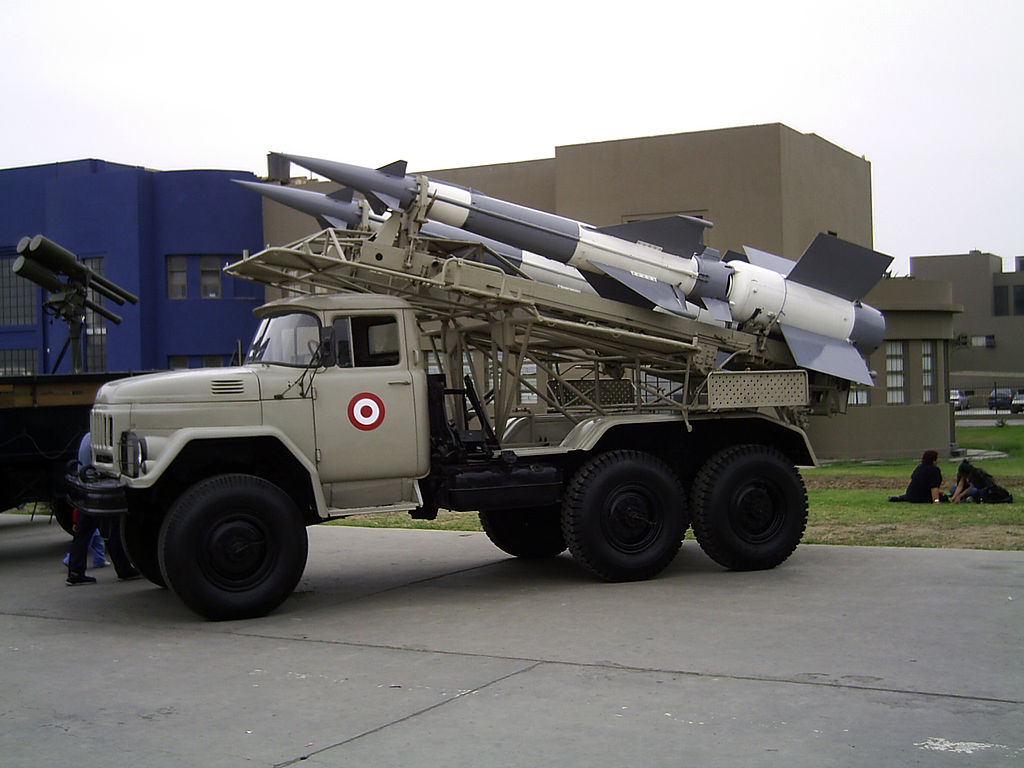

The S-125 Neva/Pechora, NATO reporting name SA-3 Goa) Soviet surface-to-air missile system was designed by Aleksei Isaev to complement the S-25 and S-75. It has a shorter effective range and lower engagement altitude than either of its predecessors and also flies slower, but due to its two-stage design, it is more effective against more maneuverable targets. It is also able to engage lower-flying targets than the previous systems, and being more modern it is much more resistant to ECM than the S-75. The 5V24 (V-600) missiles reach around Mach 3 to 3.5 in flight, and both stages are powered by solid-fuel rocket motors. The S-125, like the S-75, uses radio command guidance. The launchers are accompanied by a command building or truck and three primary radar systems: * P-15 "Flat Face" or P-15M "Squat Eye" 380 kW C-band target acquisition radar (also used by the SA-6 and SA-8, range 250 km/155 miles) * SNR-125 "Low Blow" 250 kW I/D-band tracking, fire control, and guidance radar (range 40 km/25 miles, second mode 80 km/50 miles) * PRV-11 "Side Net" E-band height finder (also used by SA-2, SA-4 and SA-5, range 28 km/17 miles, max height 32 km/105,000 ft) The S-125 system uses 2 different missile versions. The V-600 (or 5V24) had the smallest warhead with only 60 kg of high explosive. It had a range of about 15 km. The later version is named V-601 (or 5V27). It has a length of 6.09 m, a wing span of 2.2 m, and a body diameter of 0.375 m. This missile weighs 953 kg at launch and has a 70 kg warhead containing 33 kg of HE and 4,500 fragments. The minimum range is 3.5 km, and the maximum is 35 km (with the Pechora 2A). The intercept altitudes are between 100 m and 18 km. The S-125M (1970) system uses 5V27. The intercept altitudes are between 20 m and 14 km. The minimum range is 2.5 km, and the maximum is 22 km. The S-125M1 (1978) system uses 5V27D. In the early 1980s established for each system 1-2 radar simulators (against anti-radar missiles were assigned). The S-125 is somewhat mobile, an improvement over the S-75 system. The missiles are typically deployed on fixed turrets containing two or four but can be carried ready-to-fire on ZIL trucks in pairs. Reloading the fixed launchers takes a few minutes.