ARMSNET
Military Equipment Database
Initializing 0%

SU-100 Russian Tank Destroyer

SU-100
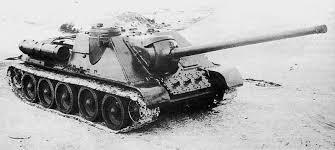
Tank Destroyer
Spotted an error? Sign in to suggest an edit.
Basic Information
Name
SU-100 Russian Tank Destroyer
Designation
SU-100
Alternate Designation
SU-100
Equipment Type
Tank Destroyer
Manufacturer
UZTM (Ural Heavy Machinery Factory)
Date of Introduction
1944
Description

The SU-100 (Samokhodnaya Ustanovka 100) was a Soviet tank destroyer armed with a 100 mm anti-tank gun in a casemate superstructure. It was used extensively during the last year of World War II and saw service for many years afterwards with the armies of Soviet allies around the world. The SU-85 was developed from the chassis of the T-34 tank replacing the turret with a larger, fixed superstructure that allowed a larger gun to be fitted: the 85 mm D-5 gun, providing dramatically upgraded firepower compared to the T-34's 76.2 mm models. Introduced to service in 1943, the SU-85 was quickly rendered obsolete as a new tank design featured the same gun on the T-34-85. This prompted the design of a more advanced turretless tank destroyer with an even more powerful cannon. Development was conducted under supervision of L. I. Gorlitskiy, chief designer of all medium Soviet self-propelled guns. The work started in February 1944 and the first prototype of the SU-100, "Object 138", was delivered in March. After intensive testing with different models of 100 mm gun Soviet engineers approved the D-10S gun for mass production. This gun was developed in Constructors Bureau of Artillery Factory No. 9 under the guidance of F. F. Petrov. After the Second World War this gun was installed on T-54 and T-55 tanks; these vehicles and their derivatives were in service forty years after initial development. It was built at the UZTM (Russian abbreviature УЗТМ for Уральский Завод Тяжелого Машиностроения – Ural Heavy Machinery Factory, also called Uralmash) in Yekaterinburg. The SU-100 quickly proved itself to be able to penetrate around 125 mm (4.9 in) of vertical armor from a range of 2,000 m (1.2 mi) and the sloped 80 mm (3.1 in) front armor of the German Panther from 1,500 m (0.93 mi). The hull of the SU-100 had major improvements over the SU-85; the thickness of the front armour was increased from 45 to 75 mm (1.8 to 3.0 in), and the commander's workplace was made in a small sponson on the right side of the hull; combined with the commander's cupola this improved the commander's effectiveness. Its German Jagdpanzer-family counterparts — the Jagdpanzer IV, Jagdpanther and Jagdtiger, by comparison, lacked this key piece of observational equipment. On the other hand, the SU-100's optics were inferior. For better ventilation two ventilator units were installed, instead of only one as in the SU-85. Mass production began in September 1944.

Ground Specifications
Crew 4
Mobility Type Tracked
Main Weapon 100 mm rifled anti-tank gun
Engine V-12 diesel (500 hp)
NBC Protection Yes
Max Speed 56.0 km/h
Range 299.0 km
System
Alternative Designation SU-100
Type Tank Destroyer
Crew 4 ea
Dimensions
Length 9.45 m
Width 3.00 m
Height 2.25 m
Weight, Combat 31.6 Tons
Ground Clearance 408 mm
Automotive
Engine Name Kharkiv Model V-2
Engine Type V-12 diesel
Engine Power 500 hp
Cruising Range 299 km
Speed, Maximum Road 56 km/h
Speed, Average Cross INA
Speed Maximum Swim Not Amphibious
Suspension Christie type with coil springs, 5 road wheels, rear drive, front idler, no return rollers
Gradient 60 %
Vertical Obstacle 0.69 m
Trench 2.51 m
Fording 0.88 m
Communications
TBR-121
VHF Transceiver Yes
VHF Range 1 to 50 km
Proliferated Widely
Digital Data Yes, Full
Control Self-Adaptive Control (Including Automatic Antenna Tuner)
Frequency Agile Yes
Wireless Network Capabilities Yes
Note: Very similar in capabilities to the US SINCGARS ASIP
Main Gun
System
Name D-10S Gun
Type Rifled Anti-Tank Gun
Caliber 100 mm
Length 5.608 m
Barrel Length 5.35 m
Weight 1,438 kg
Breech Horizontal sliding wedge (semi-automatic)
Recoil Hydraulic buffer and hydropneumatic recuperator
Carriage Vehicle mount
Maximum Elevation +17 deg
Minimum Elevation -2 deg
Traverse Range 34 deg
Traverse Left 17 deg
Traverse Right 17 deg
Rate of Fire 4 rounds/min avg 5–6 rounds/min max.
Muzzle Velocity 1,000 m/s
Maximum Firing Range 14,600 m (16,000 yds), or 16,000 m (17,500 yds)
Ammunition
Name 3UBK10-1
Type 9M117 Bastion
Caliber 100 mm
Cartridge Fixed QF 100 × 695 mm. R
Basic Load 34
Armor Penetration 600 mm at up to 4,000 m
Available Ammunition * 3UBK10-1 (9M117 Bastion), penetrating 600 mm at up to 4,000 m * 3UBK10M-1 (9M117M Kan) tandem warhead, penetrating 650 mm at up to 4,000 m * 3UBK23-1 (9M117M1 Arkan) extended-range tandem warhead, penetrating 750 mm at up to 6,000 m * 3UBK23M-1 (9M117M2 Boltok) extended-range warhead penetrating 850 mm at up to 6,000 m
Secondary Weapon System
System
Name Type 73
Type Light Machine Gun
Caliber 7.36 mm
Manufactuer First Machine Industry Bureau
Proliferation Widely Proliferated in North Korea
In Service 2002-Present
Length 1190 mm
Barrel Length 608 mm
Weight 10.6 kg
Action Gas
Rate of Fire 600–700 rpm
Feed System Box magazine Belt
Sights Iron
Ammunition
Type Type 73
Caliber 7.63 mm
Cartridge 7.62×54mmR
Basic Load INA
Fire Control
Name INA
Computerized FCS INA
Thermal Sight Tank Commander INA
Thermal Sight Gunner INA
Main Gun Stabilization INA
Protection
Hull Armor 46 mm
Turret Armor INA
Applique Armor Available
Explosive Reactive Armor INA
Active Protection System INA
Mine Clearing INA
Self-Entrenching Blade INA
NBC Protection Yes
Smoke Equipment INA
Details
Country of Origin Russia
Category Tracked Anti-Tank Vehicles
Land > Anti-Tank Vehicles > Tracked Anti-Tank Vehicles
Filter Label
S
Classification
Domain
Ground
Equipment Status
Active
Dimensions
Length
9.45 m
Width
3 m
Height
2.25 m
Weight
31600 kg
Operators (9)
Russia
Albania
Algeria
Angola
Cuba
Morocco
Romania
Vietnam
Yemen
Something went wrong. Please reload the page. Reload