AIM-9 Sidewinder American Short-Range Air-to-Air Missile
AIM-9

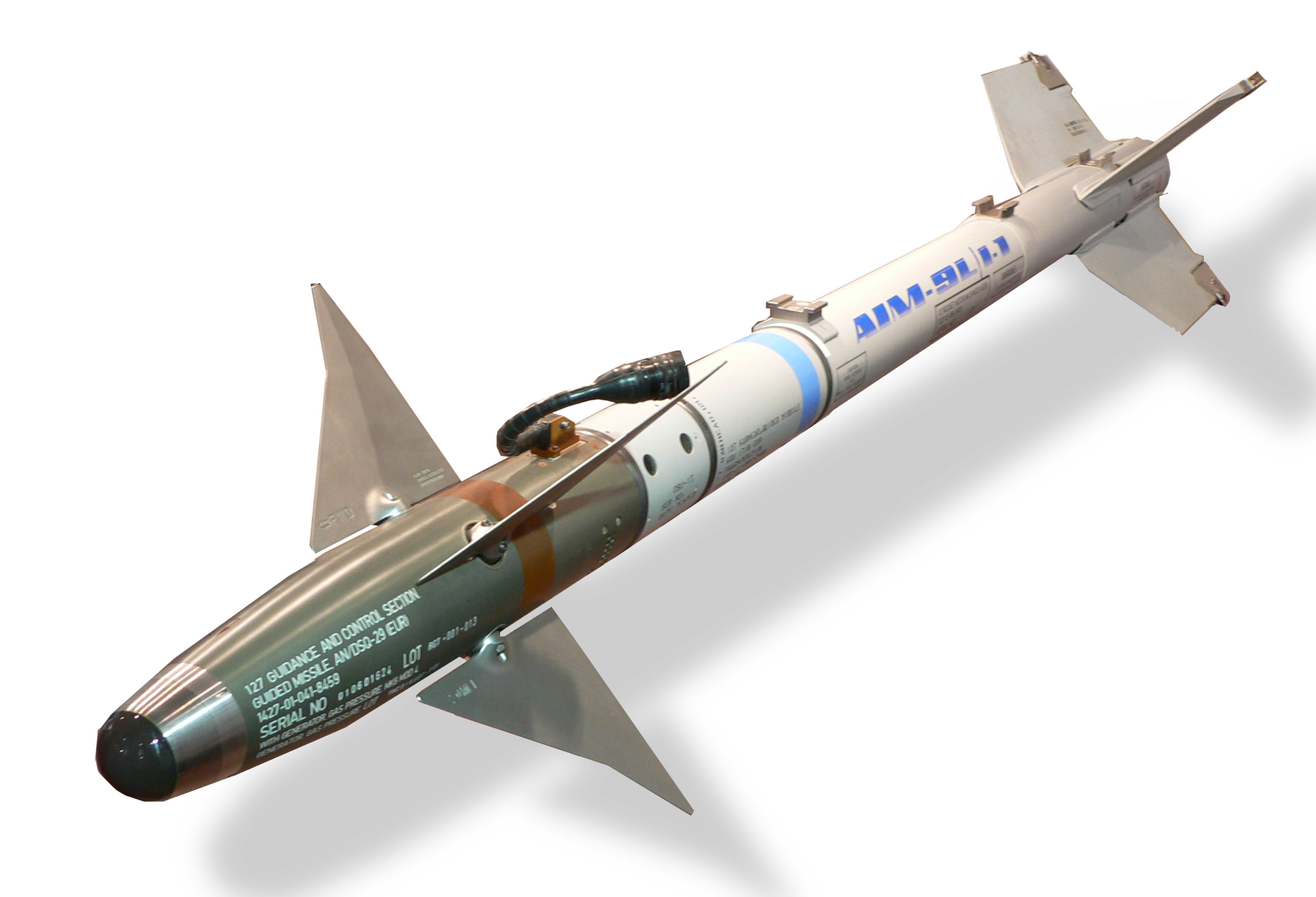
The AIM-9 Sidewinder is a short-range air-to-air missile which entered service with the US Navy in 1956 and subsequently was adopted by the US Air Force in 1964. Since then the Sidewinder has proved to be an enduring international success, and its latest variants are still standard equipment in most western-aligned air forces. The Soviet K-13, a reverse-engineered copy of the AIM-9, was also widely adopted by a number of nations. Low-level development started in the late 1940s, emerging in the early 1950s as a guidance system for the modular Zuni rocket. This modularity allowed for the introduction of newer seekers and rocket motors, including the AIM-9C variant, which used semi-active radar homing and served as the basis of the AGM-122 Sidearm anti-radar missile. Originally a tail-chasing system, early models saw extensive use during the Vietnam War but had a low success rate. This led to all-aspect capabilities in the L version which proved to be an extremely effective weapon during combat in the Falklands War and the Operation Mole Cricket 19 ("Bekaa Valley Turkey Shoot") in Lebanon. Its adaptability has kept it in service over newer designs like the AIM-95 Agile and SRAAM that were intended to replace it. The Sidewinder is the most widely used air-to-air missile in the West, with more than 110,000 missiles produced for the U.S. and 27 other nations, of which perhaps one percent have been used in combat. It has been built under license by some other nations including Sweden, and can even equip helicopters, such as the Bell AH-1Z Viper. The AIM-9 is one of the oldest, least expensive, and most successful air-to-air missiles, with an estimated 270 aircraft kills in its history of use. When firing a Sidewinder, NATO pilots use the brevity code FOX-2 The United States Navy hosted a 50th-anniversary celebration for the Sidewinder in 2002. Boeing won a contract in March 2010 to support Sidewinder operations through to 2055, guaranteeing that the weapons system will remain in operation until at least that date. Air Force Spokeswoman Stephanie Powell noted that due to its relatively low cost, versatility, and reliability it is "very possible that the Sidewinder will remain in Air Force inventories through the late 21st century". The AIM-9 is made up of a number of different components manufactured by different companies, including Aerojet and Raytheon. The missile is divided into four main sections: guidance, target detector, warhead, and rocket motor. The guidance and control unit (GCU) contains most of the electronics and mechanics that enable the missile to function. At the very front is the IR seeker head utilizing the rotating reticle, mirror, and five CdS cells or "pan and scan" staring array (AIM-9X), electric motor, and armature, all protruding into a glass dome. Directly behind this are the electronics that gather data, interpret signals, and generate the control signals that steer the missile. An umbilical on the side of the GCU attaches to the launcher, which detaches from the missile at launch. To cool the seeker head, a 5,000 psi (34 MPa) argon bottle (TMU-72/B or A/B) is carried internally in Air Force AIM-9L/M variants, while the Navy uses a rail-mounted nitrogen bottle. The AIM-9X model contains a Stirling cryo-engine to cool the seeker elements. Two electric servos power the canards to steer the missile (except AIM-9X). At the back of the GCU is a gas grain generator or thermal battery (AIM-9X) to provide electrical power. The AIM-9X features high off-boresight capability; together with JHMCS (Joint Helmet-Mounted Cueing System), this missile is capable of locking on to a target that is in its field of regard said to be up to 90 degrees off boresight. The AIM-9X has several unique design features including built-in test to aid in maintenance and reliability, an electronic safe and arm device, an additional digital umbilical similar to the AMRAAM and jet vane control. Next is a target detector with four IR emitters and detectors that detect whether the target is moving farther away. When it detects this action taking place, it sends a signal to the warhead safe and arm device to detonate the warhead. Versions older than the AIM-9L featured an influence fuze that relied on the target's magnetic field as input. Current trends in shielded wires and non-magnetic metals in aircraft construction rendered this obsolete. The AIM-9H model contained a 25 lb (11 kg) expanding rod-blast fragmentary warhead. All other models up to the AIM-9M contained a 22 lb (10.0 kg) annular-blast fragmentary warhead. The missile's warhead rods can break rotor blades (an immediately fatal event for any helicopter). Recent models of the AIM-9 are configured with an annular-blast fragmentation warhead, the WDU-17B by Argotech Corporation. The case is made from spirally wound spring steel filled with 8 lb (3.6 kg) of PBXN-3 explosive. The warhead features a safe/arm device requiring five seconds at 20 g (~200 m/s²) acceleration before the fuze is armed, giving a minimum range of approximately 2.5 km (1.6 mi). The Mk36 solid-propellant rocket motor provides propulsion for the missile. A reduced-smoke propellant makes it difficult for a target to see and avoid the missile. This section also features the launch lugs used to hold the missile to the rail of the missile launcher. The forward of the three lugs has two contact buttons that electrically activate the motor igniter. The fins provide stability from an aerodynamic point of view, but it is the "rollerons" at the end of the wings providing gyroscopic precession to free-hinging control surfaces in the tail that prevent the missile from spinning in flight. The wings and fins of the AIM-9X are much smaller and control surfaces are reversed from earlier Sidewinders with the control section located in the rear, while the wings up front provide stability. The AIM-9X also features vectored thrust or jet vane control to increase maneuverability and accuracy, with four vanes inside the exhaust that move as the fins move. The last upgrade to the missile motor on the AIM-9X is the addition of a wire harness that allows communication between the guidance section and the control section, as well as a new 1760 bus to connect the guidance section with the launcher's digital umbilical.