H-5 (Hongzhaji-5) Chinese Twin-Engine Light Bomber
H-5

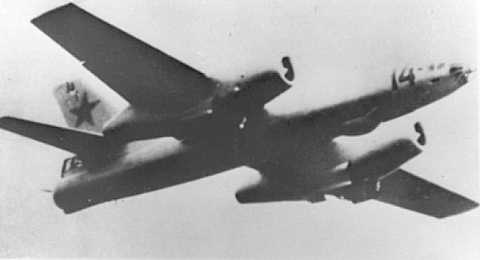
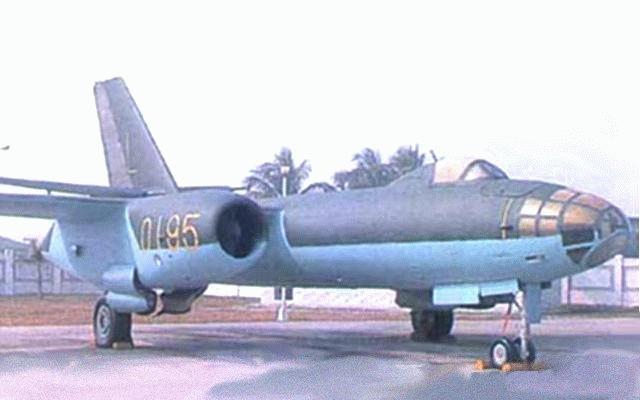
H-5 Light Bomber The reports of the demise of the H-5 seem somewhat exaggerated. It was asserted without citation in 1995 that the H-5 had been withdrawn from service, but the continued presence of the H-5 in the PLAAF inventory is widely attested by subsequent sources. The light bomber is a kind of tactical bomber and is used for close air support to the ground troop operations. Its bomb load is small but it is light, manoeuvrable and agile and has some peculiarities which make it irreplaceable by medium bombers. The Il 28 was the Soviet Union's standard light bomber, and was in use in all air forces of the Soviet Bloc. The 11-28 aircraft is a light bomber designed and produced in the Soviet Union. It flew for its first time in 1947 and entered into service in 1950. It was put into production in large quantities and was widely used in 1950s and 1960s because of its simple structure and low price. This aircraft was produced in China under the nomenclature H-5. The H-5 was a light subsonic bomber with a cantilever high set wing. The high-mounted wings have a straight leading edge and forward-tapered trailing edge with blunt tips. Two turbojets are mounted beneath the wings in pods. Pods extend beyond wings' leading and trailing edges. The fuselage is tubular and cigar-shaped tapering to the rear with a rounded, glassed-in nose and bubble canopy. The tail fin is swept-back and tapered with a blunt tip. Flats are low-mounted on the fin, swept-back, and tapered with blunt tips. A glassed-in tail gunner compartment is to the rear of the tail. The prototype production of the H-5 was different from that of the H-6. It was not a complete licenced production, because a great number of design modifications were incorporated according to the military Services' operational requirements. The design modifications were made possible by the following: China imported a number of 11-28 bombers and a lot of suggestions were made by the military Services based on a long period of operation; the Harbin Aircraft Factory had repaired the I1-28s since the mid-1950s, manufactured main parts and components for the purpose of repairing and, therefore, mastered necessary manufacturing techniques, the factory was expanded and reconstructed on a large-scale for purpose of the H-6's prototype production and had capabilities for manufacturing production tooling, assembling a complete aircraft and then testing it in flight; and finally the factory had experienced prototype productions of the Z-5 helicopter and the H-6 medium bomber. The Chinese built H-5 light bomber is an equivalent of the 11-28 aircraft but with some local improvement in design. Forty per cent of the original I1-28 design was modified. Main modifications were: A conventional structure wing was used to replace the wing which was spliced at the central line and, therefore, 110 kg of weight was saved. Major airborne equipment were in common with that of the H-6. One example was use of H-6's tail turret. Of course it introduced corresponding structure changes. The operational performance was remarkably improved by use of a great number of new airborne equipment: a new radar with significantly increased operational range, a new sight which increased aiming angle and observation angle and hence bombing precision, the new turrent with an electrical control system which was good in the follow-up behavior, an increased ammunition capacity, higher rate of fire and longer effective firing range; and a new and improved friend-or-foe identification. The Harbin Aircraft Factory initiated their preparation for the trial-production of the H-5 in 1963. They first corrected the drawings used for aircraft repair, and then supplemented with some drawings and data of stress analysis and aerodynamic computation and prepared a complete set of processing documents. The manufacturing of production tooling and aircraft parts began in 1964. Two prototype aircraft were completed in 1966 and one of them was used for static test. The static test was carried out from July to September and it proved that the structure strength was in conformity with the technical requirement. Another prototype flew for its first time on September 25, 1966. The H-5 aircraft was formally put into production in April, 1967. Hu Xichuan, chief engineer, Qi Zhikun, vice chief engineer, Xiong Wenjie and Li Guangshu who were in charge of the design work, made active contributions to the development of the H-5. Sun Zhaoqing who was in charge of manufacturing techniques and his colleagues made bold innovations in managing manufacturing techniques. They applied some new techniques such as the plastic molds, combined fixtures and explosive forming, etc. so that the product quality was improved and the prototype production was completed in a shorter period of time. With support from various departments and agencies all over the country most of the necessary 3,200 materials and 334 vendor furnished equipment could be manufactured in China. The success in partial redesign of the H-5 marked the breaking away from the yoke of pure licenced production in area of bomber technology and the beginning of transition from modification and derivation to independent development. Several derivatives were developed on the basis of the requirement of the military Services after the H-5 aircraft was certified and put into production. The PLA Air Force is equipped with several dozen of special-purpose electronic aircraft, including a few specially modified Hongdian-5 light bombers which have been equipped to support electronic warfare operations. However, the PLAAF remains some 15 years behind world standards in this field.