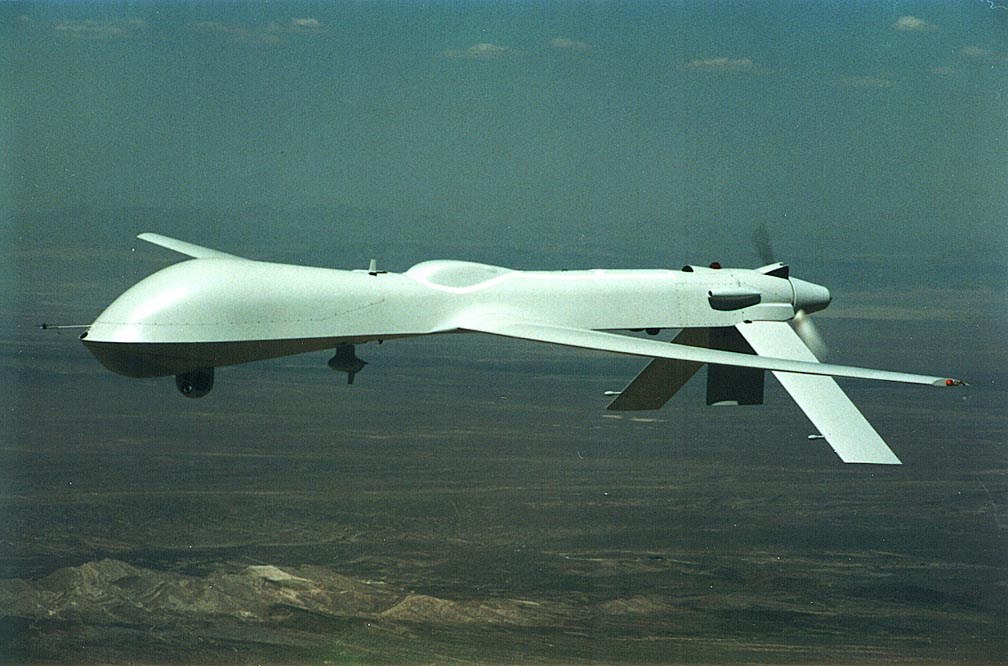
MQ-1 Predator
MQ-1 Predator
The Predator is a medium altitude, long endurance, unmanned aerial vehicle system for use in risk areas minimizing to human life. It is a theater asset for reconnaissance, surveillance and target acquisition in support of Joint Force commander. General Atomics had developed a complete family of unmanned aerial vehicles based on Predator to meet the needs of of a wide range of customers both civil and military. Predator family includes Predator B, I-GNAT, Altus, Altair, Warrior and I-GNAT ER which are operated by the United States Armed Forces, NASA, NOAA and the US government as well as by the Italian Air Force and the Turkish Army. The RQ-1A/B is a system consisting of 4 Predator air vehicles, a ground control station (GCS), a Predator primary satellite link communication suite, and 55 people for continuous 24-hour operations. The Predator UAV has C-band line-of-sight data-link or a Ku-band satellite data-link for beyond line-of-sight operations. The payload can be a CCD-TV camera, a variable aperture Infrared camera, and a synthetic aperture radar (SAR) for looking through smoke, clouds and haze. On the RQ-1B, either the CCD-TV or IR camera may be operated simultaneously with the SAR. For ease of operation and rapid deployment, each Predator UAV can be disassembled into 6 main components and loaded in a container. A 5,000 by 125 feet (1,524 by 38 meters) runway is requested for UAVs takeoff and land operations. The improved RQ-1B Predator UAV features an ARC-210 radio, APX-100 IFF, ice mitigation system, upgraded engine, and validated technical orders for operations and maintenance. The MQ-1 configuration refers to Munitions (M) capable and enables the Predator UAV to carry precision guided and smart munitions such as the Hellfire laser-guided anti-tank missile and the BAT smart weapon. The US Air Force intends to provide the AAS-52 Multi-Spectral Targeting system to MQ-1 configured Predators to guide two Hellfire anti-tank missiles carried by the aircraft. The AAQS-52 also provides surveillance capability through its built-in EO and IR sensors. The MQ-1 Predator was deployed successfully for the first time during the Afghan campaign in 2001 and subsequently during operation Iraqi Freedom in 2003. The US Air Force announced the aircraft had reached Initial Operating Capability (IOC) on March 1, 2005. On 21 June 2005 General Atomics was awarded a $73 million contract to speed up procurement of 17 Predator aircraft, production of 15 MQ-1L Block 10, support equipment, aircraft initial spares, readiness spares package kits, and multi-aircraft ground control station initial spares. The US Air Force as the main customer expected delivery of those items to be complete by September 2008. The MQ-1/RQ-1 Predator production for the United States Air Force ceased in early 2011 after completing the deliveries of 268 aircraft. The United States Air Force plans to procure up to 329 MQ-9 Reapers as replacement aircraft offering greater altitude, payload and airspeed compared with the MQ-1 UAV. The US Air Force MQ-1 Predator is slated for retirement on July 1, 2017.
deagel.com: https://www.deagel.com/x/x/a000517