CRJ700 Canadian Regional Jet
CRJ700

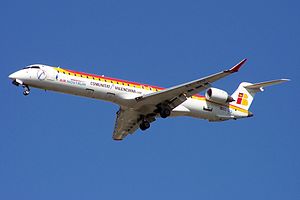
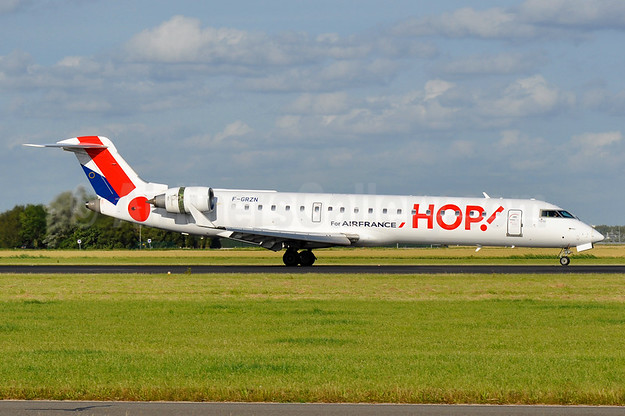
Design work on the CRJ700 by Bombardier started in 1995 and the programe was officially launched in January 1997. The CRJ700 is a stretched derivative of the CRJ200. The CRJ700 features a new wing with leading edge slats and a stretched and slightly widened fuselage, with a lowered floor. Its first flight took place on 27 May 1999. The aircraft's FAA Type Certificate designation is the CL-600-2C10. The CRJ700 first entered commercial service with Brit Air in 2001. Seating ranges from 63 to 78. The CRJ700 comes in three versions: Series 700, Series 701, and Series 702. The Series 700 is limited to 68 passengers, the 701 to 70 passengers, and the 702 to 78 passengers. The CRJ700 also has three fuel/weight options: standard, ER, and LR. The ER version has an increase in fuel capacity as well as maximum weight, which in turn increases the range. The LR increases those values further. The executive version is marketed as the Challenger 870. The CRJ700 directly competes with the Embraer 170, which typically seats 70 passengers. The early build aircraft were equipped with two General Electric CF34-8C1 engines. However, later-build aircraft are now equipped as standard with the -8C5 model, which is essentially an uprated 8C1. Most airlines have replaced the older engines with the newer model, while a few have kept the older -8C1 in their fleet. Maximum speed is Mach 0.85 (903 km/h; 488 kn) at a maximum altitude of 12,500 m (41,000 ft). Depending upon payload, the CRJ700 has a range of up to 3,620 km (2,250 mi) with original engines, and a new variant with CF34-8C5 engines will have a range of up to 4,660 km (2,900 mi). The Bombardier CRJ700, CRJ900, and CRJ1000 (after June 2020, the Mitsubishi CRJ) are a family of regional jet airliners designed and manufactured by Canadian transportation conglomerate Bombardier; this aircraft trio has been collectively marketed by the company as the CRJ Series.[4] Their design was derived from the smaller CRJ100 and 200 airliners. During the 1990s, Bombardier initiated development on the CRJ-X, a program to produce enlarged derivatives of its popular CRJ100/200 family. Officially launched in 1997, the CRJ700's maiden flight took place on 27 May 1999; it was soon followed by the stretched CRJ900 variant. Several additional variants of the type were subsequently introduced, including the CRJ550 and the elongated CRJ1000. While production of the smaller CRJ100/200 range was discontinued during 2006, the larger CRJ Series models have continued to be produced into the 2010s. Competitors have included the Fokker 70/Fokker 100, the BAe 146 family, and the Embraer E-Jet family. In Bombardier's lineup, the CRJ Series was formerly marketed alongside a family of larger jets, the C Series (now majority-owned by Airbus and marketed as the Airbus A220) and a twin-turboprop, the Q Series (now owned by De Havilland Canada and marketed as the Dash 8). During the late 2010s, Bombardier sought to sell off several of its aircraft programs. The CRJ program was acquired by Japanese corporation Mitsubishi Heavy Industries in a deal that closed 1 June 2020.