Skylark IV British Single Seat Sailplane
Skylark IV

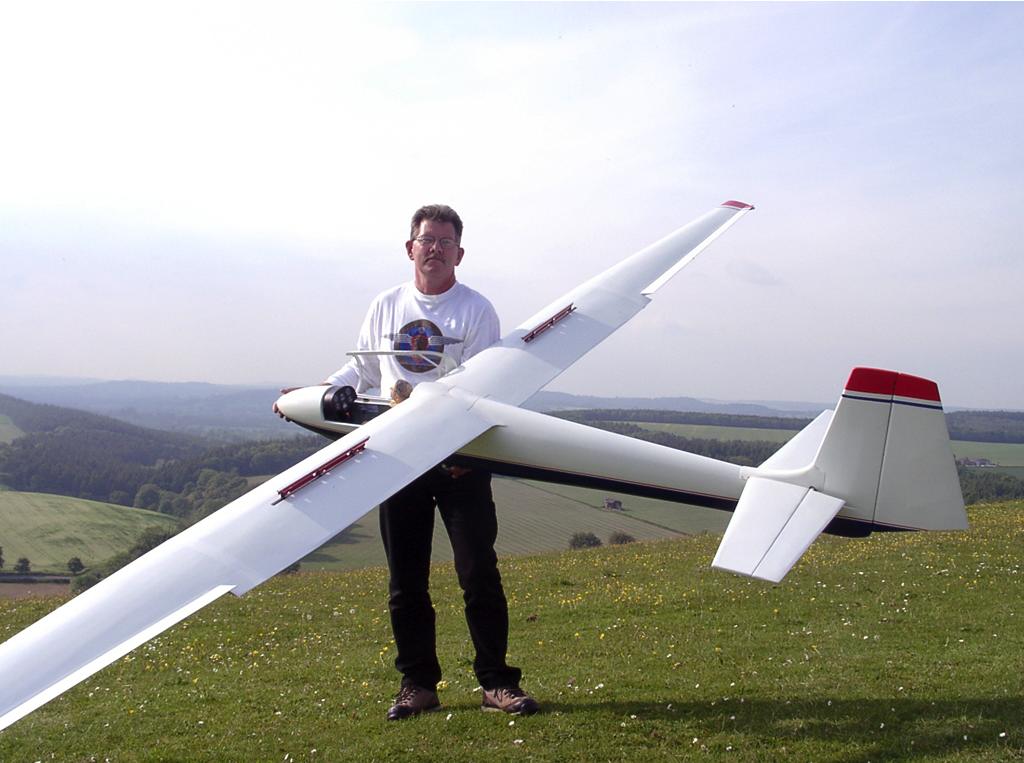

The Slingsby T.50 Skylark 4 was a British single seat competition glider built by Slingsby Sailplanes in the early 1960s. It sold in numbers and had success at national, though not world level competition. The Slingsby Skylark 4 is the final development of the Skylark series of gliders and was first manufactured in 1961 using a wing similar to that of the Skylark 3. About 30 Skylark 4s are still flying today (2010). Slingsby had introduced double curvature fuselage panels made of glass reinforced plastic (GRP) into their previous design, the T.49 Capstan and they remodelled the front of the wooden fuselage of the Skylark 3 in this material for the Skylark 4, introducing a reclining pilot's position and smoother canopy line. Though the previous wing planform, span and area was retained, its ailerons were extended to increase the rate of roll and the outer panels used a different airfoil section, the more cambered NACA 6415, to give a better lift distribution. The Skylark 4 has a high wing with a single inner section of parallel chord extending out almost to mid span, followed by outer sections with taper on the trailing edges. Ailerons filled almost all of the outer sections and airbrakes, operating in pairs above and below the wings, are mounted on the main spar in the inboard section. The wing is wooden, built around a main spar of Spruce and a lighter rear spar and Gaboon ply covered from this rear spar forward. Behind this spar the wing was fabric covered, though the ailerons were ply skinned. The Gaboon ply was applied diagonally across the ribs, which produced a very smooth wing-surface that is claimed to generate a laminar airflow. This in turn gives a best-glide ratio of 1:36 which is comparable with early fibreglass gliders. Behind the cockpit the fuselage is a semi-monocoque, elliptical in cross section and built around spruce frames with a plywood skin. The fuselage line no longer fell away rapidly behind the trailing edge, but continued straight to the tail, where tapered and clipped tailplane and elevators were mounted on top, far enough forward that the rudder hinge was behind the elevators. These surfaces were plywood covered. Fin and rudder together are tapered and flat topped; the fin is also ply-skinned, but the unbalanced rudder is fabric covered. Skylark 4 fuselage prepared for rigging at Borders Gliding Club, The undercarriage was conventional, with a nose skid, fixed monowheel and tail bumper. A simple-friction wheel brake is applied to the mainwheel by pulling on the air brake lever at the end of its furthest travel. The cockpit is immediately ahead of the wing leading-edge, enclosed with a lengthened perspex canopy, and the Skylark 4 was 80 mm (4 in) longer than its predecessor