BMP-1D Russian Infantry Fighting Vehicle (IFV)
BMP-1 'Afghan' (BMP Desantnaya (Assault))
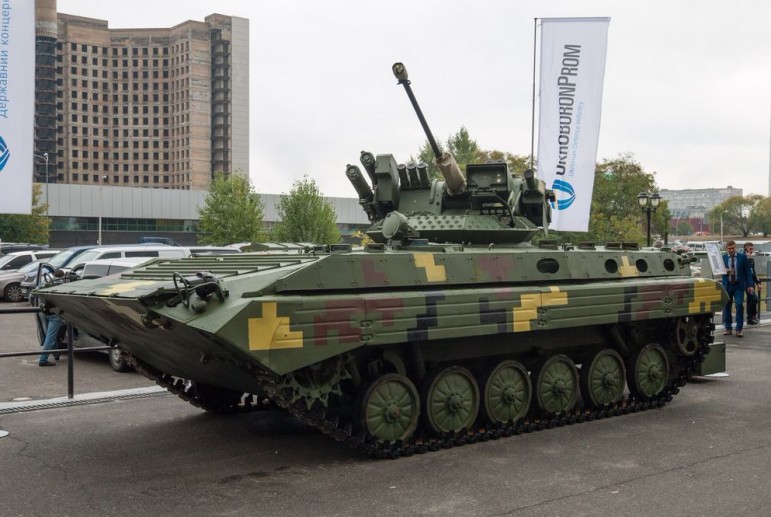
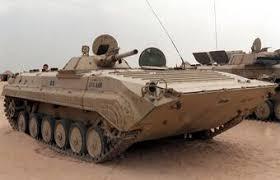
A non-amphibious BMP-1D (the so-called 'Afghan' variant), was built in 1982 for assault units in Afghanistan. It had 5 mm thick appliqué steel armor plates on the hull sides with holes for side firing ports as well as armor plate under the commander's and driver's seats for added protection against mines. It also had large steel armored skirts fitted to the sides of the hull covering the suspension. Firing ports were added into the top hatches of the troop compartment and a stowage box was placed on the roof at the rear of the hull on some vehicles. The 9S428 ATGM launcher was often removed and replaced by an AGS-17 automatic grenade launcher. Due to experience in Afghanistan, a new version with enhanced fighting capabilities, the BMP-2, was introduced in 1980. It had a new two-man turret armed with a 30 mm 2A42 multi-purpose autocannon and a 9P135M-1 ATGM launcher capable of firing SACLOS guided 9M113 Konkurs and 9M113M Konkurs-M as well as 9M111 and 9M111-2 Fagot ATGMs. Later modernization plans included mounting the turret of the BMD-2 IFV on to BMP-1s, but the vehicle never left the design phase. Recent proposals for the modernization of BMP-1s include mounting new turrets armed with a 2A72 30 mm (1.2 in) autocannon, finally approved in 2018, or a TKB-799 Kliver one-man weapons station with a computerized fire control system, armed with a missile pod (which can be armed with either four 9M133 Kornet (AT-14 Spriggan) or 9M133F Kornet ATGMs or 9K38 Igla (SA-18 Grouse) SAMs), a 30 mm 2A72 dual-purpose autocannon and a 7.62 mm (0.300 in) PKTM coaxial machine gun (BMP-1AM ‘Basurmanin’ and BMP-1M respectively).