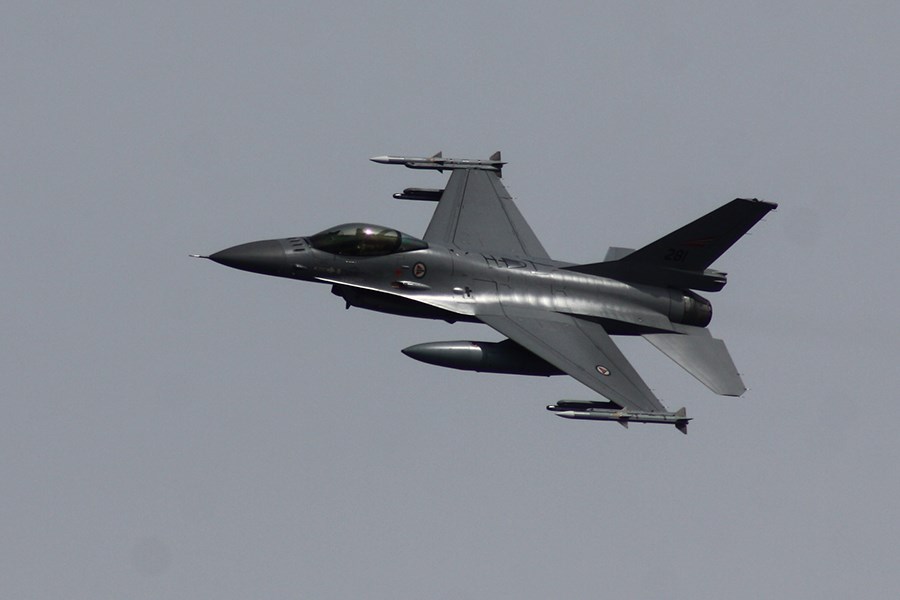
F-16C Block 52
F-16C Block 52
The single seat Block 52 F-16C, also known as F-16CJ, is a Block 42 follow-on with more powerful engine models and new weapon options. The US Air Force has integrated the HTS pod in some F-16CJs for suppression of enemy air defenses using the HARM missile. The Block 52 F-16C was deployed in 1991. The US Air Force Block 52 F-16C will receive the advanced Sniper XR targeting/navigation pod replacing older systems currently in the US inventory, as well as software updates for integration of smart munitions such as AGM-154, JDAM bombs, and AGM-158. The US Air Force expects the F-16CJ to remain in service until 2025. Falcon STAR, F-16 Structure Augmentation Roadmap, program will see US Air Force F-16 fleet receiving parts kits to strengthen their structure. This measure will enable the F-16 aircraft to attain its projected 8,000-hours of service life through 2025 for the US Air Force, when the entire fleet should be dismantled. Falcon STAR program is valued at $1 billion. The parts kits involved in this program number 79,000. Ogden Air Logistics Center at Hill Air Force Base, Utah, is where modification work is taking place. Starting in 2006, F-16s for European countries will undergo Falcon STAR modification. All in all, more than 2,000 F-16s belonging to the United States, Belgium, Denmark, the Netherlands, Norway, Portugal, Israel, Greece, Singapore, Thailand and Bahrain will be modified through 2014. The governments of Greece and the United States signed a Letter of Offer and Acceptance (LOA) for the sale of 30 F-16C/D Block 52+ aircraft to Greece on December 13, 2005. The agreement valued at $2 billion also included an option for an additional 10 F-16s. The Hellenic Air Force was expected to use the 20 single-seat F-16Cs and 10 two-seat F-16Ds to supplement its existing F-16 fleet. Final delivery to the Greek Air Force was scheduled for the fourth quarter of 2009.
deagel.com: https://www.deagel.com/x/x/a000540