SAM-14A (SA-16 Gimlet) Iranian Man-Portable Air-Defense Systems (MANPADS)
9K310 Igla-1 (SA-16 Gimlet)
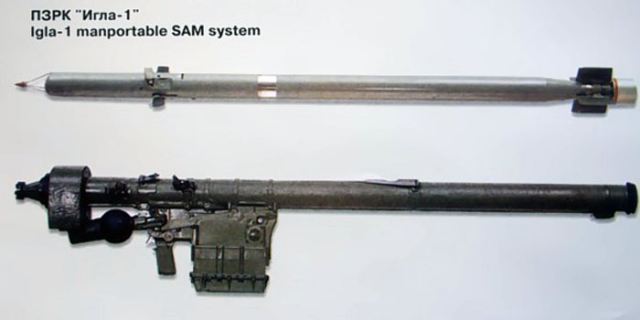

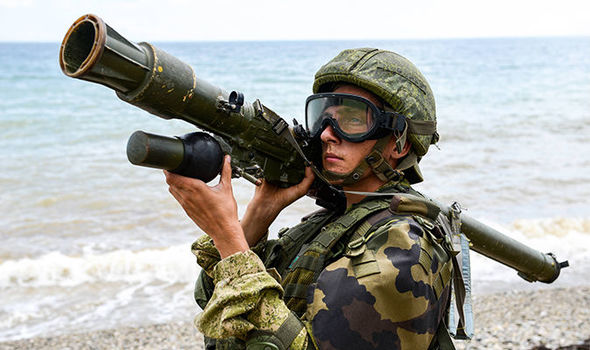
The SAM-14 is a export of the Russian 9K310 Igla-1 (NATO: SA-16 Gimlet) The 9K310 Igla-1 system and its 9M313 missile were accepted into service in the Soviet army on 11 March 1981. The main differences from the Strela-3 included an optional Identification Friend or Foe system to prevent firing on friendly aircraft, an automatic lead and super elevation to simplify shooting and reduce minimum firing range, a slightly larger rocket, reduced drag and better guidance system extend maximum range and improve performance against fast and maneuverable targets, an improved lethality on target achieved by a combination of delayed impact fuzing, terminal maneuver to hit the fuselage rather than jet nozzle, an additional charge to set off the remaining rocket fuel (if any) on impact, an improved resistance to infrared countermeasures (both decoy flares and ALQ-144 series jamming emitters), and slightly improved seeker sensitivity. 9K38 Igla (SA-18) missile and launcher top and 9K310 Igla-1 (SA-16) missile and launcher below. The seeker has two detectors – a cooled MWIR InSb detector for detection of the target and uncooled PbS SWIR detector for detection of IR decoys (flares). The built-in logic determines whether the detected object is a target or a decoy. The latest version (Igla-S) is reported to have additional detectors around the main seeker to provide further resistance against pulsed IRCM devices commonly used on helicopters. The 9M313 missile features an aerospike mounted on a tripod (Igla's 9M39 missile has aerospike attached directly to the seeker dome), which reduces a shock wave, thus providing less dome heating and greater range. The name Igla is derived from these devices. Like many other MANPADS, Igla-1 and Igla feature so-called rolling airframe missiles. These missiles roll in flight (900 – 1200 rpm) so steering the missile requires just a single pair of control surfaces, unlike roll-stabilized missiles, which require separate control surfaces for pitch and yaw. Both 9M313 and 9M39 missiles contain a gas generator, which drives a small gas turbine to provide electrical power, and the pistons, which move the canards used to steer the missile in a bang-bang mode. In addition to that, two exhaust tubes of the gas generator are placed perpendicular to the steering canards to provide maneuverability immediately after launch when the missile airspeed is too low for canards to be effective. Later versions of Igla are reported to use proportional control to drive the canards, which enables greater precision and less oscillation of the flight path. According to the manufacturer, South African tests have shown the Igla's superiority over the contemporary (1982 service entry) but smaller and lighter American FIM-92A Stinger missile. According to Kolomna OKB, the Igla-1 has a Pk (probability of kill) of 0.30 to 0.48 against unprotected targets which is reduced to 0.24 in the presence of decoy flares and jamming. In another report, the manufacturer claimed a Pk of 0.59 against an approaching and 0.44 against receding F-4 Phantom II fighter not employing infrared countermeasures or evasive maneuvers