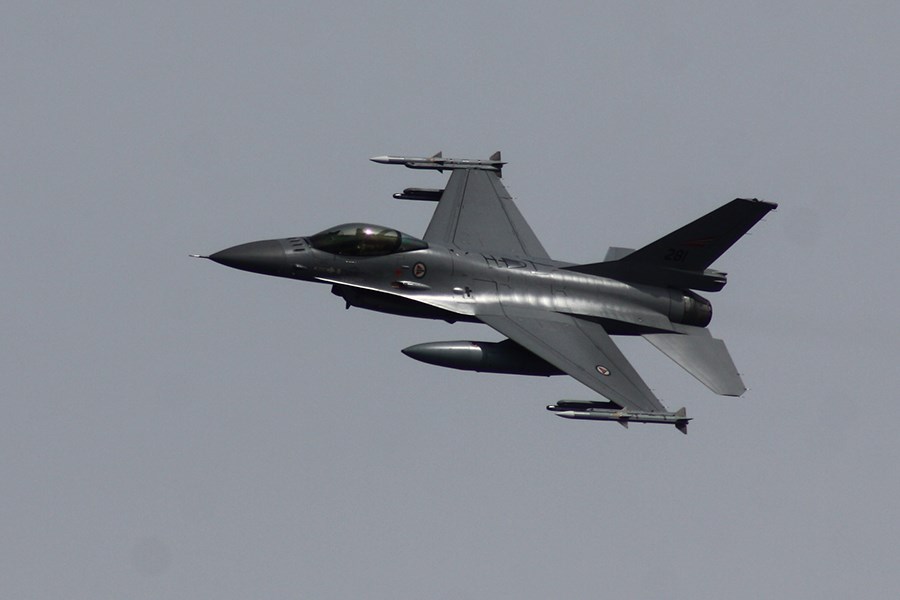
F-16D Block 32
F-16D Block 32
The twin-seat Block 25 and Block 32 F-16D incorporate a new radar (AN/APG-68), a more powerful engine, increased range and enhanced military capabilities. These models were also compatible with advanced weaponry such as the HARM and the Maverick missiles. The Block 25 F-16D was deployed in 1984 and the Block 32 in 1986. The Air National Guard Block 32 F-16D will receive the advanced Sniper XR targeting/navigation pod replacing older systems currently in the US inventory, as well as software updates for integration of smart munitions such as AGM-154, JDAM bombs, etc. Falcon STAR, F-16 Structure Augmentation Roadmap, program will see US Air Force F-16 fleet receiving parts kits to strengthen their structure. This measure will enable the F-16 aircraft to attain its projected 8,000-hours of service life through 2025 for the US Air Force, when the entire fleet should be dismantled. Falcon STAR program is valued at $1 billion. The parts kits involved in this program number 79,000. Ogden Air Logistics Center at Hill Air Force Base, Utah, is where modification work is taking place. Starting in 2006, F-16s for European countries will undergo Falcon STAR modification. All in all, more than 2,000 F-16s belonging to the United States, Belgium, Denmark, the Netherlands, Norway, Portugal, Israel, Greece, Singapore, Thailand and Bahrain will be modified through 2014.
deagel.com: https://www.deagel.com/x/x/a000540