Panzerfaust 3 German 60mm Anti-tank Grenade Launcher (ATGL)
Balliste, Pzf 3-T600
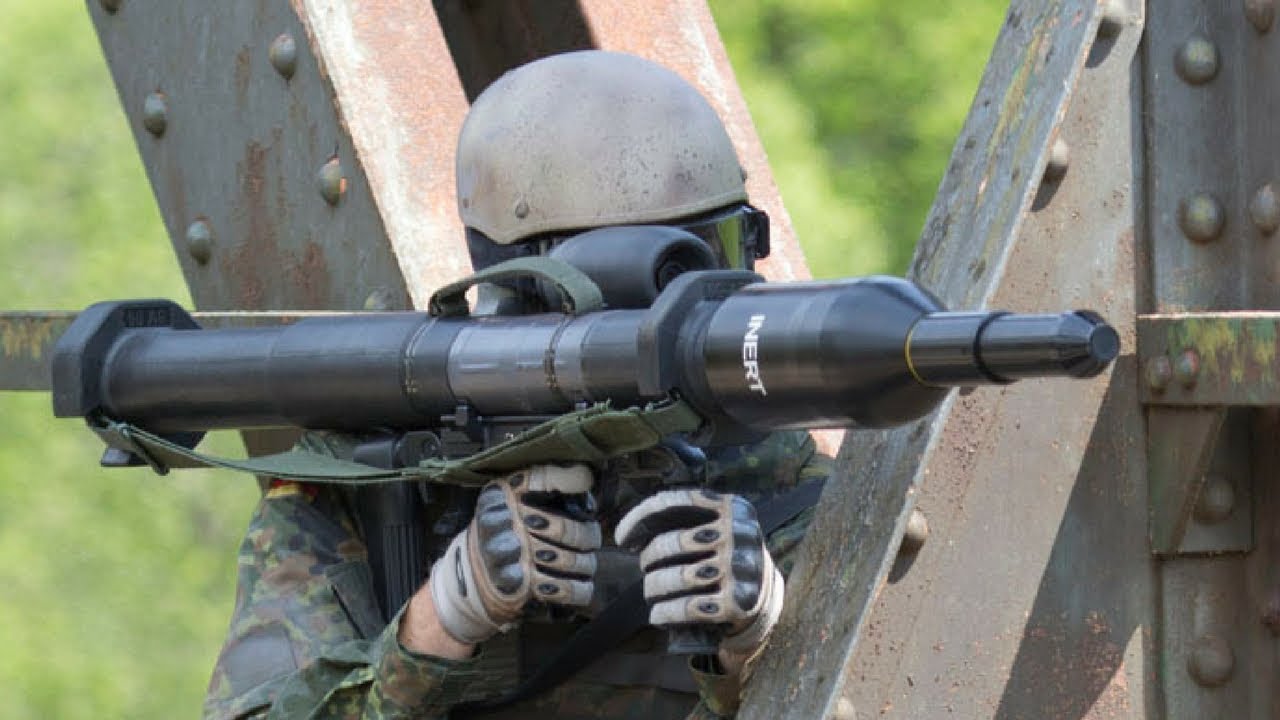
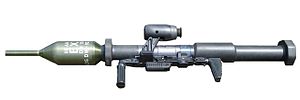
HEZBOLLAH Proliferation. The Panzerfaust 3 (lit. "armor fist" or "tank fist") is a modern disposable recoilless anti-tank weapon, which was developed between 1978 and 1985 and put into service by the Bundeswehr in 1992. It was first ordered in 1973 to provide West German infantry with an effective weapon against contemporary Soviet armour, thereby replacing West Germany's aging PzF 44 Light Lanze launchers and the heavy Carl Gustaf 84 mm anti-tank recoilless rifle manufactured in Sweden. The Panzerfaust 3 is operated by at least 11 countries and has first seen combat in Afghanistan. The Panzerfaust 3 series of launchers is a compact, lightweight, shoulder-fired, unguided antitank weapon series. It consists of a disposable canister with a 110-mm warhead and reusable firing and sighting device. The DM12 and DM12A1 projectile consists of a shaped-charge warhead and is filled with Octol 7030, while the tandem DM22 warheads are made of PBX octogene (ca. 95% β-HMX) including the propulsion unit. The penetration performance of the Panzerfaust 3 is due to the shaped charge principle and the quick response of the percussion fuze; the effect on the target does not depend on the impact velocity. The Panzerfaust 3 is light enough to be carried and fired by one person. It can be fired from enclosures since it does not have a significant backblast; the rear of the tube, filled with plastic granulate, minimises the blast effect by the so-called recoilless countermass principle. The booster propellant for the projectile in its tube is ignited by a bolt via a spring mechanism. Once ejected from the launcher, the projectile coasts a safe distance and then the rocket motor is ignited, boosting it to its maximum speed, after which it coasts until impact. The gunner carries at least two rounds, while the assistant grenadier carries an additional three rounds. As a safety precaution, the built-in fuse for the warhead is released by a safety mechanism. This arms the warhead after a flight distance of approximately five meters. Once armed, the warhead will detonate on impact, and as a safety when the rocket's propellant runs out. This safeguards against live ammunition staying around and causing hazards to all in the future. The Panzerfaust 3 is distributed in a special package including spare parts and a cleaning kit. The package contains a launcher, ejector and spring, extractor, dummy extractor plug, bolt-head retaining pin, plastic cleaning rod with brass tip, bore and chamber brushes, camel's hair brush and a prismatic bore scope. It takes several minutes to assemble and load the launcher. The ergonomic design of the controls, such as handles, launcher, barrel shape and optical sight, is a predefined standard. All controls are easy to handle in all shooting positions (lying, kneeling or standing). After the weapon is fired, the firing mechanism with the attached optical sight is removed and the barrel thrown away, the firing mechanism is reusable. The effective combat range of Panzerfaust 3 is from 15 to 300 metres against moving targets and from 400 to 600 metres against static ones. An optical sight with line pattern fixed to the reusable firing mechanism enables it to engage moving or static targets. To ensure night combat capability, a night-vision device or residual light amplifier can be set up in front of the optical sight.