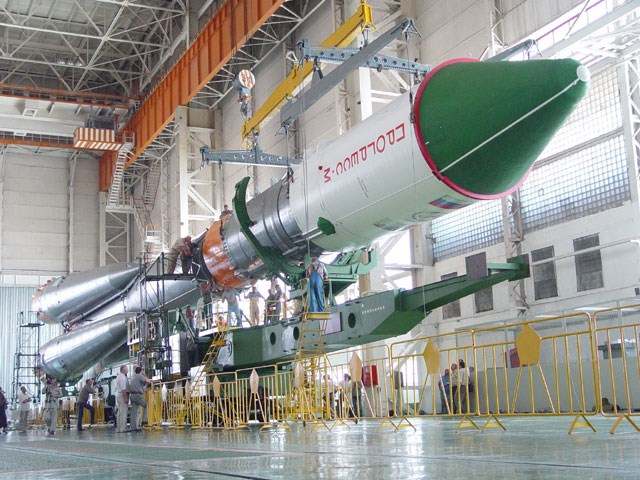
Soyuz-U
Soyuz-U
The Soyuz-U is a medium, liquid propellant, three-stage, highly reliable, launch vehicle intended to place civil, research and special-purpose spacecraft as well as Soyuz and Progress spaceships into low Earth orbit. It can lift off from launch pads operating at the Plesetsk and Baikonur Cosmodromes. Once launched, the separation of the lateral rocket engine assemblies occur after the first stage burnout. The second stage assembly separates after burnout. The liquid propellant consists of a non-toxic mix of oxygen and kerosene. The first engine ignites on-the-ground allowing for launch abortion in comparison to Russian ICBM-based launch vehicles which ignite after ejection off the launch canister by gas or steam. The third stage propulsion system consists of a four-chamber single-burn engine and four gimbaled steering nozzles which are used for three-axis flight control. Soyuz-U can place a payload of 7,200 kg, 6,600 kg, 6,300 kg into a circular orbit at an altitude of 200 km with 51-degree, 62.8-degree, 82,6-degree of inclination respectively. The final flight of a Soyuz-U rocket was performed on May 17, 2012, carrying a Kobalt-M satellite. The Soyuz-U was retired in 2012. The final launch of a Soyuz-U rocket was carried out on February 22, 2017.
deagel.com: https://www.deagel.com/x/x/a000231