ARMSNET
Military Equipment Database
Initializing 0%

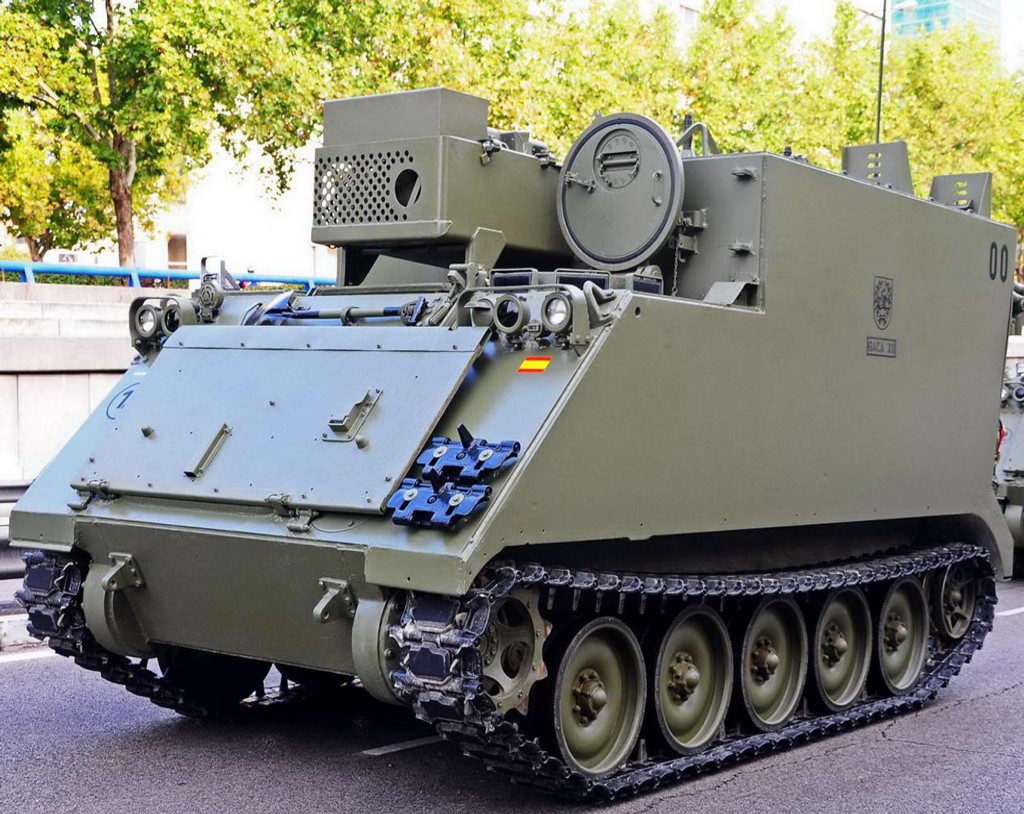
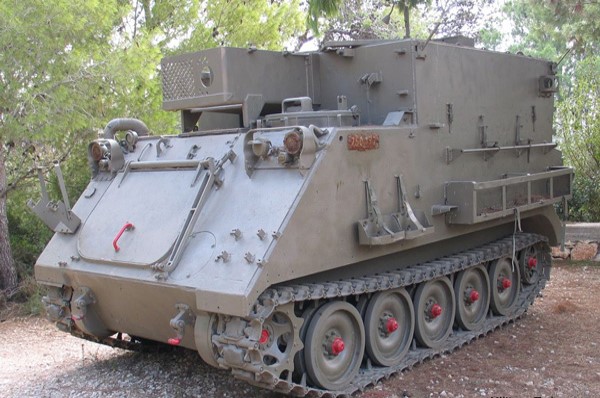
M577 American Armored Command Vehicle

M577
Armored Command Vehicle
Spotted an error? Sign in to suggest an edit.
Basic Information
Name
M577 American Armored Command Vehicle
Designation
M577
Alternate Designation
Equipment Type
Armored Command Vehicle
Manufacturer
BAE Systems Ground Systems
Date of Introduction
1964
Description

The M577 command post vehicle is a member of the BAE Systems Ground Systems (previously United Defense) M113 series of full-tracked Armored Personnel Carrier (APC) family of armored fighting vehicles. Its correct US Army designation is Carrier, Command Post, Light Tracked M577. The M113 armored personnel carrier was developed by the FMC (Food Machinery Corp.) based on M59 and M75 armored personnel carriers from the 1950s. The first prototype of M113 was produced in 1957. The US Army adopted the vehicle in 1960. Kaiser Aluminum and Chemical produced the aluminum required for the development of M113. FMC transferred the production of M113 vehicles to its new subsidiary, the United Defense in 1994. United Defense was acquired by BAE in 2005. As of November 2011, more than 80,000 M113 vehicles were produced in different variants. The vehicle is operational in more than 44 countries. The M113 is a fully tracked armored personnel carrier (APC) that was developed and produced by the Food Machinery Corp (FMC). The M113 was sent to USAREUR to replace the mechanized infantry's M59 APCs in the 1961/62 time frame. The M113 was first tried out in combat in April 1962 after the United States provided the South Vietnamese Army (ARVN) with heavy weaponry such as the M113, under the Military Assistance Command, Vietnam (MACV) program. Eventually, the M113 was the most widely used armored vehicle of the U.S. Army in the Vietnam War, earning the nickname 'Green Dragon'[dubious – discuss][citation needed] by the Viet Cong as it was used to break through heavy thickets in the midst of the jungle to attack and overrun enemy positions. It was largely known as an "APC" or an "ACAV" (armored cavalry assault vehicle) by the allied forces. The M113 was the first aluminum hull combat vehicle to be put into mass production, it introduced new aluminum armor that made the vehicle much lighter than earlier vehicles; it was thick enough to protect the crew and passengers against small arms fire but light enough that the vehicle was air transportable and moderately amphibious. In the U.S. Army, the M113 series have long been replaced as front-line combat vehicles by the M2 and M3 Bradleys, but large numbers are still used in support roles such as armored ambulance, mortar carrier, engineer vehicle, and command vehicle. The U.S. Army's heavy brigade combat teams are equipped with approximately 6,000 M113s and 4,000 Bradleys. The M113's versatility spawned a wide variety of adaptations that live on worldwide, and in U.S. service. These variants together currently represent about half of U.S. Army armored vehicles. To date, it is estimated that over 80,000 M113s of all types have been produced and used by over 50 countries worldwide, making it one of the most widely used armored fighting vehicles of all time. The Military Channel's Top Ten series named the M113 the most significant infantry vehicle in history. The U.S. Army planned to retire the M113 family of vehicles by 2018, seeking replacement with the GCV Infantry Fighting Vehicle program, but now replacement of the M113 has fallen to the Armored Multi-Purpose Vehicle (AMPV) program. Thousands of M113s continue to see combat service in the Israel Defense Forces, although as of 2014 the IDF was seeking to gradually replace many of its 6,000 M113s, with Namer APCs.

Ground Specifications
Crew 2
Mobility Type Tracked
Main Weapon 12.7 mm machine gun
Engine Detroit Diesel water-cooled, 2-stroke, V-6 (209 hp)
Active Protection None
Max Speed 66.0 km/h
Range 483.0 km
Variants
M113 Original gasoline version
M113A1 Diesel production model
M113A1 Armored Cavalry Assault Vehicle (ACAV) Armor around the commander’s position & 2 extra M-60 MGs
M113A2 Improved engine cooling, better rear fuel cells, & new suspension system
M113A2 ARV Armored Recovery Vehicle with a 1361 kg auxiliary crane
Stretched M113A2 Prototype with an extra road wheel
M113A3 Bigger engine, yoke steering, Kevlar spall liner, applique liner, external fuel cells
M113A3 M/R Maintenance/Recovery vehicle with 9000 kg winch & 1360 kg crane
M58 Wolf Smoker Generator Carrier Vehicle dedicated to produce smoke
M106 M113 with M30 (107-mm) mortar in back with 88-93 rounds
M125 M113 with M29 (81-mm) mortar in back with 114 rounds
M163 M113A1 with turret with M61A1 Vulcan 20-mm 6-barrel Gatling cannon
M548 Unarmored cargo carrier
M577 Command post carrier with built-up rear area & telescopic antenna
M577A3 M113A3 engine with extended hull & 6 road wheels
M901 Improved TOW Vehicle with an Emerson ITV turret with 2 TOW tubes with an additional 10 missiles
M981 Fire Support Vehicle (FSV) with laser designator & improved commo gear
M1059 Lynx M113A2 with M157 smoke generator system
M1064A3 M113A3 with Soltan (120-mm) mortar with 60 rounds
M1068A3 Modified M113 into the Standard Integrated Command Post (SICP)
M113 Ambulance Various versions available
M113 with Dozer Blade M113s with trim vane removed to be fitted with a bulldozer kit
M113 HAZMAT Stretched M113A3 for spills
System
Alternative Designations M577
Type Armored Command Vehicle
Manufacturer INA
Crew 2 (driver, commander) ea
Passengers INA
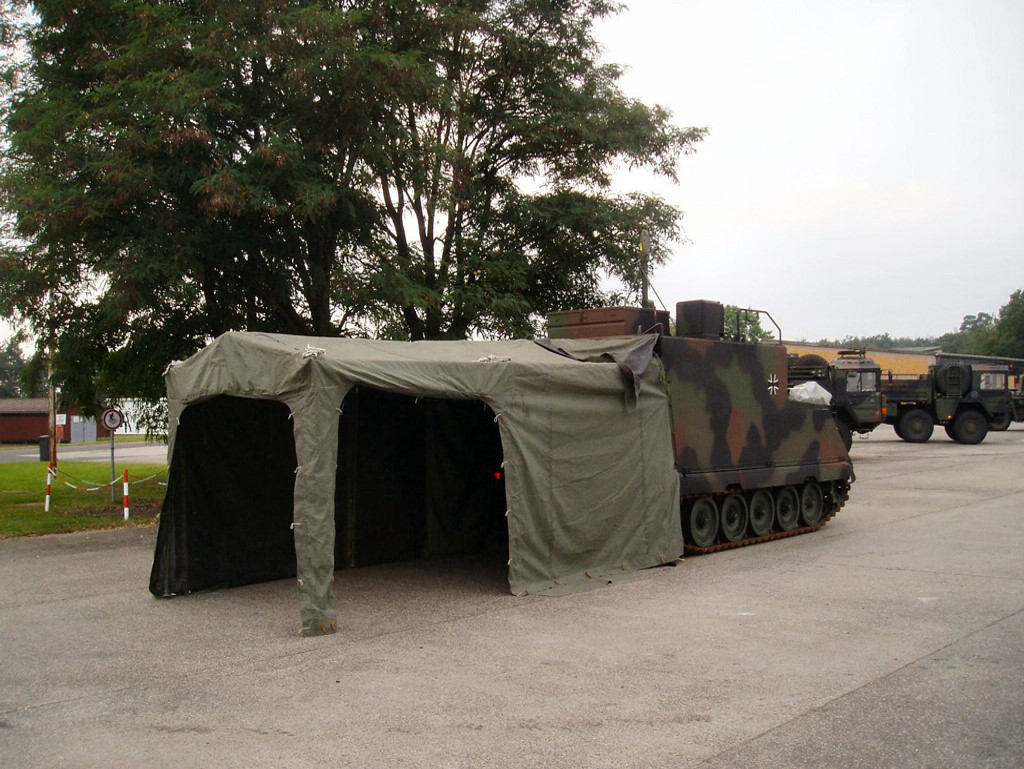
Tent Extension The M577 has a tent extension. It is attached at the rear, when vehicle is stationary. It provides additional work space for command staff. Furthermore multiple M577 command vehicles can be connected via the tents. In traveling order the tent is carried on top of the vehicle. Onboard the vehicle there are map boards, folding tables, computers, radio and other command and control equipment.
Note Although the M577 was originally developed for use as a command post vehicle, it can also be used as a fire-direction centre, communications vehicle and a mobile medical treatment facility. The US Army and a number of other countries use the M577 for a variety of other roles such as ambulance.
Dimesions
Length 5.3 m
Width 3 m
Height 1.85 m
Weight 14 tons
Automotive
Engine Name Chrysler 75M petrol
Engine Type Detroit Diesel water-cooled, 2-stroke, V-6
Engine Power 209 hp
Cruising Range 483 km
Speed (Max Road) 66 km/h
Speed (Max Off-Road) 35 km/h
Speed (Average cross-country) INA
Speed (Max Swim) 5.8 km/h
Ground pressure 0.55 (kg/cm2
Gradient 60 deg
Side Slope 30 deg
Vertical Step 0.6 m
Trench 1.7 m
Fording Depths (m) Amphibious
Gearbox General Motors TX-200 manual gearbox
Note On water it is propelled by spinning its tracks
Main Weapon System
Note 12.7 mm machine gun mounted over commander's hatch
System
Name M2 HB Anti-Aircraft Machine Gun
Type 12.7mm
In Service 1933-Present
Proliferation Over 3 Million
Length 1,654 mm
Barrel Length 1,143 mm
Weight, Gun Only 38 kg
Weight, Gun with Tripod 58 kg
Max Rate of Fire (M2HB Version) 450-600 rds/min
Max Rate of Fire (AN/M2 Version) 750-850 rds/min
Max Rate of Fire (AN/M3 Version) 1,200-1,300 rds/min
Action Short recoil-operated
Effective Range 1,800-2,000 m
Ammunition
Name INA
Type Rifle
Caliber 12.7mm
Cartridge 0.50 BMG (12.7×99mm NATO)
Muzzle Velocity 450-1,300 m/s
Basic Load 2,000 ea
Fire Control
FCS Name INA
Computerized FCS No
Protection
Armor (turret front) Protection of the M577 was rather limited. All-round protection is against 7.62 mm ball rounds and artillery shell splinters. At close range the M113 would be penetrated by 12.7 mm heavy machine gun rounds
Applique Armor Yes, on the bottom of the APC
Explosive Reactive Armor Available
Active Protection System No
Self-entrenching Blade Available
NBC Protection System Yes
Smoke Equipment No
Survivability Equipment Anti-mine armor on bottom
Note Up to 40% of vehicle components are manufactured from light alloys
Details
Country of Origin United States
Category Land
Land
Filter Label
M
Classification
Domain
Ground
Equipment Status
Active
Dimensions
Length
5.3 m
Width
3 m
Height
1.85 m
Weight
14000 kg
Operators (26)
United States
Germany
South Korea
Ukraine
Brazil
Spain
Afghanistan
Albania
Argentina
Australia
Belgium
Benin
Bolivia
Cambodia
Congo, Republic of the
Ecuador
Guatemala
Norway
Philippines
Saudi Arabia
Somalia
Sudan
Switzerland
Uruguay
Vietnam
Yemen
Something went wrong. Please reload the page. Reload