BTR-90 (GAZ-5923) Russian 8x8 Amphibious Armored Personnel Carrier (APC)
BTR-90

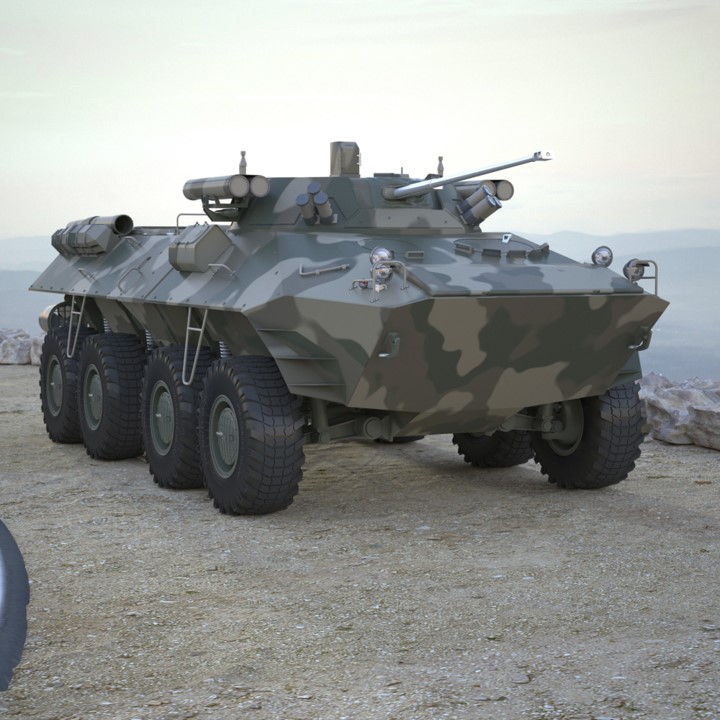
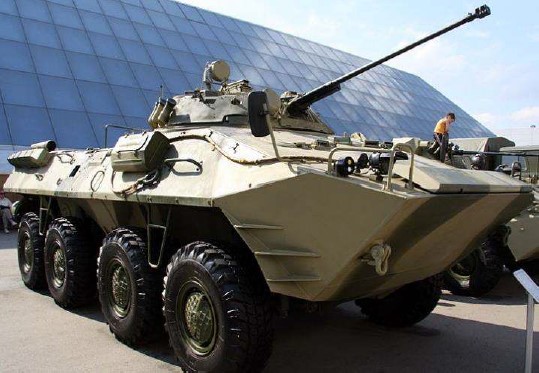


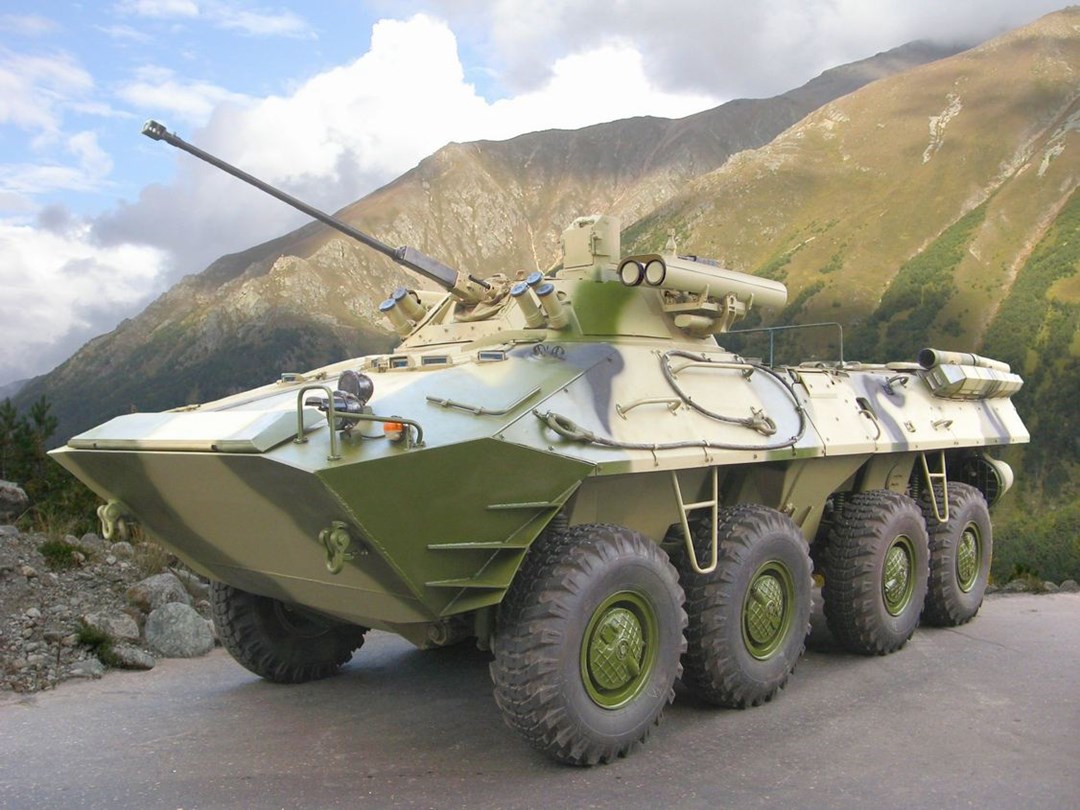
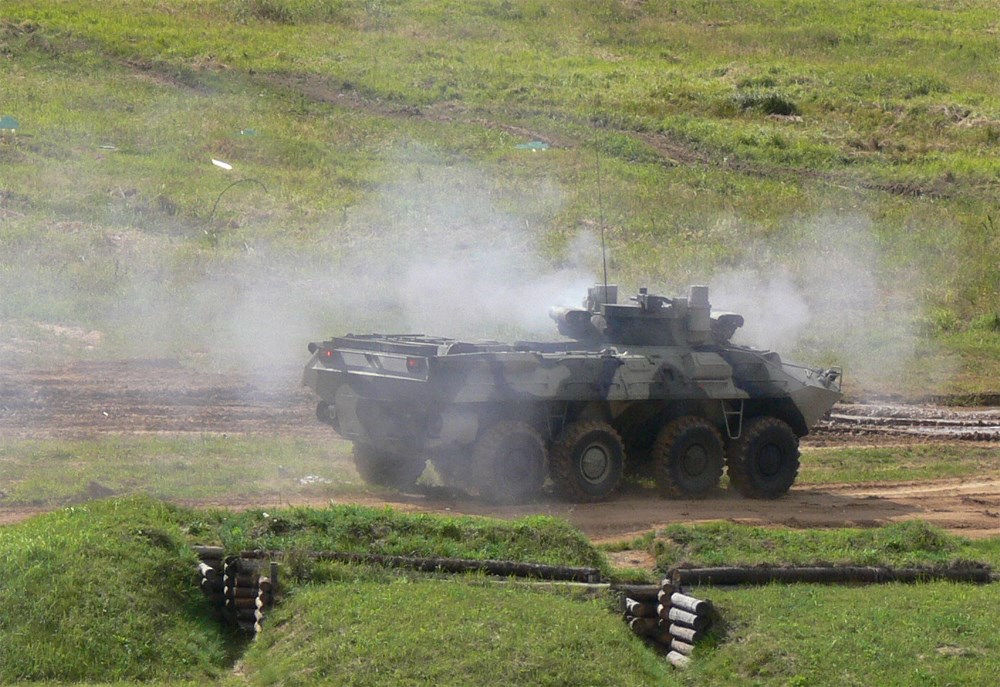


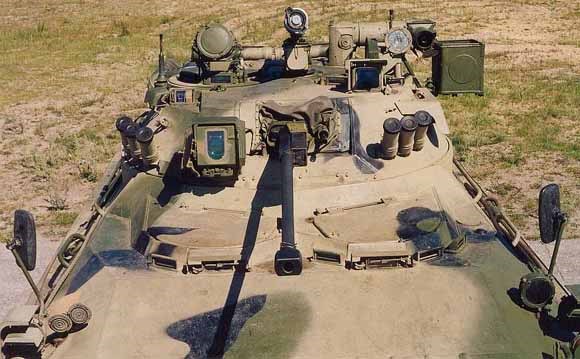

BTR-90 (GAZ-5923) is an 8×8 wheeled armored personnel carrier developed in Russia, designed in 1993 and first shown publicly in 1994. It is a larger version of the BTR-80 vehicle, fitted with a BMP-2 turret. Armor protection is improved compared with the BTR-80, giving protection from 14.5 mm projectiles over the frontal arc. It is armed with a 2A42 30 mm autocannon, a coaxial 7.62 mm PKT machine gun, an AT-5 Spandrel ATGM, as well as an AGS-17D 30 mm automatic grenade launcher. Limited numbers have been produced and are in service with Russian Internal Troops. In October 2011, the Ministry of Defense refused to buy the BTR-90 and did not include them in the list of the state program of armament until 2020, and waived exports for the BTR-90. The BTR-90 has a pointed nose, somewhat similar to that of the LAV-25. The hull is made of welded steel armor plate and is slightly larger and higher than the BTR-80, from which it is developed. A turbocharged, liquid-cooled, multi-fuel diesel engine is used, which can develop 510 bhp. The vehicle has an eight-wheel drive and has an automatic reversible hydro-mechanical transmission, which is capable of providing different speeds to each side of the vehicle. Duplicated electrical and compressed air engine start systems are also used. The wheels are utilized with independent torsion-bar suspension and the traverse arms have high capacity telescopic hydraulic shock absorbers. Communication equipment installed in the BTR-90 includes an R-163-50U radio set for external communications, an R-163UP receiver, and an R-174 intercom device for communication between the crew members. The layout and positioning of equipment and parts in the BTR-90 is similar to those of the BTR-80 and BTR-80A. The commander and gunner are accommodated in a fighting compartment in the turret. This compartment also houses a BPK-3-42 gunner's day/night sight and a 1P-13 commander's optical sight. Optionally, a BPK-M thermal imaging sight can be fitted in this compartment as the gunner's sight. The driver is located somewhat to the middle of the hull, just in front of the turret. The troop compartment is located behind the driver's position and the turret. The engine compartment is at the rear of the hull. Hatches are provided on the top of the turret and hull, and side doors are available in the middle of the vehicle. These are designed to allow quick dismounting and boarding of troops even while the vehicle is on the move. The eight wheels are located as two sets, with two pairs at the front of the hull and two pairs at the rear. Split side doors are located between these two sets of wheels. The two forward pairs of wheels are utilized with power steering. The BTR-90 is capable of achieving a maximum speed of 100 km/h, and has cross-country driving ability comparable to that of tracked vehicles, with an average speed of 50 km/h. The vehicle is fully amphibious and can negotiate water obstacles without any preparation. Two water jet propellers power the vehicle in water, and it can achieve a maximum speed of 9 km/h. It can enter and be deployed from amphibious assault ships from the water. The BTR-90 can be deployed by truck, rail, and also by water and air transportation means. Its hydro-mechanical transmission helps to increase its maneuverability by providing different speeds to each side of the vehicle. This allows the BTR-90 to have a low turning radius of 6 m. When turning with only the front four wheels, it has a turning radius of 14 m. It can cross up to 2.1 m wide trenches and can negotiate 60% gradients, 30% side slopes, and 0.8 m vertical steps. The vehicle has an inner capacity of 12 cubic meters and can carry a load of 7,000 kg. An air conditioning system can be added optionally. The commander has the ability to carry out all-round surveillance and can take full control of the weapons from the gunner. An onboard information control system (OICS) enables automatic control over the transmission, engine, and other important parts of the BTR-90, and it is the first armored personnel carrier to have such a system. A centralized tire pressure control system is also available and allows the vehicle to move even if four of its wheels are destroyed.
System
Ammunition
System
Ammunition
System
Ammunition
deagel.com: https://www.deagel.com/x/x/a000347