CATS Warrior India Unmanned Aerial Vehicle (UAV)
CATS Warrior

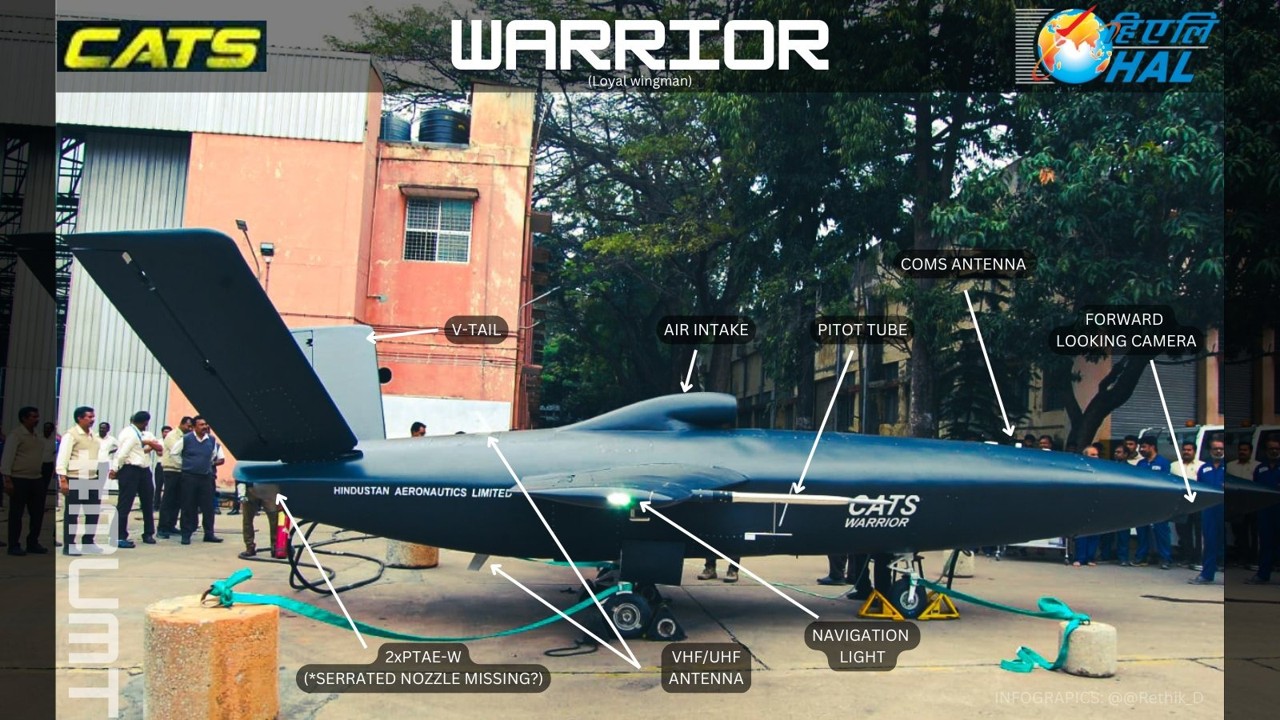


The CATS Warrior India Unmanned Aerial Vehicle (UAV) The CATS Warrior India Unmanned Aerial Vehicle (UAV) is part of a broader strategic initiative by HAL and India's defense sector aimed at enhancing UAV technologies. This project focuses on integrating UAV systems with manned aircraft to improve overall combat effectiveness. By leveraging the strengths of autonomous UAVs, the CATS program represents a significant advancement in India’s goal to develop indigenous, high-tech solutions for modern warfare, particularly in contested environments where manned aircraft may be vulnerable. Designed as a loyal wingman for fighter jets like the LCA Tejas and the upcoming Advanced Medium Combat Aircraft (AMCA), the CATS Warrior is an autonomous unmanned combat aerial vehicle (UCAV) capable of operating alongside manned aircraft. This design philosophy enhances the Indian Air Force's (IAF) combat versatility while minimizing risks to pilots, especially during high-stakes missions such as surveillance, reconnaissance, and airstrikes. Modeled after similar international systems like Boeing’s MQ-28 Ghost Bat, the CATS Warrior can autonomously execute critical missions or be controlled remotely by human pilots when necessary. This flexibility acts as a force multiplier, extending the IAF’s operational reach while reducing the risk to personnel. Equipped with impressive technological features, the CATS Warrior is a formidable asset for modern warfare. Powered by two HAL PTAE-7 turbofan engines, the Warrior can achieve speeds of up to 790 km/h and has a combat range exceeding 800 km. With a maximum takeoff weight of around 2,100 kg, it offers a significant payload capacity, allowing it to carry various munitions and sensors. These include advanced air-to-air missiles, loitering munitions, and the Smart Anti-Airfield Weapon (SAAW), developed by India’s Defense Research and Development Organization (DRDO). Furthermore, the Warrior features state-of-the-art avionics, such as an AESA radar and electro-optical/infrared sensors, enabling it to perform complex surveillance and target acquisition tasks. An advanced AI-based software system enhances its operational autonomy, reducing the need for human intervention during missions while allowing it to make decisions on route planning, threat detection, and combat strategies. The strategic importance of the CATS Warrior in India’s defense ecosystem is considerable. It plays a vital role in the country’s broader defense modernization strategy, which emphasizes self-reliance in technology and indigenization. The Warrior’s potential as a force multiplier is immense: by seamlessly integrating with manned fighter jets, it enhances mission flexibility, reduces operational costs, and strengthens India’s strategic capabilities. The Warrior is designed to perform a wide range of roles, including intelligence, surveillance, and reconnaissance (ISR), electronic warfare (EW), and direct combat missions when armed with air-to-air or air-to-ground weapons. This versatility makes the CATS Warrior a critical asset in addressing the challenges of modern aerial combat. India’s increasing focus on unmanned systems, especially UCAVs, comes at a crucial time. With global security dynamics rapidly evolving, including lessons drawn from the Ukraine conflict, the demand for advanced unmanned platforms has never been more urgent. Unlike slower, propeller-driven UAVs, jet-powered UCAVs like the CATS Warrior are designed to evade detection and counter sophisticated threats, providing a decisive advantage in contested airspace. These capabilities are essential as India seeks to maintain air superiority in increasingly complex and high-threat environments. Looking ahead, the CATS Warrior is expected to play a transformative role in India’s defense strategy, particularly as the IAF continues to modernize its fleet and enhance its regional posture. HAL's success with the CATS Warrior sets the stage for future UCAV developments, potentially leading to larger platforms designed for strategic strike roles. The project also aligns with India’s vision of reducing dependence on foreign technologies, ensuring that the nation’s defense sector remains competitive on a global scale. By combining cutting-edge autonomous technology with the operational needs of the IAF, the CATS Warrior is poised to become a cornerstone of India's future air defense framework, fundamentally reshaping how India approaches modern warfare.