ARMSNET
Military Equipment Database
Initializing 0%

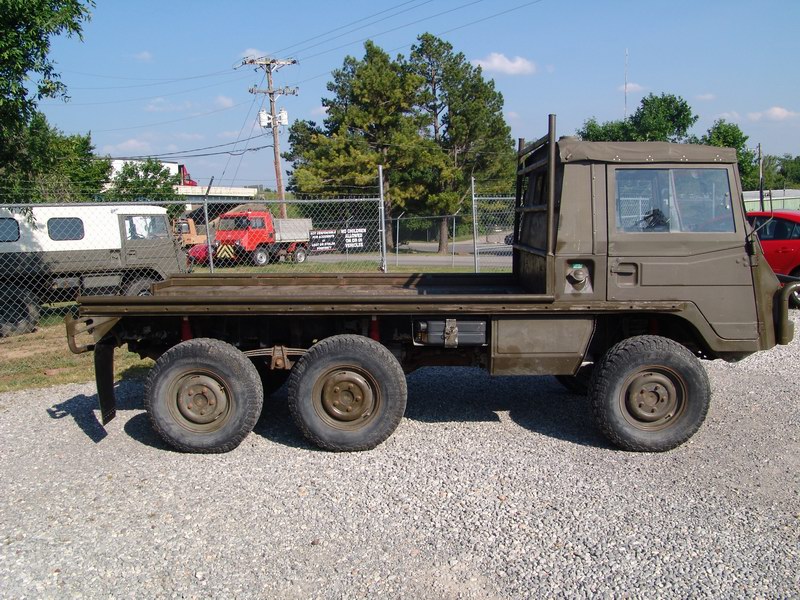
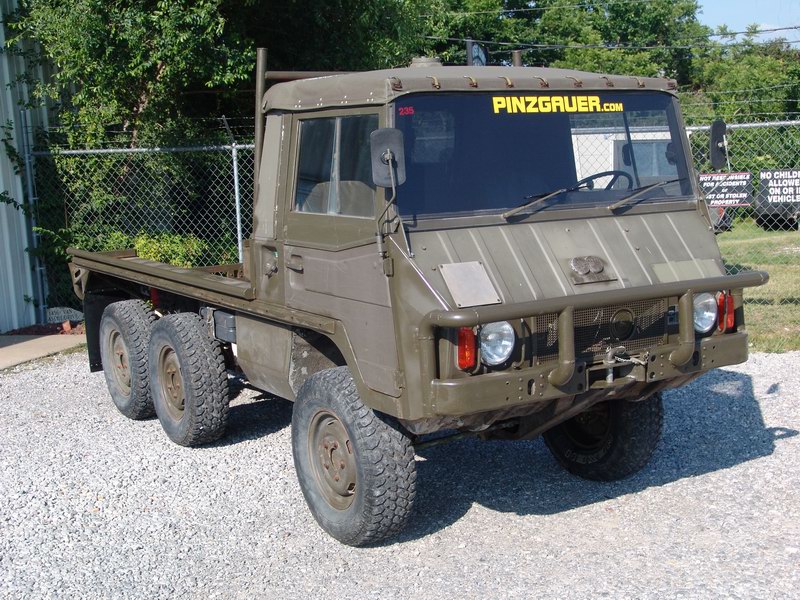
Pinzgauer 712T Austrian 6x6 High-Mobility All-Terrain Vehicle

Pinzgauer 712T
4x4 High-Mobility All-Terrain Vehicle
Spotted an error? Sign in to suggest an edit.
Basic Information
Name
Pinzgauer 712T Austrian 6x6 High-Mobility All-Terrain Vehicle
Designation
Pinzgauer 712T
Alternate Designation
Pinzgauer 712T
Equipment Type
4x4 High-Mobility All-Terrain Vehicle
Manufacturer
Steyr-Daimler-Puch: 1971-2000 BAE Systems Inc. 2000-2007
Date of Introduction
1987
Description

Pinzgauer 712T: Flat Top Carrier The Pinzgauer is a family of high-mobility all-terrain 4WD (4×4) and 6WD (6×6) military utility vehicles. They were most recently manufactured at Guildford in Surrey, England by BAE Systems Land & Armaments. The vehicle was originally developed in the late 1960s and manufactured by Steyr-Daimler-Puch of Graz, Austria, and was named after the Pinzgauer, an Austrian breed of horse. It was popular amongst military buyers, and continued in production throughout the rest of the century. In 2000 the rights were sold to Automotive Technik Ltd (ATL) in the UK. ATL was subsequently acquired by Stewart & Stevenson Services, Inc. in 2005; in May 2006, Stewart & Stevenson became a subsidiary of the aerospace and defense group Armor Holdings, Inc.. One year later, Armor Holdings was acquired by BAE Systems plc, who discontinued UK production of the Pinzgauer, which was proving to be vulnerable to mines and improvised explosive devices in Afghanistan. Development work (done in the UK) on a planned Pinzgauer II was evaluated by a BAE subsidiary in Benoni, Gauteng, South Africa but no vehicle was ever made. First Generation: The original prototype was developed around 1969 and production began in 1971, as successor of the Steyr-Daimler-Puch Haflinger 700 AP 4×4 light military multi purpose offroad vehicle. The Pinzgauer first generation model (710, 712) was produced until 2000 by Steyr-Daimler-Puch in the city of Graz, Austria. It was, and is in use in many armies around the world like Austria, Switzerland, United Kingdom, Saudi Arabia, Thailand, Albania, and Bolivia. When Austrian millionaire Mr. Stronach took over the shareholder majority of Steyr-Daimler-Puch off-road vehicles; he gave the right to build the Steyr Pinzgauer to Automotive Technik Ltd (now BAE). As of 2009, in the Graz plant, the Mercedes-Benz G Wagon / Puch G off-road vehicles were being built. The Pinzgauer is one of the most capable all-terrain vehicles ever made.[citation needed] While not as fast on-road (110 kilometers per hour (68 mph)) as an American Humvee, it can carry more troops, and move faster over rough trails. Even the smaller 710M can carry 10 people or two NATO pallets. Both the 4×4 and 6×6 models can tow 5,000 kilograms (11,023 lb) on road; and 1,500 kilograms (3,307 lb) or 1,800 kilograms (3,968 lb), respectively, off-road. It has a range of over 400 kilometers (249 mi) on one tank of fuel, or nearly 700 kilometers (435 mi) with the optional 125 liter tank. The first generation Pinzgauer is available in both four-wheel drive (4×4) (model 710) and six-wheel drive (6×6) (model 712) versions. The Pinzgauer was designed to be reliable and easy to fix; it is shipped with an air-cooled petrol engine with dual-Zenith 36 mm NDIX carburetors. The engine in the Pinzgauer was specifically designed for the vehicle; it has more than one oil pump so that the engine will not get starved of oil no matter how the vehicle is oriented. The Pinzgauer has a chassis design which contributes to its high mobility. It has a central tube chassis with a transaxle which distributes the weight more evenly, and keeps the center of gravity as low as possible. The differentials are all sealed units and require minimal additional lubrication. The Pinzgauer also has portal axles like the Unimog to provide extra clearance over obstacles. The 710 4×4 was the more popular variant, but the Pinzgauer was designed to have a very capable 6×6 configuration from the start. The rear suspension on the back of the 6×6 712 is designed to provide maximum traction in the most demanding circumstances along with increasing its towing, load carrying, and off-road abilities. During production from 1971 until 1985, 18,349 first-generation 710s and 712s were produced and sold to both civilian and military customers. Second generation: In 1980, Steyr-Daimler-Puch started development on a second generation Pinzgauer. After six years of research and development, the initial second generation Pinzgauer II rolled off the assembly line in 1986. In 2000, Magna, who bought Steyr-Daimler-Puch, sold its rights to the Pinzgauer to Automotive Technik in the UK who took over production of the Pinzgauer. The Pinzgauer is now owned and produced by BAE Systems Land Systems in Guildford, Surrey, however production has ceased. The four-wheel drive (4×4) model is now called a 716, and the six-wheel drive (6×6) model is now called a 718. The same letter body type designations apply. The new 716 has the same payload rating as the old 712, and the new 718 also has a similarly higher payload capacity. There were a few minor changes to the design of the Pinzgauer II: Inline six-cylinder Volkswagen Group Turbocharged diesel engine model D24T; ZF Friedrichshafen four-speed automatic transmission, or five-speed manual transmission; Slightly wider track; Slightly bigger tires; Disc brakes; Standard automatic transmission, with optional manual transmission. The second generation motor vehicle went through several minor revisions through its life, unlike the first generation which used the same design throughout production. The first second-generation Pinzgauers were designated P80 (1980). It went through a minor revision in 1990 (P90), and 1993 (P93), when an intercooler version of the VW engine (D24TIC) was substituted. A more significant engine change was carried out in 2002 when a new Volkswagen Group Turbocharged Direct Injection (TDI) engine was introduced to meet the new Euro3 emissions requirements.

Ground Specifications
Crew 2
Mobility Type Wheeled (6x6)
Engine 1 x Inline 4-cylinder Steyr-designed petrol/gasoline engine, or inline 5- or inline 6- cylinder diesel engine (87 hp)
Active Protection None
Max Speed 100.0 km/h
Range 700.0 km
Variants
Pinzgauer 710 4×4 Version
Pinzgauer 712 6×6 Version
Note Many Pinzgauers were sold to military forces (initially Austrian and Swiss) to be used as non-tactical utility vehicles. Typical military roles are as general-purpose utility truck, command vehicles, troop carrier, ambulance, and tow vehicle. Roles very similar to other civilian sourced vehicles like Land Rover in the UK, the Blazer CUCV in the US, and the Mercedes G in many European countries.
System
Alternative Designation Pinzgauer 712T
Type 6x6 High-Mobility All-Terrain Vehicle
Manufacturer Steyr-Daimler-Puch: 1971–2000 BAE Systems Inc. 2000–2007
Configuration 6x6
Family Pinzgauer
Crew Driver, Co-driver
Passenger Capacity 14 ea
Maximum Payload 1,500 kg
Worldwide Markets The Pinzgauer is increasingly replacing the Land Rover Defender in the military utility vehicle role; despite its high cost of upwards of US$100,000 per unit. Pinzgauer (or Pinz as it is known to most British soldiers) is more common as a utility vehicle in Royal Artillery units due to its employment as a light gun tractor. A new armored version called the "Vector" entered service in the British Army in early 2007, as part of an effort to provide safer patrol vehicles for troops in Afghanistan. The 6×6 Vector PPV (Protected Patrol Vehicle) will, according to the manufacturer, "Build on the existing proven design, with enhancements that will include a combination of physical protection, as well as the use of sophisticated electronic counter measures to maximize survivability while on patrol". However, the Vector PPV was found to have unreliable suspension and wheel hubs as well as poor protection against improvised explosive devices. It quickly lost the confidence of field commanders and was withdrawn from service. The Pinzgauer is also the basis for the Tactical Ground Station (TGS) element of the Raytheon Systems Limited Airborne Standoff Radar (ASTOR). The TGS comprises two workstation vehicles, a mission support vehicle, and a standard utility vehicle. Many Pinzgauers were sold to military forces (initially Austrian and Swiss) to be used as non-tactical utility vehicles. Typical military roles are as general-purpose utility truck, command vehicles, troop carrier, ambulance, and tow vehicle. Roles very similar to other civilian sourced vehicles like Land Rover in the UK, the Blazer CUCV in the US, and the Mercedes G in many European countries. Yugoslavia bought 3975 Pinzgauers from 1971 in all variants 4x4 and 6x6. The New Zealand Army has purchased 321 Pinzgauer vehicles in 8 variants to fulfill the Light Operational Vehicle (LOV) role. The Malaysian Army purchased 168 2 Ton 4×4 716 Gun Tractors and 164 2 Ton 6×6 718 Mortar Transporters to replace older Volvo C303 and C304 in their inventories. It is affectionately called "Piglet" due to its design. The Pinzgauer was also marketed to the civilian marketplace worldwide for use as campers, farm trucks, ambulances, fire-trucks, and rescue vehicles. Likewise, many ended up being used as tourist vans due to their large passenger capacity and stable, reliable platform. Pinzgauers have been used as tourist transports in Africa, Australia, South America, Hawaii, and other exotic locales. Some are still in use today. Pinzgauers were also marketed to- and used extensively by energy companies for oil exploration purposes. A few Pinzgauers were used for off-road racing, including the famous Paris to Dakar Rally and the International Rainforest Challenge in Malaysia.
Versions
Pinzgauer 712M soft top with rear passenger seats
Pinzgauer 712T flat top carrier
Pinzgauer 710FW fire truck
Pinzgauer 712K 5-door station wagon
Pinzgauer 712W workshop with air-portable shelter
Pinzgauer 712DK 4-door crew cab pickup
Pinzgauer 712AMB-S ambulance, with air-portable removable shelter
Dimensions
Length 4.95 m
Width 1.76 m
Height 2.05 m
Cargo Bed Length 2.9 m
Cargo Bed Width 1.6 m
Empty Weight 2,400 kg
Ground Clearance 33.5 cm
Total Weight 3,900 kg
Displacement 2499 ccm
Automotive
Engine Name Steyer; Model: INA
Engine Type 1 x Inline 4-cylinder Steyr-designed petrol/gasoline engine, or inline 5- or inline 6- cylinder diesel engine
Engine Power 87 bhp
Fuel Type Gasoline
Fuel Capacity 75 liter
Fuel Consumption 19 liters/100km
Electrical System 24 volt electrical system
Transmission ZF Friedrichshafen four-speed automatic transmission, or five-speed manual transmission
Operational Range 400 km
Maximum Speed 100 km/h
Suspension Fully independent suspension
Brakes Disc Brakes
Approach Angle 38°
Departure Angle 45°
Slope 100% slope, or until tyres lose traction
Side Slope 43.5°
Fording 700 mm
Protection
Armor INA
Applique Armor Available
Active Protection System None
Mine Clearing No
NBC Protection INA
Smoke Equipment None
Details
Country of Origin Austria
Category Wheeled All-Terrain Vehicles
Land > All-Terrain Vehicles > Wheeled All-Terrain Vehicles
Filter Label
P
Classification
Domain
Ground
Equipment Status
Active
Dimensions
Length
4.95 m
Width
1.76 m
Height
2.05 m
Weight
2400 kg
Operators (19)
United States
United Kingdom
Serbia
Albania
Argentina
Australia
Austria
Bolivia
Cyprus
Lebanon
Lithuania
Malaysia
Montenegro
New Zealand
North Macedonia
Saudi Arabia
Switzerland
Thailand
Venezuela
Something went wrong. Please reload the page. Reload