OTR-21 Tochka (SS-21 Scarab) Russian Close-Range Ballistic Missile
OTR-21 Tockka

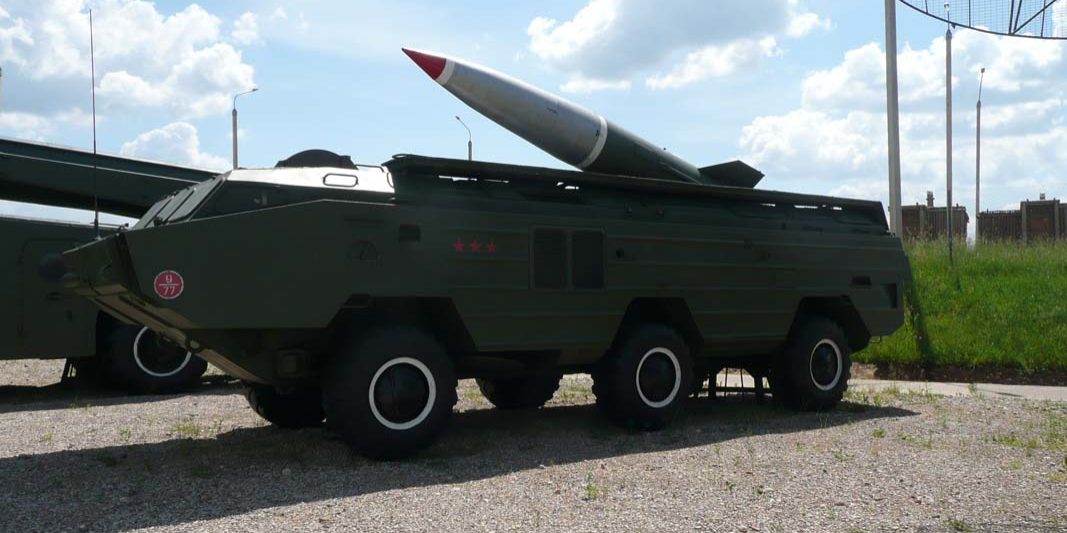

First operationalized in 1975, the road-mobile Scarab-A variant was designed to be deployed alongside conventional forces, maintain flexibility on the battlefield, and attack tactical targets such as bridges, storage facilities, troop concentrations, and airfields. It is a single-stage, single warhead, solid-fueled battlefield short-range ballistic missile (BSRBM) with a range of 70 km and inertial guidance to achieve an accuracy of 150 m Circular Error Probable (CEP). It has a 482 kg warhead that can be equipped with conventional, chemical, or nuclear munitions; the nuclear warhead is believed to have a selectable yield of 10 or 100 kT. If fitted with fragmentation or submunition conventional warheads, the Scarab’s blast radius is increased increasing its lethality against military units and troop concentrations. The missile can also be fitted with an Electromagnetic Pulse (EMP) warhead that can be calibrated for air burst to maximize effectiveness. The Scarab-B (also known as the Tochka-U), with an extended range of 120 km, was developed in the mid-1980s and began replacing the A variant in 1989. While the B variant employs inertial guidance for targeting, it also utilizes GPS and radar—or optical terminal correlation system—to increase its accuracy to 95 m CEP. Like the Scarab-A, the Scarab-B is also capable of being tipped with conventional and nuclear payloads, however, increased in-flight maneuverability allows the B version to better avoid missile defenses. All versions use a road-mobile Transporter-Erector-Launcher (TEL) which makes them highly mobile and able to quickly redeploy after launch. The Scarab is gradually being phased out by the more capable Iskander SRBM, which has a longer range, improved accuracy, and can carry multiple warheads. The missile has been proliferated to numerous Warsaw Pact countries and former Soviet allies. According to the Russian RIA news agency, the conventionally-equipped Scarab has been employed a total of 60 times in combat. Ukraine is believed to possess around 500 Scarab missiles and has purportedly exported the Russian BSRBM to countries such as Syria and Yemen. Reports speculate that Syria received around 40 Scarab BSRBMs and 12 corresponding TEL vehicles from Ukraine. In the mid-1990s, Syria provided North Korea with a Scarab-A prototype, which the Koreans reverse engineered and domestically produced and deployed as the KN-02 BSRBM. Yemen was also a recipient of the Scarab, obtaining an estimated 40 missiles from Ukraine. In December 2015, Houthi rebels in Yemen used the Scarab to carry out devastating strikes on the Arab coalition operating within the country, killing hundreds. Armenia, Belarus, and Kazakhstan are also believed to be in possession of the Scarab.