ARMSNET
Military Equipment Database
Initializing 0%

Su-33 (Flanker-D) Russian Carrier-Based Air Superiority Fighter
Spotted an error? Sign in to suggest an edit.
Basic Information
Name
Su-33 (Flanker-D) Russian Carrier-Based Air Superiority Fighter
Designation
Alternate Designation
Equipment Type
Manufacturer
Design: Sukhoi Design Bureau, Moscow, Russia Contractor: Komsomolsk-on-Amur Aircraft Production Association (KnAAPO), Komsomolsk-on-Amur, Russia
Date of Introduction
1988
Description

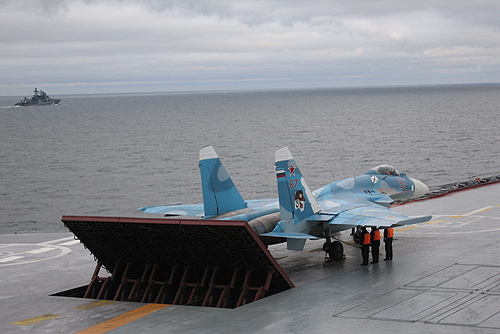
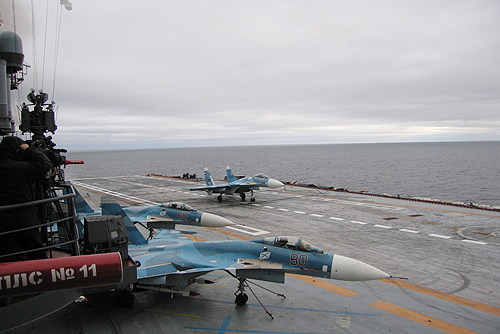
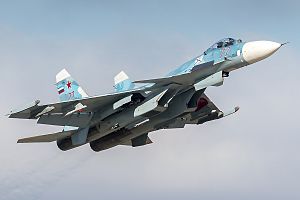
The Su-33 (Flanker-D) Russian Carrier-Based Air Superiority Fighter is an all-weather carrier-based twin-engine air superiority fighter designed by Sukhoi and manufactured by Komsomolsk-on-Amur Aircraft Production Association, derived from the Su-27 and initially known as the Su-27K. Compared with the Su-27, the Su-33 has a strengthened undercarriage and structure, folding wings, and stabilators, all for carrier operations. The Su-33 has canards and its wings are larger than the Su-27 for increased lift. The Su-33 has upgraded engines and a twin nose wheel and is air refuelable. First used in operations in 1995 aboard the aircraft carrier Admiral Kuznetsov,[N 1] the fighter officially entered service in August 1998, by which time the designation "Su-33" was used. Following the break-up of the Soviet Union and the subsequent downsizing of the Russian Navy, only 24 aircraft were produced. Attempted sales to China and India fell through. With plans to retire the Su-33 once they reach the end of their service life, the Russian Navy ordered the MiG-29K as a replacement in 2009. Design: To adapt the original Su-27 for naval operations, Sukhoi first incorporated a reinforced structure and undercarriage to withstand the great stress experienced upon landing, particularly quick descents and non-flare landings (landings where the aircraft does not 'float' and slow its descent rate just prior to touchdown). The leading edge slats, flaperons, and other control surfaces are enlarged to provide increased lift and maneuverability at low speeds, although the wingspan remains unchanged. The wings feature double-slotted flaps and outboard drooping ailerons; in total, the refinements enlarge the wing area by 10–12%. The wings and stabilators are modified for folding to maximize the number of aircraft the carrier can accommodate and to allow ease of movement on deck. The aircraft is outfitted with more powerful turbofan engines to increase the thrust-to-weight ratio, as well as an in-flight refueling probe. The Su-33 sports canards shorten the take-off distance and improve maneuverability, but have required reshaping of the leading edge root extensions (LERX). The rear radome is shortened and reshaped to prevent striking the deck during high-Alpha (angle of attack) landings. Compared with the rival MiG-29K, the Su-33's maximum takeoff weight (MTOW) is 50% higher; fuel capacity is more than double, allowing it to fly 80% further at altitude (or 33% at sea level). The MiG-29K can spend as much time as the Su-33 on station by using external fuel tanks, but this limits its ordnance capacity. The Su-33 can fly at speeds as low as 240 km/h (150 mph), in comparison the MiG-29K needs to maintain a minimum of 250 km/h (160 mph) for effective control. However, the MiG-29K carries more air-to-ground munitions than the Su-33. The Su-33 is more expensive and physically larger than the MiG-29K, limiting the numbers able to be deployed on an aircraft carrier. The Su-33 carries guided missiles such as the R-73 (four) and R-27E (six) on twelve hardpoints, supplemented by the 150-round 30 mm GSh-30-1. It can carry an assortment of unguided rockets, bombs, and cluster bombs for secondary air-to-ground missions. The aircraft can be used in both night and day operations at sea. The radar used, "Slot Back", has been speculated to have poor multi-target tracking, making the Su-33 reliant on other radar platforms and airborne warning and control system (AWACS) aircraft like the Kamov Ka-31 early-warning helicopter. The R-27EM missiles have the capability to intercept anti-ship missiles. The infra-red search and track (IRST) system is placed to provide better downward visibility.

Air & Air Defense Specifications
Crew 1
Engine Turbofan (29320 hp)
Max Speed 2300.0 km/h
Range 3000.0 km
Wingspan 14.70 m
Variants
Su-27K Carrier-based version of the Su-27 designed for Project 11435 and Project 1160 aircraft carriers (heavy aircraft cruisers in Soviet classification).
Su-27KI Project of a carrier-based version of the Su-27 designed for Project 11435 and Project 1153 aircraft carriers (heavy aircraft cruisers in Soviet classification).
Su-27KPP Project of a two-seat carrier-based electronic-warfare aircraft.
Su-27KRS Project of a two-seat carrier-based reconnaissance and target designation aircraft.
Su-27KT/Su-27KTZ Project of a carrier-based tanker aircraft.
Su-27KU Project of a two-seat carrier-based trainer.
Su-27KSH Project of a carrier-based attack aircraft.
Su-28K Project of a two-seat carrier-based attack aircraft.
Su-28KRS Project of a carrier-based reconnaissance and target designation aircraft based on the Su-28K.
Su-29K Project of a carrier-based interceptor aircraft with a possibility to carry the long-range R-33 air-to-air missiles.
Su-33 Designation for the Su-27K after its introduction into service with the Russian Naval Aviation on 31 August 1998.
Su-27KUB/Su-33UB Two-seat training-and-combat version based on the Su-27K and Su-27KU with side-by-side seating for crew of two. One prototype built.
System
Alternate Designation(s) Su-33; NATO: Flanker-D. It is designated the Su-27K by the Russian navy.
Primary Function / Type This carrier-capable aircraft is intended for air-superiority, air-defense and anti-ship missions.
Manufacturer Design: Sukhoi Design Bureau, Moscow, Russia Contractor: Komsomolsk-on-Amur Aircraft Production Association (KnAAPO), Komsomolsk-on-Amur, Russia
Crew 1 (pilot)
Number of Engines 2 ea
Number of Hard Points 12 × external hardpoints with a capacity of up to 6,500 kg (14,300 lb) of ordnance, with provisions to carry combinations of Rockets, Missiles, and Bombs.
Modernization In 2010, Sukhoi developed an upgraded version of the Su-33; flight trials began in October 2010. This modernized Su-33 was to compete with a potential Chinese indigenous version of the original Su-33, the Shenyang J-15, and to encourage orders from the Russian Navy. Major upgrades to the aircraft included more powerful (132 kN, 29,800 lbf) AL-31-F-M1 engines and a larger weapons carriage; upgrades to the radar and weapons were not possible at the time due to funding constraints. According to military author Richard Fisher, it has been speculated that further modifications to a new production batch would include a phased-array radar, thrust-vectoring nozzles, and long-range anti-ship missiles. In September 2016, it was announced the Su-33 will be outfitted with a new sighting and computing system SVP-24 from the Russian company Gefest & T, that will allow the aircraft to use unguided bombs with similar precision as guided ones, giving it an ability of a strike fighter. The SVP-24 takes into account data such as the current plane's location together with flight parameters, target data, and environmental parameters and determines the optimal trajectory for unguided ammunition. It is believed, the installation of modern targeting systems will increase the capability of the Su-33 fighters close to Su-30SM level. The second stage of the modernization is to include the installation of more powerful engines and detection systems, according to Naval Aviation Chief Major-General Igor Kozhin.
Dimensions
Length 12.19 m without probe
Wingspan 14.70 m
Wingspan Folded 7.40 m
Height 5.85 m
Wing Area 67.80 m sq
Wheelbase 5.87 m
Wheel Track 4.40 m
Empty Weight 18,500 kg
Normal Takeoff Weight 25,000 kg
Maximum Takeoff Weight 29,940 kg
Maximum Weight 33,000 kg after in-flight refueling
Maximum Combat Load 6,500 kg
Automotive
Engine Name 2 x modified Saturn AL-31K
Engine Type Turbofan
Engine Power 29,320 lb (130.42 kN) thrust each
Fuel Capacity 20,944 lb (9,500 kg) internal
Maximum Speed 2,300 km/h
Maximum Speed at Sea Level 1,400 km/h
Approach Speed 240 km/h
Maximum Range 3,000 km w/out refueling
Ceiling 17,000 m
Carrier Takeoff 120 m on 14-deg ramp
Carrier Landing 90 m with arrestor hook
Maximum Load +9 G
Operational Load +8 G
Main Gun System
System
Name 1 x Gryazev-Shipunov GSh-30-1
Type Autocannon
Caliber 30 mm
Length Gryazev-Shipunov GSh-30-1
Barrel Length 1,500 mm
Width 156 mm
Height 185 mm
Weight 46 kg
Barrels 1
Action Short recoil operated
Rate of Fire 1,800 rounds/min
Muzzle Velocity 900 m/s
Maximum Firing Range 1,800m
Effective Firing Range 200-1,800m
Ammunition
Type Rifle
Caliber 30 mm
Shell 30×165mm
Basic Load 150 Rounds
Missile Systems
Anti-Air Missiles AA-10 Alamo, AA-8 Aphid, AA-11 Archer, AA-12 Adder AAMs
Anti-Ship Missiles AS-17 Krypton, Moskit ASM-MSS (SS-N-22 Sunburn)
Anti-Ship Missile
Name P-270 Moskit
Type Supersonic Anti-Ship Cruise Missile
Manufacturer MKB Raduga
Length 9.745 m
Diameter 0.8 m
Wingspan 2.10 m
Weight 4,500 kg
Warhead Weight 300 KG (660 lb) overall 150 kg (330 lb) explosive or 120 kt of TNT fission-fusion thermonuclear weapon
Engine Four ramjets (solid fuel rocket on air-to-surface version)
Operational Range 120–250 km
Flight Altitude 20 m (66 ft) above sea level
Maximum Speed Mach 3 (3,675 km/h)
Guidance System Inertial guidance plus terminal active radar homing
Rockets
Note S-8, S-13 or S-25 pods
Bombs
Note up to 8 x 1,100 lb (500 kg) or 28 x 550 lb (250 kg)
Fire Control / Avionics
Fire Control Radar NIIP N011 multi-mode look-down shoot-down; or Phazotron Zhuk-27
Navigation Radar INA
Protection
Stealth Properties None
Heat Signature Reduction INA
NBC Protection INA
EW Counter Measures INA
Chaffs/Flares Yes
Details
Country of Origin Russia
Category Fixed Wing Aircraft
Air > Fixed Wing Aircraft
Filter Label
S
Classification
Domain
Air & Air Defense
Equipment Status
Active
Dimensions
Length
12.19 m
Width
Height
5.85 m
Weight
25000 kg
Operators (1)
Russia
Something went wrong. Please reload the page. Reload