Vikramaditya Class Indian Aircraft Carrier
Vikramaditya Class
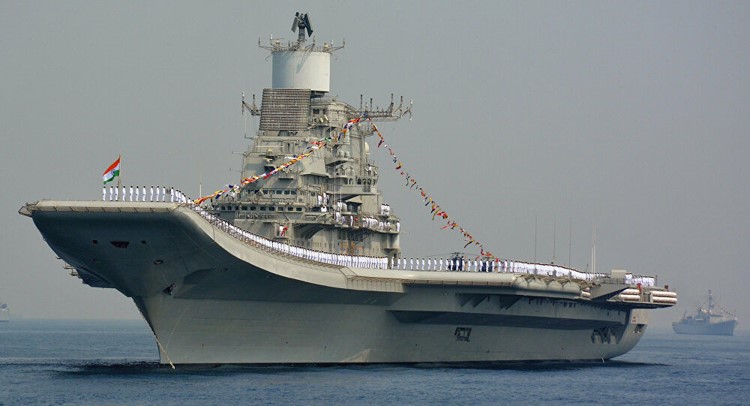


Vikramaditya (Sanskrit, Vikramāditya meaning "Brave as the Sun") is a modified Kiev-class aircraft carrier and the flagship of the Indian Navy, which entered into service in 2013. She has been renamed in honor of Vikramaditya, a legendary emperor of India. Originally built as Baku and commissioned in 1987, the carrier served with the Soviet Navy and later with the Russian Navy (as Admiral Gorshkov) before being decommissioned in 1996. The carrier was purchased by India on 20 January 2004 after years of negotiations at a final price of $2.35 billion. The ship successfully completed her sea trials in July 2013 and aviation trials in September 2013. She was commissioned on 16 November 2013 at a ceremony held at Severodvinsk, Russia. On 14 June 2014, the Prime Minister of India formally inducted INS Vikramaditya into the Indian Navy and dedicated her to the nation. Refurbishment The hull work was completed by 2008 and Vikramaditya was launched on 4 December 2008. Around 99% of the structural work and almost 50% of the cabling work had been completed by June 2010. Almost all of the large equipment, including engines and diesel generators, was installed. A naval MiG-29K prototype aircraft was used to test the deck systems of Vikramaditya in 2010. All reconfiguration work was completed at Severodvinsk, Russia; however, it was delayed by three years due to underestimation of the amount of cabling needed. An expert-level discussion on technical and financial matters was held between India and Russia to sort out the issues. The MiG-29K entered operational service with India in February 2010. A compromise was finalized and India was to pay an extra undisclosed amount. Russia was to install new systems instead of repairing the old ones. On 1 June 2010, The Times of India reported a naval officer saying: "With India earlier this year agreeing to the revised refit cost of $2.33 billion for Gorshkov after three years of bitter wrangling since the earlier agreement inked in January 2004 had earmarked only $974 million for it, Russia has appointed a high-level apex committee to oversee the work on the carrier". The ship was to go for harbor trials by early 2011 to ensure it could be handed over to India by December 2012 or so. Dock trials began on 1 March 2011. The focus of these trials was on the main power generation units and the radio-electronic armament systems, manufactured in India. Indian Navy personnel began training on Vikramaditya in April 2011. On 19 April 2012, it was announced that all internal systems were functioning, and the ship was entirely self-contained. Measurement of the ship's magnetic field and center of gravity were performed before sea trials began. As completed, Vikramaditya has a larger full load displacement than when the ship was originally launched in 1982 as Baku. 1,750 out of 2,500 compartments of the ship were re-fabricated, and extensive re-cabling was done to support new radars and sensors. The elevators were upgraded, and two restraining stands were fitted, allowing combat aircraft to reach full power before making a ski jump-assisted short take-off. Three arresting gears were fitted on the aft part of the angled deck, and navigation and carrier-landing aids were added to support fixed-wing "short take-off but arrested recovery" (STOBAR) operations. The major modifications were to allow Admiral Gorshkov to operate as a STOBAR aircraft carrier in Indian service, as opposed to the STOVL configuration the ship was built as. This involved removal of all the armaments, including the P-500 Bazalt cruise missile launchers and the four Antey Kinzhal surface-to-air missile bins fitted on the ship's bow, to make way for a 14.3°, full-width ski-jump. The 20-ton capacity aircraft lift beside the ship's island superstructure was unchanged, but the aft lift was enlarged and its lift capacity increased to 30 tons. For STOBAR operations, three 30 m arrestor wires and three restraining gears on the stern of the angled deck were fitted. Sponsons were installed to increase the area of the flight deck, to allow the ski-jump to be fitted, for strengthening of arresting gear and runway area, and to lengthen the after end, which allowed an increase to the length of the landing strip aft of the arresting gear. 234 new hull sections were installed to achieve the desired shape, and the total steel added to carry out these modifications amounted to 2500 tons. The superstructure profile was designed to accommodate the fixed phased array scanners of the Soviet Navy's Mars-Passat 3D air search radar system, along with extensive command and control facilities to conduct an aerial campaign. An extensive revamp of sensors was carried out, with long-range air-surveillance radars and advanced electronic warfare suites fitted, which enable the maintenance of a surveillance bubble of over 500 km around the ship. An aft mast was installed to accommodate various communication antennae. These changes needed 2,300 km of new cables and 3,000 km of new pipes. The eight original boilers were replaced by a new generation, high-pressure boilers, converted to take diesel fuel utilizing LSHSD instead of furnace fuel oil, each providing a steam capacity of 100 tonnes per hour. The new boilers are highly efficient and have high levels of automation. They power four propellers in four shaft configurations, producing a total thrust of 180,000 horsepower (134,226 kW) at the shaft, providing a top speed of over 30 knots. Six turbo-alternators and six diesel alternators generate 18 MW of electricity to power various equipment. Modern oil-water separators, as well as a sewage treatment plant, were incorporated to meet international standards. Six new Finnish Wärtsilä 1.5 MW diesel generators, a Global Marine communications system, Sperry Bridgemaster navigation radar, a new telephone exchange, a new data link, and an IFF Mk XI system were added. Hotel services were improved with the addition of two reverse osmosis plants producing 400 tons of freshwater per day, as well as updated refrigeration and air conditioning. A new gallery was installed together with improved domestic services and accommodation for 10 female officers. Combat systems The combat systems onboard the carrier is controlled by LESORUB-E, the computer-aided action information system. It gathers data from the ship's sensors and data links and creates comprehensive situation awareness. The CCS Mk II communication complex is installed for external communications and the Link II tactical data system enables integration into the Indian Navy's network-centric operations. Modern launch and recovery systems are installed for handling different aircraft – the LUNA Landing system for MiG-29Ks and the DAPS Landing system for Sea Harriers. The Resistor-E automated air-traffic-control system has been installed, which provides assistance during the approach, landing, and short-range navigation down to a distance of 30 meters short of the flight deck to the pilots. Along with various other sub-systems, it provides navigation and flight data to ship-borne aircraft operating at long distances from the carrier. When delivered, Vikramaditya had yet to be fitted with any onboard armament, leaving her dependent on her battle group for self-defense. This was rectified during the ship's short refit of April–June 2015, when she was fitted with four license-built AK-630 CIWS, and a Barak 1 SAM system stripped from the decommissioned INS Godavari. During the ship's first scheduled major refit in 2017, the Barak 1 system will be replaced with the newly developed Barak 8 long-range air-defense system (LR-SAM), which is currently being tested. It is launched from vertical launch cells and has an operational range of 0.5–100 km. The carrier will carry up to 48 missiles. The official expected life span of the ship is 40 years and is unlikely to require any major repair work for at least a decade. Over 70% of the ship and her equipment is new and the remainder has been refurbished.[Sevmash Shipyard, which upgraded the carrier, will provide warranty servicing including maintenance for the next 20 years.