M47 Patton American Main Battle Tank (MBT)
M47 Patto
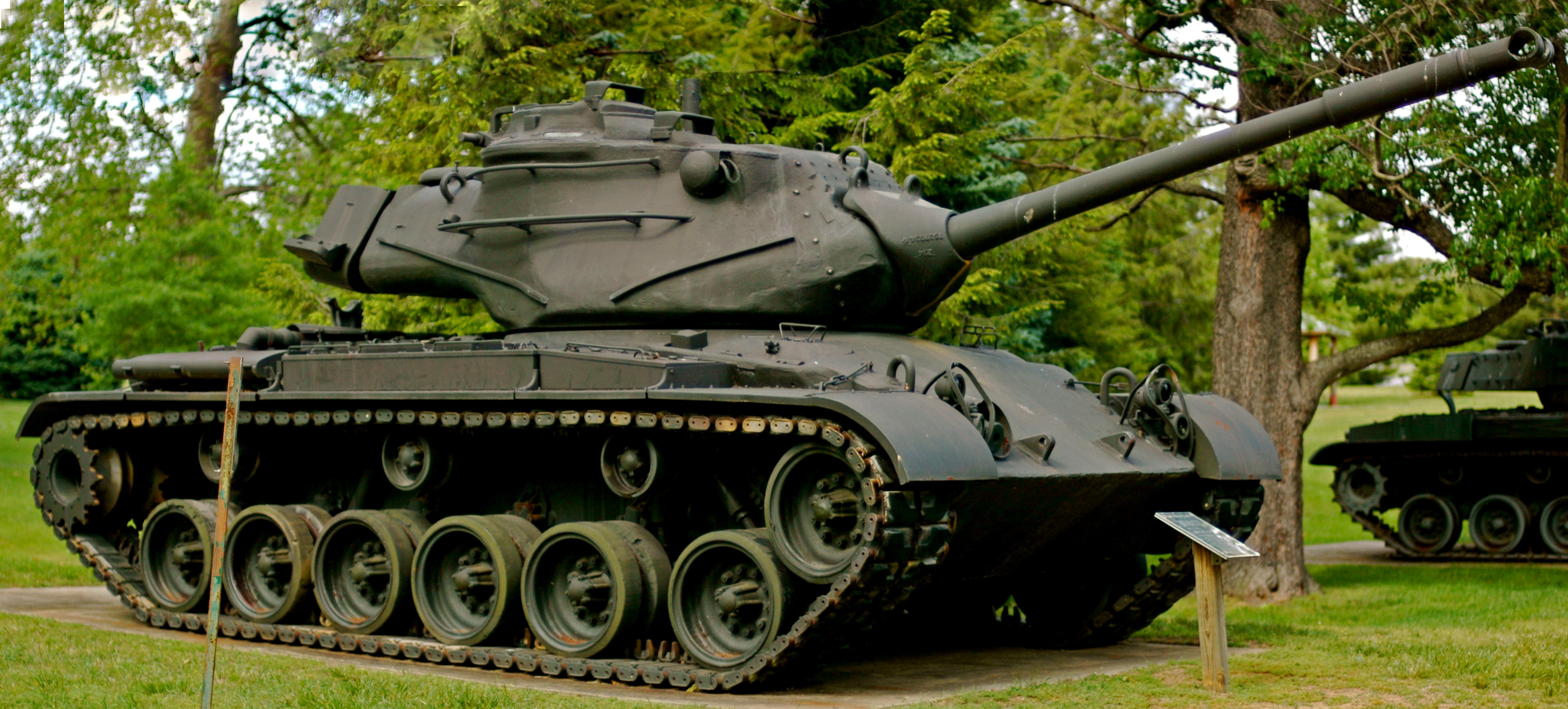
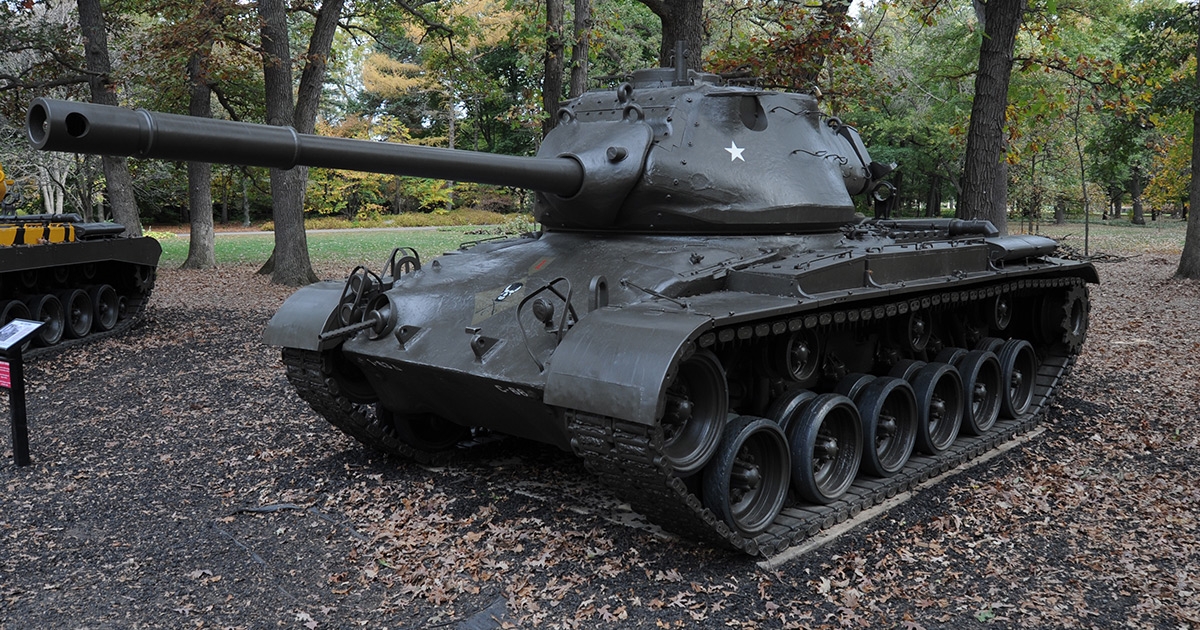
The M47 Patton was an American main battle tank, a development of the M46 Patton mounting an updated turret, and was in turn further developed as the M48 Patton. It was the second American tank to be named after General George S. Patton, commander of the U.S. Third Army during World War II and one of the earliest American advocates of tanks in battle. The M47 was the U.S. Army's and Marine Corps' primary tank, intended to replace the M26 Pershing and M46 Patton medium tanks. The M47 was widely used by U.S. Cold War allies, both SEATO and NATO countries, and was the only Patton series tank that never saw combat while in US service. Although similar in appearance to the later M48s and M60s, these were completely new tank designs. Many different M47 Patton models remain in service internationally. The M47 was the last US tank to have a bow-mounted machine gun in the hull. Although a new power plant corrected the mobility and reliability problems of the M26 Pershing, the subsequently renamed M46 was considered a stopgap solution that would be replaced later by the T42 medium tank. However, after fighting erupted in Korea, the Army decided that it needed the new tank earlier than planned. It was deemed that there was not enough time to finish the development of the T42. The final decision was to produce another interim solution, with the turret of the T42 mounted on the existing M46 hull. Although this interim tank was itself technically immature, Army officials felt the improvements over the M46 in firepower and armor were worth the risk. The composite tank, developed by the Detroit Arsenal, was named the M47 Patton. In December 1950 the Army awarded a $100 million contract to the American Locomotive Company for the production of 500 tanks. It entered production in 1951. Its main gun was the M36 90 mm gun with an M12 optical rangefinder fitted. The secondary armament consisted of two .30 cal Browning machine guns, one in the bow and one coaxial with the 90mm main gun in the turret, and a .50 caliber Browning M2 on a pintle mount on the turret roof. The M47 was the last American-designed tank to include a bow machine gun. The T42 turret had a larger turret ring than the M26/M46 turret, and featured a needle-nose design, which improved armor protection of the turret front, an elongated turret bustle and storage bin which protruded halfway across the engine deck, and sloped sides to further improve ballistic protection; this gave the turret a decidedly lozenge-shaped profile. It also featured the M12 stereoscopic rangefinder, which was designed to improve first-round hit probability but proved difficult to use; the rangefinder protruded from both sides of the upper turret front, which would be a feature of American tanks until the advent of the M1 Abrams in 1980. Production at American Locomotive began in July 1951. Logistical and technical issues plagued production almost from the start. Truman administration policy sought to strengthen American arms makers' resilience to aerial attack by encouraging more decentralized weapons production — away from Detroit. The U.S. curtailed civilian automobile production to boost military production with the onset of the Korean War. As a result, Detroit's newly unemployed automotive workers found little work, while tank manufacturers outside Michigan lacked skilled workers. Truman's policy also counted on civilian factories being able to quickly transition to war-time production. However many factories lacked needed tank production machinery, done away with during World War II demobilization. A faulty Ordnance Corps-designed hydraulic turret-control mechanism, shared by the M41 Walker Bulldog, kept the tanks from Korea while engineers worked on a fix. Engineers improved production quality controls of the hydraulics by April 1952, and set about correcting M47s sidelined in storage. By then Army officials had scrapped plans to send the tanks to Korea, in favor of providing them to troops stationed in Europe and at home. The first M47s were not fielded to the 1st and 2nd Armored Divisions until summer 1952. Standardized in May 1952, the M47 Patton's production ran until November 1953; Detroit built 5,481 tanks, and American Locomotive Company (Alco) produced 3,095, for a total production run of 8576 M47 Pattons.