ARMSNET
Military Equipment Database
Initializing 0%

Dual Mount Stinger American Man-Portable Air-Defense System (MANPADS)

Dual Mount Stinger (DMS)

Man-Portable Air Defense System (MANPADS)
Spotted an error? Sign in to suggest an edit.
Basic Information
Name
Dual Mount Stinger American Man-Portable Air-Defense System (MANPADS)
Designation
Dual Mount Stinger (DMS)
Alternate Designation
Dual Mount Stinger (DMS)
Equipment Type
Man-Portable Air Defense System (MANPADS)
Manufacturer
Prime contractor: Raytheon Missile Systems (formerly Hughes Missile Systems; formerly General Dynamics), Tucson, Ariz. Prime contractor (Europe): Daimler-Benz Aerospace (now DaimlerChrysler) (Dasa), Munich, Germany
Date of Introduction
1997
Description

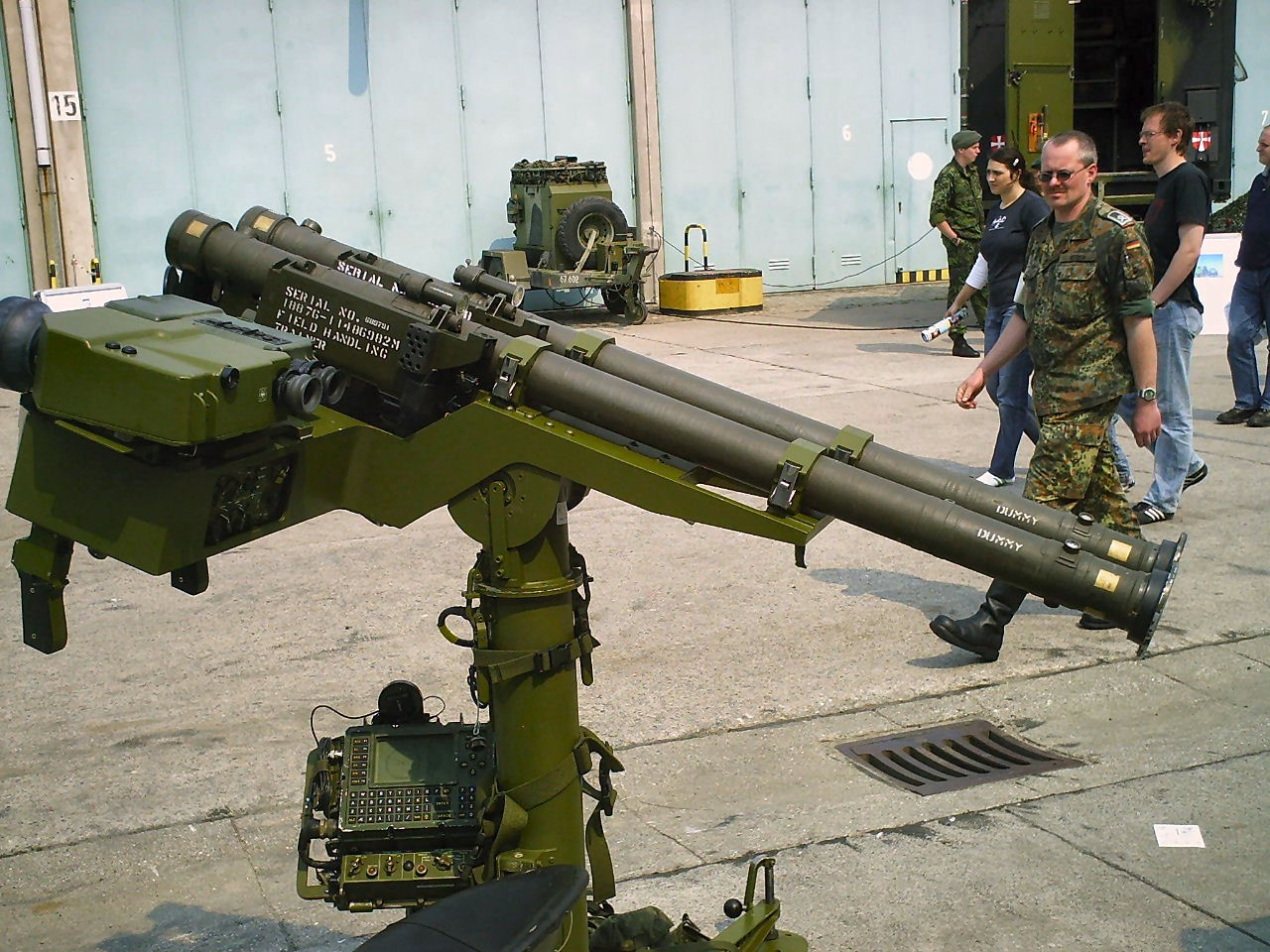
The Dual Mount Stinger (DMS) is a tripod-mounted launch platform for the Stinger Missile developed by Hughes Missile Systems Company (HMSC) for the SHORAD Project Office. (HMSC was later sold to Raytheon Corporation and is currently operating as Raytheon Missile Systems Corporation [RMSC].) Tripod-mounted missile launch devices are not a new concept. Developed for FMS customers, the DMS Weapon System consists of the DMS launcher with two Stinger tactical missiles (Guided Missile, Intercept Aerial). This system provides air defense capability from a fixed ground position. A self-contained system, the DMS includes its own electrical power system, argon coolant, and sighting units. Easily disassembled into portable components that require minimal set-up time, the DMS can be operated autonomously or in conjunction with an external early warning command and cueing/control system. The DMS launcher has provisions to receive Forward Area Air Defense Data Link or Ground Based Data Link cueing data, which can be from either two-dimensional (2D) or three-dimensional(3D) sensors. Cueing data from a 2D system give the approach direction (azimuth) and range of the target aircraft, while cueing data from a 3D system give the approach direction (azimuth), range of the target aircraft, and elevation angle. Since the United States had no requirement for this system in 1997, its development and fielding presented a unique set of challenges. A current FMS customer approached the SHORAD Project Office with the requirement for a tripod launcher, and we immediately started the research necessary to meet the requirement. The sale of this system, even though it technically did not exist at the time, required the same U.S. Department of State approval as any other FMS case. In August 1998 the Taipei Economic and Cultural Representative Office (TECRO) in the United States requested a possible sale of 61 Dual Mount STINGER Missile Systems consisting of: 61 Dual Mount STINGER (DMS) launchers (includes elevation assembly, tripod assembly, and sights) with coolant units, 61 STINGER RMP (-) captive flight trainers, 728 complete STINGER RMP (-) missile rounds (less battery coolant unit), 132 AN/VRC-91 export version Single Channel Ground/Air Radio System (SINCGARS) radios, spare and repair parts, support equipment, Interrogator Friend or Foe interrogator sets, interrogator programmers, utility carrier trucks, aerial flight handling and launcher trainers, coolant units, gas bottles, publications and documentation data, personnel training and training equipment, U.S. Government and contractor engineering and logistics personnel services, U.S. Government Quality Assurance Teams, Mobile Training Teams, and other related elements of logistics support. The estimated cost was $180 million. The Short Range Air Defense (SHORAD) Project Office obtained necessary approvals and built the customer a Stinger Missile Launcher that ultimately met their requirements in a timely and cost-effective manner.

Ground Specifications
Crew 1
Main Weapon Stinger
Max Speed 2835.2 km/h
Range 4.8 km
Variants
FIM-92A Stinger Basic: The basic model.
FIM-92B Stinger POST: In this version, the infrared seeker head was replaced by a combined IR/UV seeker that utilized rosette scanning. This resulted in achieving significantly higher resistance to enemy countermeasures (flares) and natural disturbances. Production ran from 1981 to 1987; a total of 600 missiles were produced.[
FIM-92C Stinger RMP: The resistance to interference was increased again by adding more powerful digital computer components. Moreover, the software of the missile could now be reconfigured in a short time in order to respond quickly and efficiently to new types of countermeasures. Until 1991, some 20,000 units were produced for the U.S. Army alone.
FIM-92D Various modifications were continued with this version in order to increase the resistance to interference.
FIM-92E Stinger—RMP Block I: By adding a new rollover sensor and revised control software, the flight behavior was significantly improved. Additionally, the performance against small targets such as drones, cruise missiles and light reconnaissance helicopters was improved. The first deliveries began in 1995. Almost the entire stock of U.S. Stinger missiles was replaced by this version.
FIM-92F A further improvement of the E version and the current production version.
FIM-92G An unspecified upgrade for the D variant.[
FIM-92H Indicates a D variant that has been upgraded to the E standard.
Stinger—RMP Block II This variant was a planned developed based on the E version. The improvements included an imaging infrared seeker head from the AIM-9X. With this modification, the detection distance and the resistance to jamming was to be greatly increased. Changes to the airframe would furthermore enable a significant increase in range. Although the missile reached the testing phase, the program was dropped in 2002 for budgetary reasons.
FIM-92J Block 1 missile upgrade to replace aging components to extend service life an additional 10 years. Upgrades include a proximity fuse warhead section, equipped with a target detection device to increase effectiveness against unmanned aerial vehicles.
FIM-92K variant of FIM-92J designed to use a vehicle datalink rather than the missile's own seeker for targeting.
System
Alternative Designation Dual Mount Stinger (DMS)
Type Man-Portable Air-Defense System (MANPADS)
Manufacturer Prime contractor: Raytheon Missile Systems (formerly Hughes Missile Systems; formerly General Dynamics), Tucson, Ariz. Prime contractor (Europe): Daimler-Benz Aerospace (now DaimlerChrysler) (Dasa), Munich, Germany
Crew 1, Normally 2 with a loader ea
In Service 1997-Present
Main Weapon System
Launcher
Note Two Stinger fire-and-forget missiles mounted on a tripod with an operator's seat and controls. It can be mounted on a light utility truck or on deck of a small patrol boat.
System Weight 15.2 kg
Missile
Name Stinger
Type Man-Portable Air-Defense System (MANPADS)
Length 1.52 m
Diameter 70 mm
Missile Weight 10.0 kg
Warhead Weight 3.0 kg
Engine 1 x Atlantic Research Mk 27 dual-thrust solid-fuel rocket
Maximum Speed Mach 2.2
Maximum Range 4.8 km
Maximum Altitude 3,800 m
Warhead penetrating high-explosive; impact fuze
Optics optical sight (some thermal imaging capability) proportional navigation with lead bias and Target Adaptive Guidance (TAG)
Guidance System all-aspect passive infrared homing
Fire Control System
ADAD British passive thermal IR scanners on remote tripod or vehicle mount with 240 o FOV automatic cueing system.
IFF AN/PPX-1 trigger-activated on grip-stock, with battery belt-pack
Target Alert Display Set (TADDS) US portable graphic display set w/audio alert, VHF radio, and IFF.
Day Sight
Acquisition Range 4000+ km
Field of View INA deg
Type Ring and bead, most launchers Optical sight with lead bias available.
Night Sight
Type Optional AN/PAS-18, Wide- Angle Stinger Pointer System (WASP) thermal sight.
Night Sights
Acquisition Range 20-30 side or tail aspect, 10 head-on aspect km
Field of View 20o x 12 o deg
Radar
Radar Equipment Providing Omni-directional Reporting of Targets at Extended Ranges (REPORTER), German/Dutch EW system with I/J band radar and IFF. Range: 40 km. Altitude: 15-4000 m.
Radar Other Several U.S. and foreign radars are available for use with Stinger.
Details
Country of Origin United States
Category Man-Portable Air-Defense Systems (MANPADS)
Land > Air Defense > Man-Portable Air-Defense Systems (MANPADS)
Filter Label
D
Classification
Domain
Ground
Equipment Status
Active
Dimensions
Length
1.52 m
Width
0.07 m
Height
Weight
15.2 kg
Operators (28)
United States
Germany
United Kingdom
Israel
Japan
South Korea
Turkey
India
Iran
North Korea
Pakistan
Bangladesh
Bosnia and Herzegovina
Chad
Chile
Colombia
Egypt
Finland
Georgia
Greece
Iraq
Lithuania
Morocco
Netherlands
Norway
Portugal
Slovenia
Switzerland
Something went wrong. Please reload the page. Reload