M109A1 American 155mm Self-Propelled Howitzer (SPH)
M109A1
Self-Propelled Howitzer (SPH)
Spotted an error? Sign in to suggest an edit.
Other
Basic Information
Name
M109A1 American 155mm Self-Propelled Howitzer (SPH)
Designation
M109A1
Alternate Designation
M109A1
Equipment Type
Self-Propelled Howitzer (SPH)
Manufacturer
—
Date of Introduction
1970
Description
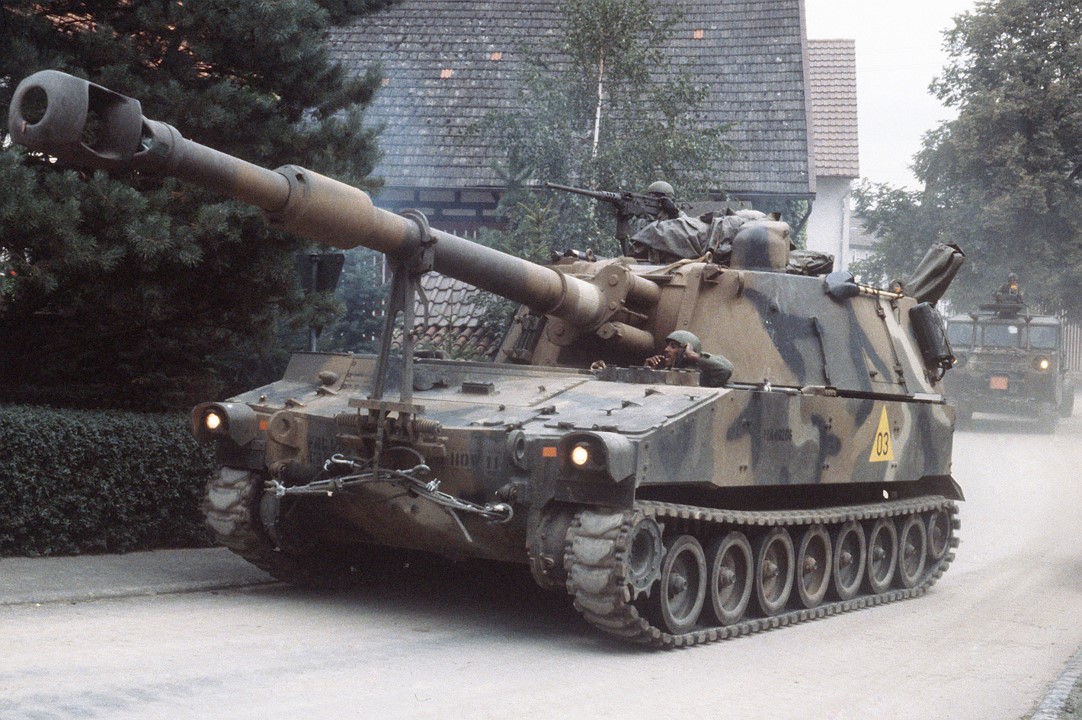
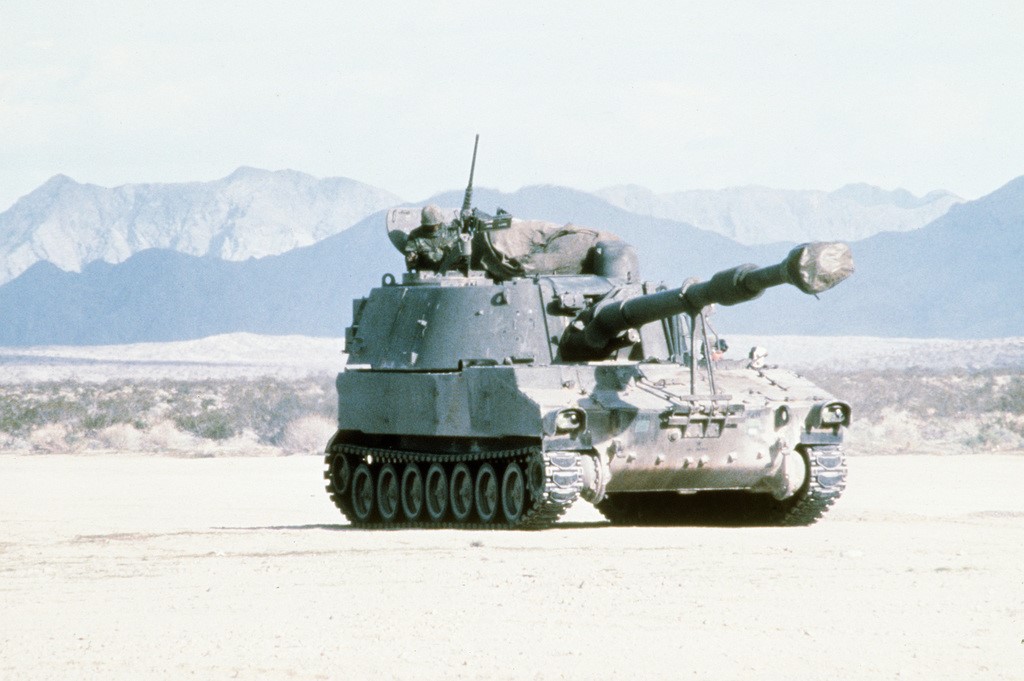
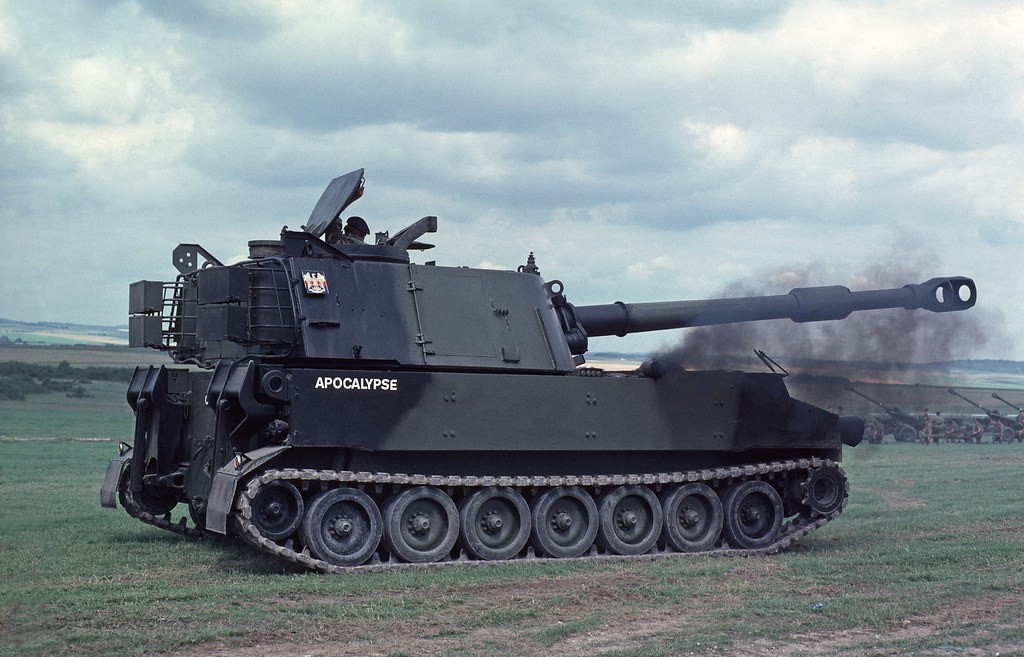
The M109A1 variant features an improved gun—the M185 155 mm/L39 howitzer. This artillery system was introduced in 1970 and deliveries commenced in 1973. Other improvements include a more efficient muzzle brake, improved load assisting system, and improved suspension. The maximum range of fire is 18.1 km with a standard HE-FRAG projectile and 24 km with a rocket-assisted projectile. IT is also capable of launching M712 Copperhead laser-guided rounds. The rounds fired by the M109A1 are intended to engage high-value hostile targets, such as tanks, armored vehicles, artillery systems, radars, observation posts, and so on. Most original M109 artillery systems were upgraded to this standard
Ground Specifications
Crew
6
Mobility Type
Tracked
Main Weapon
155 mm M185 gun
Engine
Diesel (450 hp)
Range
390.0 km
Variants
M109
First produced in 1963. It had a 23 caliber 155 mm M126 gun in an M127 Howitzer Mount and carried 28 rounds of 155 mm ammunition. It was also armed with a .50cal M2HB machine gun with 500 rounds of ammunition. Easily identified by its short barrel and a double baffle muzzle brake with a large fume extractor just behind it. The maximum range of 14,600 meters.
M109A1
Replaced the M126 gun with a longer barreled, 39 caliber M185 gun, increasing the maximum range to 18,100 meters.
M109A2
Incorporated 27 Reliability, Availability, and Maintainability (RAM) mid-life improvements. Most notably, the long-barreled 155 mm M185 cannon in the new M178 gun mount, ballistic protection for the panoramic telescope, counterbalanced travel lock, and the ability to mount the M140 alignment device. Stowage of 155mm rounds increased from 28 to 36 rounds; .50cal ammunition remained at 500 rounds. During M109A2 production, a slightly simplified version was also produced for export. This had minor internal changes and deleted the hull flotation feature. These were designated M109A1B.
M109A3 and M109A3B
M109A1s and M109A1Bs were rebuilt to M109A2 standard respectively. Some A3s feature three contact arm assemblies, while all A2s have five.
M109A4
M109A2s and M109A3s improved with Nuclear, Biological, and Chemical / Reliability, Availability, and Maintainability (NBC/RAM) improvements, including air purifiers, heaters, and Mission Oriented Protective Posture (MOPP) gear.
The traversing mechanism's clutch is hydraulic, as compared to the electric mechanism on the previous M109s, and features a manual override in the event of an electrical failure. The A4 also adds an additional hydraulic filter, for a total of two. Also included is an improvement to the engine starting equipment, greatly improving the ability to start in an emergency.
Ammunition amounts remain the same as the two previous models.
M109A5
Replaces the 155 mm M185 cannon in an M178 mount with a 39-caliber 155 mm M284 cannon in an M182 mount, giving the A5 a maximum range of 22,000 meters with unassisted projectiles and 30,000 meters with Rocket Assisted Projectiles (RAP Rounds). The vehicle can carry 36 complete rounds of ammunition and has a 440 hp engine instead of the standard 405 hp engine.
M109A5+
Various manufacturers have upgraded the fire control and other components of the M109A5. BAE Systems in York PA recently delivered 12 M109A5+ vehicles to Chile and 32 to Brazil.
M109A6 "Paladin"
Overall product improvement in the areas of survivability, RAM, and armament. This includes increased armor, a redesigned internal arrangement for safer ammunition and equipment storage, engine and suspension upgrades, and product improvement of the M284 cannon and M182A1 mount. The greatest difference is the integration of an inertial navigation system, sensors detecting the weapons' lay, automation, and an encrypted digital communication system, which utilizes computer-controlled frequency hopping to avoid enemy electronic warfare and allow the howitzer to send grid location and altitude to the battery fire direction center (FDC). The battery FDCs in turn coordinate fires through a battalion or higher FDC. This allows the Palladin to halt from the move and fire within 30 seconds with an accuracy equivalent to the previous models when properly emplaced, laid, and saved—a process that required several minutes under the best of circumstances. Tactically, this improves the system's survivability by allowing the battery to operate dispersed by pairs across the countryside and allowing the howitzer to quickly displace between salvos, or if attacked by indirect fire, aircraft, or ground forces.
Ammunition storage is increased from 36 to 39 155 mm rounds.
M109 "KAWEST"
This Swiss improved version produced by Ruag incorporates a new Swiss-designed L47 155 mm gun with an increased firing range of up to 36 km. It features an inertial navigation system coupled with a new gun-laying system and more ammunition storage(40 rounds, 64 charges). The KAWEST (lit. Kampfwertsteigerung = upgrade of combat capabilities) requires only 6 crew members instead of 8 and is able to fire 3-round bursts within 15 seconds or maintain a constant firing rate of over one round per minute.
Upgraded Swiss PzHb (Panzerhaubitze) 79 and 88 (M109A1) are known as respectively PzHb 79/95 and PzHb 88/95
M109L52
Jointly developed by the Dutch firm RDM and the German firm Rheinmetall, the M109L52 was first revealed in 2002. The main improvement was replacing the M126 series gun with the longer 52-caliber cannon from the PzH 2000, thus the MTLS ammunition of the PzH 2000 can be used. In addition, improvements to the loading system were made. This resulted in an increase of the rate of fire to 9–10 rds/min from the original 3 rds/min, and this high rate of fire can be sustained for up to 2 minutes. A total of 35 rounds can be carried.
M109A3GNM
The current version is in service with the Norwegian Army's Artilleribataljonen. 126 M109Gs were acquired from West Germany between 1969–1971. They were then upgraded to the M109A3GN configuration during the latter half of the 1980s. In 2006, there were still 56 M109A3GNs in the Army's inventory, meaning that at least 70 SPGs had been scrapped after the end of the Cold War. 14 of the M109A3GNs received additional upgrades in 2007 and were designated M109A3GNM. The upgrade includes, among other things, new intercom and new navigation and positioning systems. The M109A3GNMs are currently the only SPGs that remain in active service with the remainder of the M109s having been put in storage.
K55/K55A1
K55/K55A1 are South Korean variants of the M109A2 , originally named KM109A2 with additional domestic augmentations, license-produced by Samsung Techwin. They are fitted with M178 155 mm 39 caliber gun, NBC protection, an automatic fire extinguishing system, and a modified ammunition reception module for K56 automatic ammunition resupply vehicle. The Performance Improvement Program variant, K55A1, is a complete domestic overhaul of the K55 which is further augmented by Samsung Thales with modern digital ballistic computers, multifunctional data display and controllers, GPS navigation and target acquisition system, wireless data link equipment, and upgraded fire control storage battery and power supply unit, to closely match the US military's modernization of the Paladin into the next-generation standard. Many improved technologies of the South Korean K9 Thunder were retrofitted on the K55A1. 1,040 howitzers of these variants were produced.
M109A7
The newest M109 version for U.S. service is the M109A7, formerly known as the M109A6 Paladin Integrated Management (PIM). The M109A7 shares common components with the Bradley Fighting Vehicle such as the engine, transmission, and tracks. This creates commonality with other systems and maximizes cost savings in production, parts inventory, and maintenance personnel. The M109A7's onboard power systems harness technologies originally developed for the Non-Line-of-Sight Cannon; the electric drive is faster than the previous hydraulic system, and the automatic rammer more consistently rams the round into the gun for consistent velocities and better accuracy. It features a 600-volt onboard power system to accommodate additional armor and future networking technologies as they become ready. The M109A7 can sustain a one-round per-minute rate of fire and a maximum rate of fire of four rounds per minute.
System
Alternative Designation
M109A1
In Service
1970-Present
Type
Self-Propelled Howitzer
Crew
6 ea
Chassis
The M108 and M109 shared a common chassis (along with the M113 APC), but the M109 was heavier and had a larger gun. The M108 proved unsuccessful, mainly due to its overly light gun.
Displacement Time
INA
Emplacement Time
INA
Note
The first M109A1 conversion kits became available in early 1972 and the first examples, converted from standard models, became operational in 1973.
Dimensions
Length, Hull
6.19 m
Length, Gun Forward
9.04-m
Width
3.15 m
Height
3.28 m
Weight
24,070 kg
Automotive
Engine Name
Detroit Diesel 8V71T Diesel
Engine Type
Diesel
Engine Power
450 hp
Range
390 km
Speed, Maximum Road
65 km/h
Speed, Average Cross
INA
Speed Maximum Swim
Not Amphibious
Gradient
60 %
Side Slope
30 %
Vertical Step
0.53 m
Trench
1.83 m
Fording Depth
1.07 m
Fuel Capacity
135 gal (511 liters)
Main Gun
System
Name
M185 155 mm/L39 howitzer
Type
Howitzer
Caliber
155 mm
Length
INA
Barrel Length
INA
Weight
INA
Cannon Groves
48
Rifling
right-hand rifling with constant, 8.93-deg twist
Breech Type
Welin-step thread
Recoil System
hydropneumatic
Elevation
-3/+75 deg (-53/+1,333 mils)
Traverse
360 deg (6,400 mils)
Maximum Firing Range
14.6 km
Maximum Rate of Fire
4 rpm
Sustained Rate of Fire
2 rpm
Note #1
This self-propelled artillery system is supported by an associated M992 armored ammunition supply vehicle. It is based on the same tracked chassis as the M109.
Note #2
This version mounts the longer M185 155-mm gun and incorporated elevation, traversing and suspension improvements.
Note #3
Other improvements include a more efficient muzzle brake, improved load assisting system and improved suspension. Maximum range of fire is 18.1 km with standard HE-FRAG projectile and 24 km with rocket-assisted projectile. IT is also capable of launching M712 Copperhead laser-guided rounds. These rounds are intended to engage high-value hostile targets, such as tanks, armored vehicles, artillery systems, radars, observation posts and so on. Most original M109 artillery systems were upgraded to this standard.
Ammunition (Option 1)
Name
M712
Type
Copperhead
Caliber
155 mm
Length
54.0 in (1,372 mm)
Weight
140.0 lb (63.50 kg)
Basic Load
28 Rounds Total of any Combination Projectiles
Ammunition (Option 2)
Name
M864
Type
DPICM
Caliber
155 mm
Length
35.3 in ( 898 mm)
Weight
103.2 lb (43.80 kg)
Basic Load
28 Rounds Total of any Combination Projectiles
Ammunition (Option 3)
Name
M718
Type
RAAMS Long
Caliber
155 mm
Length
30.7 in ( 781 mm)
Weight
103.0 lb (46.71 kg)
Basic Load
28 Rounds Total of any Combination Projectiles
Auxiliary Weapon System
System
Name
M2 Browning
Type
Heavy Machine Gun
Caliber
12.7mm
Length
1,654 mm
Barrel Length
1,143 mm
Weight
38 kg (83.78 lb)
58 kg (127.87 lb) with tripod and T&E (Traverse and Elevation Mechanism)
Action
Short recoil-operated
Rate of Fire
450–600 rounds/min
Muzzle Velocity
890 m/s
Maximum Firing Range
7,400 m
Effective Firing Range
1,800 m
Feed System
Belt-fed (M2 or M9 links)
Sights
INA
Ammunition
Type
Rifle
Caliber
12.7 mm
Cartridge
.50 BMG (12.7×99mm NATO)
Basic Load
500 ea
Fire Control
Name
INA
Computerized FCS
INA
Thermal Sight Vehicle Commander
INA
Thermal Sight Gunner
INA
Main Gun Stabilization
Yes
Night Vision Devices
Yes
Protection
Hull Armor
The M109’s protection consists of up to 32 millimeters of armor, which is only effective against small arms and grenade/artillery fragments.
Turret Armor
INA
Applique Armor
INA
Explosive Reactive Armor
INA
Active Protection System
INA
Mine Clearing
INA
Self-Entrenching Blade
INA
NBC Protection
none fitted
Smoke Equipment
INA
Fire Suppression
INA
Image Sources
Notes
https://picryl.com/media/an-m109a1-155-mm-self-propelled-howitzer-participates-in-an-exercise-at-the-e0950d; https://commons.wikimedia.org/wiki/File:DF-ST-85-05063_An_M109A1_155_mm_self-propelled_Howitzer_passes_through_the_town_of_Schlitz-Willofs_during_Exercise_REFORGER_%2783.jpeg; https://russellphillips.uk/tank-name/;
Details
Country of Origin
United States
Category
Self-Propelled Gun/Howitzer Artillery Systems
Land > Artillery > Self-Propelled Gun/Howitzer Artillery Systems
Filter Label
M
Classification
Domain
Ground
Equipment Status
Active
Dimensions
Length
—
Width
3.15 m
Height
3.28 m
Weight
24070 kg
Operators (12)
Iran
Djibouti
Ethiopia
Greece
Kuwait
Morocco
Oman
Peru
Switzerland
Thailand
United Arab Emirates
CFE Treaty
Something went wrong. Please reload the page.
Reload