BTR-152 Russian 6x6 Armored Personnel Carrier (APC)
BTR-152

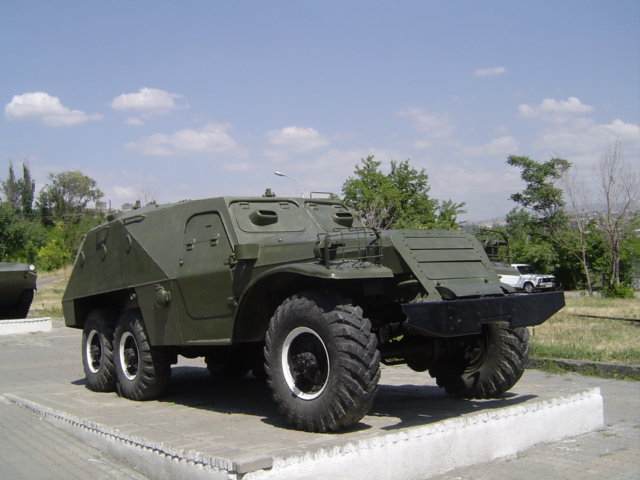
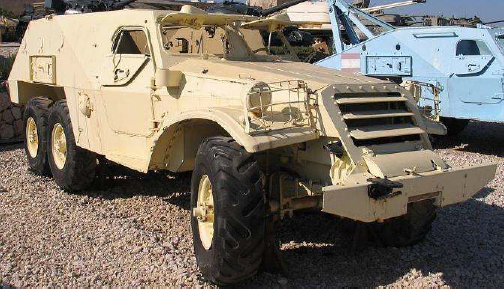
Hezbollah Proliferation. The BTR-152 (also known as BTR-140) was a six-wheeled Soviet armored personnel carrier built on the chassis and drive train of a ZiS-151 utility truck. It entered service with a number of Warsaw Pact member states beginning in 1950 and formed the mainstay of Soviet motor rifle battalions until the advent of the amphibious BTR-60 series during the 1960s. BTR-152s were available in several marks and were manufactured in large numbers for the Soviet military and export. Late production models utilized automotive components from the more reliable ZIL-157 truck. Three primary variants of the BTR-152 appeared between 1950 and 1959: the base armored personnel carrier with a single pintle-mounted 7.62mm or 12.7mm machine gun, an unarmed command vehicle with a higher roofline, and an anti-aircraft variant armed with a ZPU-2 mount. BTR-152s could carry a single infantry squad each, or specialist weapons teams along with their mortars and anti-tank equipment. In Soviet service, a number were also deployed as artillery tractors. The BTR-152 is a modified truck chassis with an armored hull and an open-topped troop compartment. The sides and rear of the troop compartment are vertical, with corners sloping inwards to deflect shell fragments. There are firing ports on each side of the troop compartment and two rear doors for rapid debarking. Infantrymen can fire their individual weapons from the relative protection of the vehicle, and exit through these doors or by jumping over the sides. The crew consists of a driver and a single passenger, who operates the radios. Two types of seating arrangements were available: the first consisted of wooden benches on either side of the troop compartment facing inwards; the second consisted of three rows of seats facing forward. Both the driver and the radio operator seated to his right are provided with individual windscreens and when in combat, these are covered by twin armored shutters with integral vision blocks. Crew members exit the vehicle through side doors, the tops of which are hinged and folded down for observation purposes. The BTR-152's armor plate is fabricated of welded steel and ranges from 4 mm (0.16 in) to 13.5 mm (0.53 in) in thickness. This protects the crew and passengers from small arms fire, shell fragments, grenades, and anti-personnel mines, but is ineffective against larger shell fragments or even heavy machine gun fire. Late production hulls may have been manufactured from steel plates with a thickness of up to 15 mm (0.59 in). The vehicle is sometimes fitted with a winch that has a maximum capacity of 5 tonnes and a 70m cable. Depending on the variant, BTR-152s can tow field artillery, transport 1.9 tonnes of cargo, or carry a half platoon of infantry. Most Soviet BTR-152s were powered by a six-cylinder ZiL-123 in-line water-cooled petrol engine developing 110 hp at 2,900 rpm. Those based on the chassis and components of the ZiL-157 utility truck utilized a slightly different ZiL-137K engine. There are several engine louvers on the front of the hull to prevent overheating; these could be safely closed for short intervals during combat, as long as the driver reduced speed and avoided overtaxing the vehicle. A BTR-152's gearbox comprised five forward gears and one reverse gear with a two-speed transfer box. Fifth gear had an overdrive. The suspension consisted of conventional leaf springs with hydraulic shock absorbers. In the late 1950s, a little over 200 BTR-152s were produced with enclosed hulls, as opposed to the traditionally open-topped design; these were designated BTR-152K and BTR-152K1. They were also known unofficially as "BTR-152 Model D" or "BTR-152 M1961" by some Warsaw Pact armies. The enclosed hull reduced situational awareness but allowed for the installation of central heating and an NBC overpressure system. Two hatches opening to the right were installed on the new roofline. The BTR-152 was originally armed with a single pintle-mounted 7.62mm SG-43 Goryunov (SGMB) medium machine gun, fed by 1,250 rounds of stored onboard ammunition. This was mounted behind the driving position. Additional 7.62mm general-purpose machine guns could be mounted on either side of the hull top as needed. The SGMB machine gun could traverse 45 degrees and elevate between -6 and +24 degrees. Some of the BTRs were fitted with single 12.7mm DShK or 14.5mm KPV heavy machine guns in place of the SGMB. Vehicles designated BTR-152A were ground support vehicles with limited air defense capability. BTR-152As carried twin KPVs in a ZPU-2 anti-aircraft mount. Variations included an Egyptian model with a Czechoslovak M53 Quad mounting for four DShKs, which were normally towed on a two-wheeled trailer, and some modified by the Palestine Liberation Organization to accept 23mm ZU-23-2 anti-aircraft guns. Because the original BTR-152 utilized the chassis and engine of the ZiS-151, it shared that truck's maintenance problems and poor cross-country mobility. Later variants, using ZiL-157 components, had more power and larger, single tires that reduced the vehicle's shortcomings but did not entirely eliminate them. Serviceability and reliability remained low.