ARMSNET
Military Equipment Database
Initializing 0%

Type 055 Class (Renhai Class) Chinese Guided Missile Cruiser

Type 055 Class (NATO/OSD Renhai Class
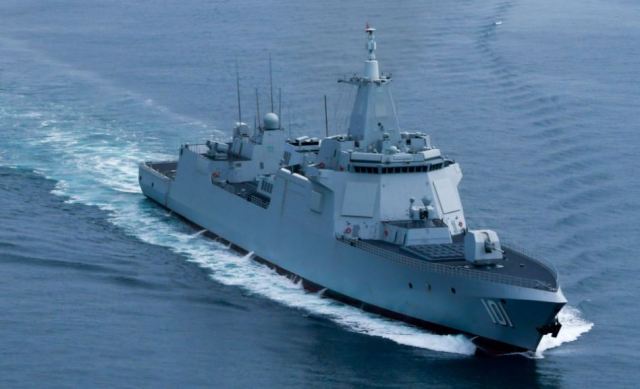
Guided Missile Cruiser
Spotted an error? Sign in to suggest an edit.
Basic Information
Name
Type 055 Class (Renhai Class) Chinese Guided Missile Cruiser
Designation
Type 055 Class (NATO/OSD Renhai Class
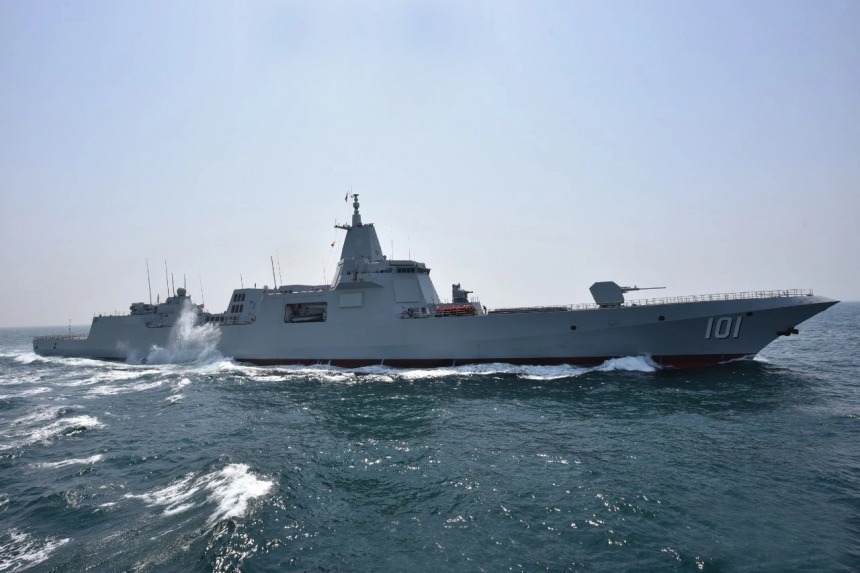
Alternate Designation
Type 055 Class (NATO/OSD Renhai Class
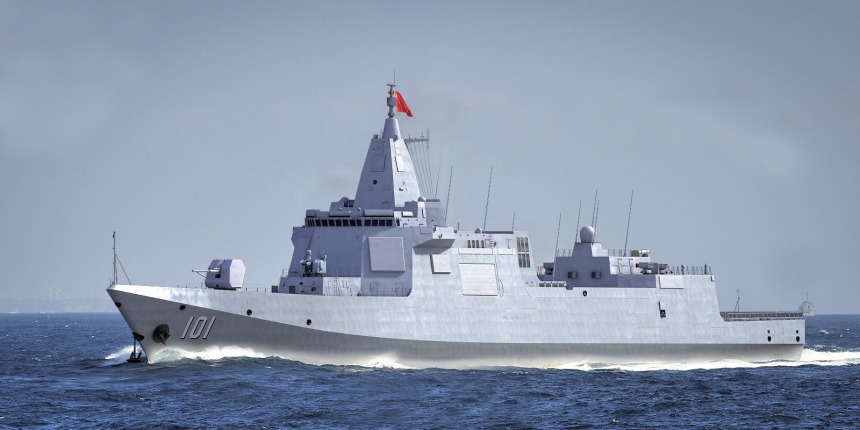
Equipment Type
Guided Missile Cruiser
Manufacturer
Changxingdao-Jiangnan Shipyard, Dalian Shipbuilding Industry Company
Date of Introduction
2019
Description

The Type 055 Class destroyer (NATO/OSD Renhai Class cruiser) is a class of stealth-guided missile destroyers being constructed for the Chinese People's Liberation Army Navy Surface Force. It is a multi-mission design; the combination of sensors and weapons suggests the main role of area air defense, with anti-submarine warfare capabilities surpassing previous Chinese surface combatants. Type 055 is expected to undertake expeditionary missions and form the primary escort for Chinese aircraft carriers. The United States classifies these ships like cruisers. The United States Navy defines a cruiser as a large multi-mission surface combatant with flag facilities; this suggests the U.S. expects the Type 055 to fulfill a similar role as the Ticonderoga-class cruiser. The People's Liberation Army Navy was interested in a large destroyer from at least the late-1960s. A development program, code-named "055", initiated in 1976 was canceled in 1983 after encountering insurmountable technical obstacles from industrial underdevelopment; for example, the required gas turbine power plants could neither be produced domestically nor imported at acceptable prices. In April 2014, an image emerged of a full-scale mock-up of the Type 055 superstructure - with an enclosed integrated mast for radar and other electronics - at the Chinese naval electronic testing range in Wuhan. Nanchang, the first ship of the class, began construction in 2014 at the Jiangnan Shipyard in Shanghai and was commissioned on 12 January 2020. Its first public appearance - preceding commissioning - was during the PLAN's 70th-anniversary parade on 23 April 2019. When launched, Nanchang was among the largest post-Second World War warships launched in East Asia. Type 055 adopts a conventional flared hull with distinctive stealthy features including an enclosed bulbous bow that hides mooring points, anchor chains, and other equipment. The bow and main deckhouse are configured similarly to previous Type 052C/D destroyers. A continuous structure amidship increases internal volume and reduces radar cross-section. The smokestack design reduces both infrared signature and radar cross-section. Chinese sources credit the design as being generally stealthy, with reduced radar, noise, infrared, and electromagnetic radiation signatures. Power plants Propulsive power is generated by four 28 MW QC-280 gas turbines in combined gas and gas arrangements. Additional power may be provided by six 5 MW QD-50 gas turbines. The maximum speed is estimated to be 30 knots. Electronics Type 055's battle management system may allow integration with carrier strike groups. The integrated mast may mount X band radar in four fixed active electronically scanned arrays (AESA). The deckhouse may mount four Type 346B AESA panels; the previous Type 346 was a dual S and C band radar, but the Type 346B may only be S-band as an X-band radar is included. The X band radar may be mounted higher as it is better suited for horizon search and low altitude object detection. The Type 346B arrays can be larger and have higher power when mounted on the deckhouse below the X band radar. Various electronic warfare support measures (ESM), electronic countermeasures (ECM), and electro-optic (EO) sensors and datalinks are mounted. They are likely more advanced than those deployed on previous ships. A deployment port exists for variable depth and towed array sonar. The large bulbous bow likely contains a bow sonar; the Type 055 may mount a larger bow sonar than previous Chinese surface combatants. Armament The primary armament is missiles carried in 112 universal vertical launch cells (VLS); 64 cells forward and 48 cells aft. The same VLS model is used on the Type 052D destroyer, which is believed to be an implementation of the GJB 5860-2006 standard. The longest variant, with 9-meter cells, is likely used. Type 055 is expected to carry HHQ-9 surface-to-air missiles, YJ-18 anti-ship cruise missiles, CJ-10 land-attack cruise missiles, and missile-launched anti-submarine torpedoes upon entering service. Future developments It has been suggested that future variants may be armed with lasers or electromagnetic railguns. Since the current design does not have integrated electric propulsion, installation of integrated electric propulsion will be required for the ship to meet power requirements in the future. The universal VLS makes it possible to carry future anti-ballistic missiles (ABM).

Naval & Littoral Specifications
Crew 280
Beam 20.00 m
Variants
Nanchang Commissioned: 2020 Status: Active Fleet: North Sea Fleet
Lhasa Commissioned: 2021 Status: Active Fleet: North Sea Fleet
Dalian Commissioned: 2021 Status: Active Fleet: INA
System
Alternative Designation Type 055 Class (NATO/OSD Renhai Class
Type Guided Missile Cruiser
Builders Changxingdao-Jiangnan Shipyard Dalian Shipbuilding Industry Company
Total Built 1 ship built as of 2021, 6 in total scheduled to be built.
Crew 280 - 300 men
Dimensions
Length 180 m
Beam 20 m
Draught 6.6 m
Displacement, Standard INA
Displacement, Full Load 12 000 - 13 000 tons
Propulsion System
Engine Name COGAG propulsion system with 4 QC-280 gas turbines (28 MW each) and 6 QD-50 gas turbines (5 MW each)
Engine Power Total: 112 MW (150,000 shp
Maximum Range 5,000 nmi (9,300 km)
Maximum Speed 30 knots (56 km/h; 35 mph)
Endurance INA
Weapons Station #1
System
Name H/PJ-38 130mm Naval Gun
Type Naval Gun
Quantity 1 X H/PJ-38 130mm Naval Gun
Caliber 30 mm
Note Designed by the Zhengzhou Mechanical-Electrical Engineering Research Institute (郑州机电工程研究所, also known as the 713th Research Institute of the 7th Academy) and manufactured by Inner Mongolia 2nd Machinery Manufacturing Factory (内蒙第二机械制造厂), the H/PJ-38 130 mm naval gun was developed from reverse engineering of Soviet AK-130 twin 130 mm naval gun, which was carried out by the same two establishments. The general designer of the H/PJ-38, Chen Dingfeng (陈汀峰), was also the general designer of all models of Type 79 100 mm naval gun, all models of Type 210 100 mm naval gun, and the H/PJ26 76 mm naval gun. Chen was recalled from retirement to complete the H/PJ-38 single barrel 130 mm naval gun. When the Soviet AK-130 was first successfully copied by Chinese developers, the Chinese navy was unsatisfied and decided not to let the AK-130 into production, despite all performance parameters being met. Because the AK-130 was judged out-of-date by the Chinese Navy, the H/PJ-38 program was created in 2005. The H/PJ-38 130 mm single barrel naval gun is considered more powerful and more reliable than other smaller caliber naval guns currently in Chinese service, and as with naval guns on most warships, it is installed in front of the VLS.
Ammunition
Type Rifle
Caliber 130 mm
Note The general designer of munitions for the H/PJ-38, Zhou Bingwu, entered the business in 1997 and almost lost the index finger of his right hand in November 2007 during an important trial. As early as 1987, Zhou had proposed multiple kinds of precision-guided munitions (PGMs) to be fired by a single caliber gun mount, but due to the limitations of the Chinese technological base and industrial capability, it was not until two decades later when it finally became a reality. Research led to the development of a single barreled 70 caliber, 130 mm system which took more than four years to complete, and the H/PJ-38 went to series production soon after completion. The primary improvement of the H/PJ-38 over the AK-130 is its adaptability: H/PJ-38 can fire both separate loading rounds and semi-fixed rounds, which is crucial in firing gun-launched missiles and PGMs. The H/PJ-38 can also fire a variety of sub-caliber rounds, but more importantly, a variety of PGMs were developed for H/PJ-38 to increase its effectiveness.
Weapon Station #2
System
Name H/PJ-11 CIWS (forward)
Type Gatling Gun
Caliber 30 mm
Quanitity 1 × H/PJ-11 CIWS
Crew Automated, with human oversight
Rate of Fire 1,200-4,200 rounds/minute (Type 730)
Effective Firing Range 1–1.5 km
Maximum Firing Range 3 km
Feed System Type 730: One ammunition boxes, holding 640 rounds
Guidance System TR47C J-band radar OFC-3 electro-optical fire control system.
Ammunition
Type Rifle
Caliber 30 mm
Basic Load INA
Weapon Station #3
Name HHQ-10 Short-Range SAM
Type Short-Range SAM
Quantity 1 × HHQ-10 short-range SAM in 24-cell launcher (aft)
Missile HHQ-10 (Red Flag 10) Surface-to-Air Missile
Length 2 m
Diameter 0.12 m
Maximum Range 9 km for subsonic targets, > 6 km for supersonic targets.
Minimum Range Less than 500 m
Guidance System RF + ImIR or ImIR only
Weapon Station #4
Name 112 VLS
Type Vertical Launch System
Missile Types * HHQ-9 surface-to-air missiles; * YJ-18 anti-ship cruise missiles; * CJ-10 land-attack cruise missiles; * Missile-launched anti-submarine torpedoes
Maximum Range INA
Minimum Range INA
Onboard Aviation Facilities
Helicopters 2 × Changhe Z-18F ASW helicopters.
Facilities Stern hangar for up to two medium-lift helicopters and 1 x Helicopter landing platform.
Sensors and Processing Systems
Radar H/LJG-346B Active Phased Radar System (C/S-band) coordinated by X-band Horizon-Search&Track Active Phased Radar System (Dual-band radar).
Protection
Active Protection System Yes
Electronic Warfare Electronic Warfare Support System Decoy Launching System.
NBC Protection Yes
Image Sources
Notes .;
Details
Country of Origin China
Category Naval
Naval
Filter Label
T
Classification
Domain
Naval & Littoral
Equipment Status
Active
Dimensions
Length
180 m
Width
20 m
Height
Weight
12500000 kg
Operators (1)
China
Something went wrong. Please reload the page. Reload