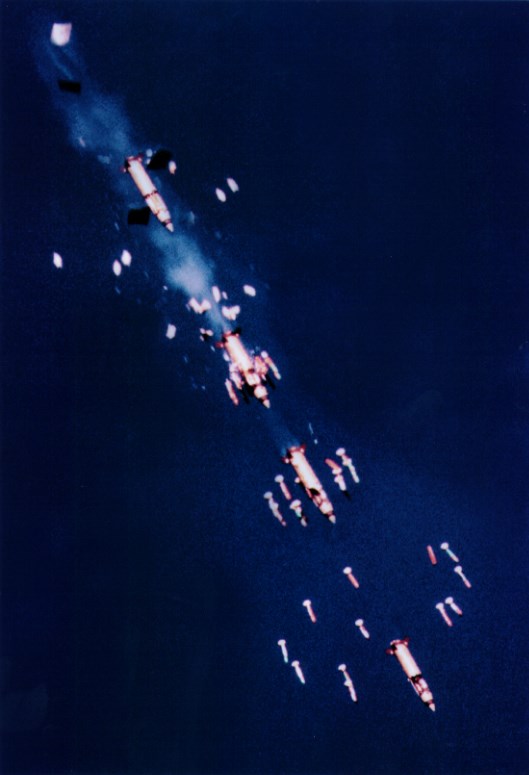
GBU-44/B Viper Strike
GBU-44/B Viper Strike
The baseline BAT submunition uses passive infrared and acoustic sensors to find, attack and destroy moving tanks and armored vehicles deep in enemy territory. The BAT is an autonomous weapon capable of detecting, tracking, attack and destroy moving targets through its seekers. It can operate under adverse weather conditions day and night. The BAT is in fact an unpowered aerodynamically stable glider. The Viper Strike is a very special derivative of the BAT munition intended for engagements against targets inside built up areas. It features a semi-active laser seeker. The Viper Strike must be aimed at the target by someone operating a laser designator. The job can be done by ground troops or by an aircraft. The US Army wants to release the Viper Strike munitions through the Hunter UAV. The Hunter UAV would also act as the target designator in the absence of ground forces. In June 2005, Northrop-Grumman released the Viper Strike precision munition was undergoing modifications to improve its midcourse guidance using a Global Position System (GPS) receiver in addition to its semi-active laser guidance. This move was aimed at enabling Viper Strike launch from higher altitudes which would translate into a greater standoff range than the baseline laser-guided Viper Strike munition. On 24 August 2005, Northrop-Grumman announced that it was under contract awarded by the US Special Operations Command to develop Viper Strike as a stand-off precision-guided munition on the AC-130 Gunship. The contract was expected to conclude by December 2006 and included the development of a two-way data link to allow communications between Viper Strike and the launch aircraft. In December 2011, MBDA purchased Northrop-Grumman's Viper Strike Munitions Business in Huntsville, Alabama.
deagel.com: https://www.deagel.com/x/x/a001163