J-11 (Flanker-L) Chinese Air Superiority Fighter
J-11
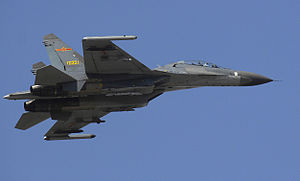
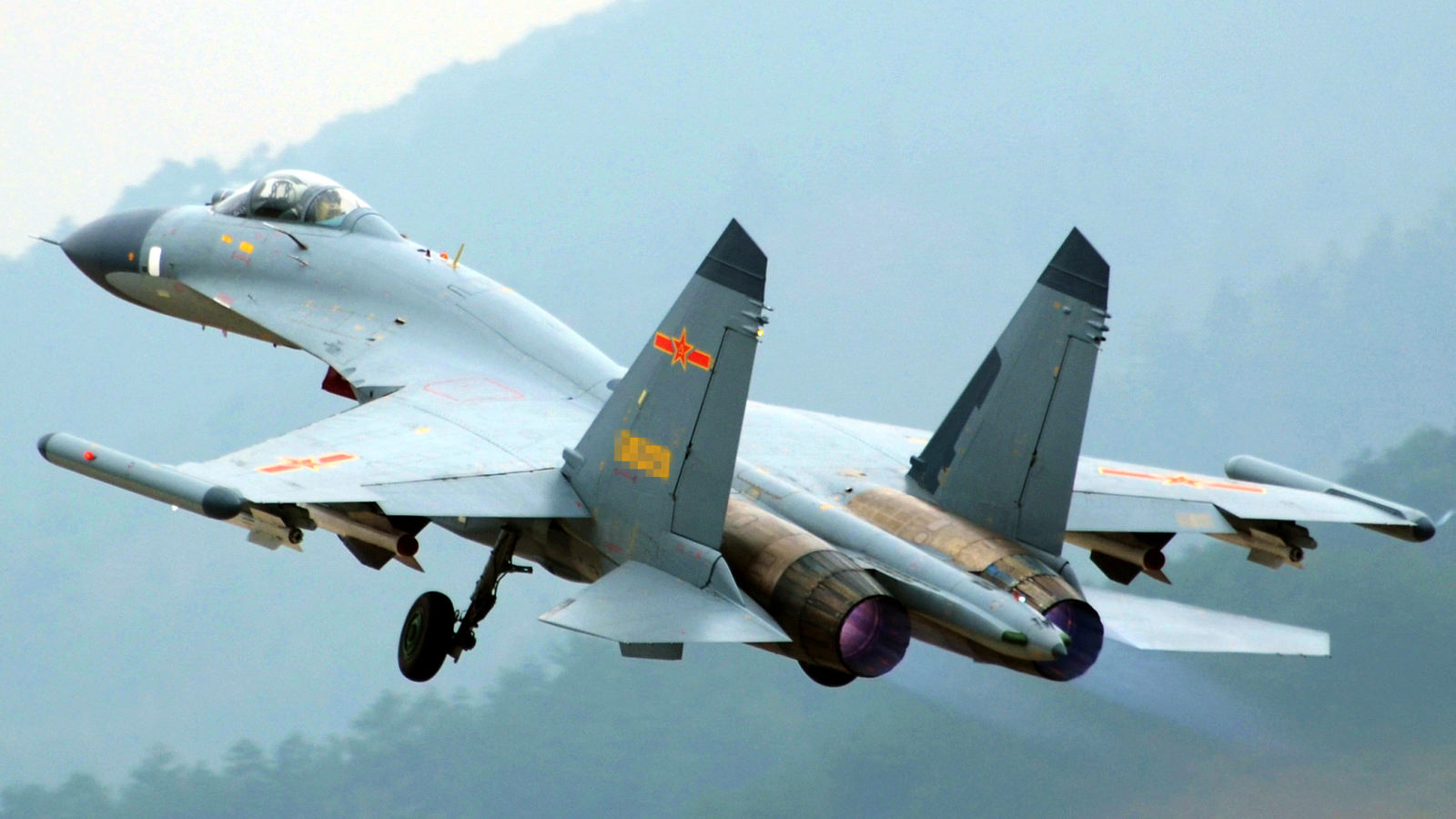
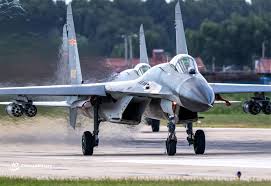
The J-11 was finally born in 1998 as a Chinese version of the Soviet-designed Sukhoi Su-27SK air superiority fighter after China secured a $US2.5 billion production agreement which licensed China to build 200 Su-27SK aircraft using Russian-supplied kits. Under the terms of the agreement, these aircraft would be outfitted with Russian avionics, radars and engines. However, in 2004, Russian media reported that Shenyang co-production of the basic J-11 was halted after around 100 examples were built. The PLAAF later revealed a mock-up of an upgraded multi-role version of the J-11 in mid-2002. The indigenous J-11B variant incorporates various Chinese material modifications and upgrades to the airframe with improved manufacturing methods in addition to the inclusion of domestic Chinese technologies such as radar, avionics suites and weaponry, including anti-ship and PL-12 air-to-air missiles presumably for the role of a maritime strike aircraft. The alleged reason for the sudden stop in the production line of the J-11 was because it could no longer satisfy the PLAAF's requirements, due to elements such as the obsolete avionics and radar, which were structured for aerial missions. The J-11/J-11B's legitimacy remains unproven, despite a wealth of information coming to light since 2007. In the course of a press conference at the 2009 Farnborough Airshow, Alexander Fomin, Deputy Director of Russia's Federal Service for Military-Technical Co-operation, reported that Russia had not so far tabled any questions to China with regard to "copying" military equipment. Fomin reported that Russia handed China the licences to manufacture the aircraft and its components, including an agreement on the production of intellectual property rights. Details of intellectual property rights, however have not been disclosed, fuelling speculation about a "secret" contract or parts of the original contract. The licence, at least officially, did not include an aircraft carrier version- Sukhoi Su-33 nor any variant of it, such as the Shenyang J-15. At the MAKS 2009, Rosoboron export's General Manager Anatoli Isaykin was quoted saying: "Russia is going to investigate the J-11B, as a Chinese copy of the Su-27 and Sukhoi Company is partaking in the process." In 2010, Rosoboronexport announced via their official website that it was in talks with the Chinese side, regarding the ongoing production of weapons that Russia considers as unlicensed. In light of the ongoing investigations, Rosoboronexport expressed its concern over future sales of advanced Russian systems and components to China. At the Zhuhai 2002 airshow, a photo was released allegedly depicting a J-11 modified for flight testing of a single WS-10 Taihang turbofan. Andrei Chang, a military specialist on China reported that one J-11A was outfitted with the indigenously produced WS-10A turbofan engine, J-11B also uses WS-10A. However, Russian media reports also indicate that China still intends to upgrade the current J-11 fleet's engines with either Saturn-Lyulka or Salyut powerplants. Engines under consideration include the Saturn AL-31-117S (a development of the Lyulka AL-31F planned for the Russo-Indian Su-30MKIs), and the Salyut AL-31F-M1, an improved variant of the AL-31F engine. In 2002, Russian media reported that Shenyang Aircraft Corporation was looking into replacing Russian-made J-11/Su-27SK components with domestic, Chinese-made parts. Specifically, to replace the Russian-made NIIP N001 radar with a Chinese-made fire control radar based on the Type 147X/KLJ-X family, the AL-31F engine with WS-10A, and Russian R-77 AAM's with Chinese-made PL-9 and PL-12 AAM's. One J-11 was photographed with an AL-31F and a WS-10A engine installed for testing in 2002. However, it was not until 2007 when the Chinese government finally revealed information on the domestic J-11: the J-11 used to test WS-10 was designated as J-11WS, and it was when state television station CCTV-7 aired J-11B footages in mid-2007 when the existence of J-11 with domestic components was finally confirmed officially. Serial manufacturing of the WS-10 and integration with the J-11, proved to be more difficult than expected. As a result, even though several related prototypes had been tested and at least one regiment converted to the Taihang powered J-11B version in 2007, these aircraft were later grounded for an extended period due to a poor operational reliability. A report in the Washington Times suggested that the Chinese engines lasted 30 hours before they needed servicing, compared to 400 hours for the Russian versions. Defects were traced back to the engine manufacturer, Shenyang Liming Aircraft Engine Company employing sub-standard manufacturing and quality control procedures. Several subsequent batches temporarily reverted to the original, Russian AL-31F turbofans. The engines manufacturing problems had finally been solved by the end of 2009 and the WS-10A had reportedly proved mature enough to power the Block 02 aircraft.