Husky 2G South African 4x4 Vehicle-Mounted Mine Detection (VMMD)
Husky 2G


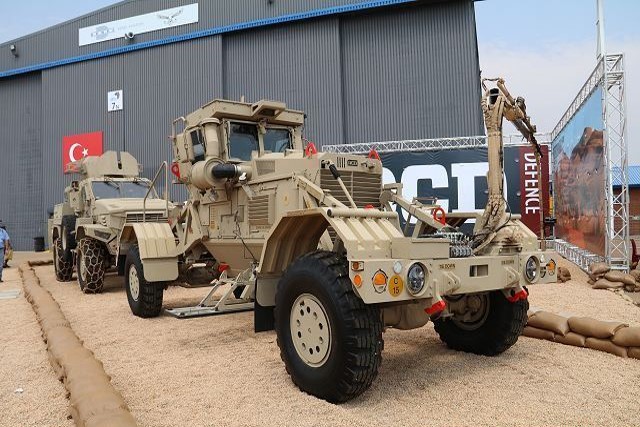
This variant has an enlarged driver's cab that can accommodate two people. The driver focuses on maneuvering the vehicle and spotting IEDs visually, while the commander handles the sensors. The driver's workload is reduced two ways. First, several functions are transferred to the commander, who oversees both the ground-penetrating radar as well as the sensor systems. In addition to vision system upgrades, the driver can use a back-up camera. The Husky 2G features the FASCAN interrogation arm, which is used to investigate suspected mines and roadside bombs. The upgraded system has additional power to operate additional sensors and enhancements, such as the NIITEK ground-penetrating radar. It is also equipped with the TORC Robotics 360 situational awareness camera system and the QinetiQ North America QNET system, which provides lightweight protection against rocket-propelled grenades. Active self-defense is available from the Common Remotely Operated Weapon Station (CROWS), which is handled by the commander from within the cab. In addition to the machine gun, the CROWS includes a large 15-inch (381-mm) color monitor that shows live video from the turret's cameras in the daytime and a second-generation forward-looking infrared (FLIR) camera at night. The commander can operate the cameras and a built-in laser rangefinder without having to use the gun. The Husky VMMD (vehicle-mounted mine detection) family of vehicles are blast-survivable, mission-configurable wheeled platforms employed around the world by specialized route clearance teams operating in high-explosive threat areas. Defined by their unique design characteristics of survivability, frangibility, and reparability, Husky vehicles enable personnel and payloads to safely operate in close proximity to sub-surface explosive hazards. The Husky is manufactured in South Africa by DCD Protected Mobility and then integrated with clearance payloads, provided, and supported by U.S.-based C-IED solutions company, Critical Solutions International. The current iteration of the Husky is part of a class of MRAP vehicles developed from a South African blast protection design. The basic v-hull concept of modern MRAP vehicles, and the Husky, was an architectural innovation that fundamentally recast the nature of the vehicle’s resistance to explosive threats. As clearance techniques matured along with emerging technologies in order to respond to evolving threats, the unique tenants of the Husky design have endured. Survivability: The sharp V-hull of the Husky dramatically reduces blast effect by increasing ground clearance and standoff from the blast, increasing structural hull rigidity, and diverting blast energy and fragmentation away from the platform and its occupants. Frangibility: With three main components (a center cab with front and rear wheel modules) connected by sheering pins, the Husky is designed to break apart in a blast event, allowing energy to transfer to the detachable front and rear modules rather than transferring stress to the critical components of the vehicle or the occupants located in the cab. Repairability: Critical components have been engineered to break apart in a predictable fashion, preventing catastrophic damage and enabling users to quickly replace modules on site. This approach increases the lifespan of the vehicle, maintains mission readiness, and limits the need for recovery teams to evacuate the vehicle to intermediate- or depot-level maintenance facilities. The Husky VMMD Mk III and 2G are powered by a Mercedes Benz OM 906 LA 6.4L six-cylinder turbo diesel engine coupled with an Allison 2500 SP 5-speed automatic transmission. The operating weight of vehicle is 8,350kg, and the Husky can reach a maximum speed of 72km/h and has a range of 400km or 200km when equipped with mine-detonation trailer (MDT). The cabin of the Husky is fitted with bullet-proof glass windows and an entry hatch on the roof. The Husky’s versatility for application in dynamic clearance missions comes from both the vehicle design and the modularity provided by easy integration of tailored payloads.