Zubr Class (Project 1232.2 Class) Russian Landing Craft Air-Cushion (LCAC)
Zubr Class
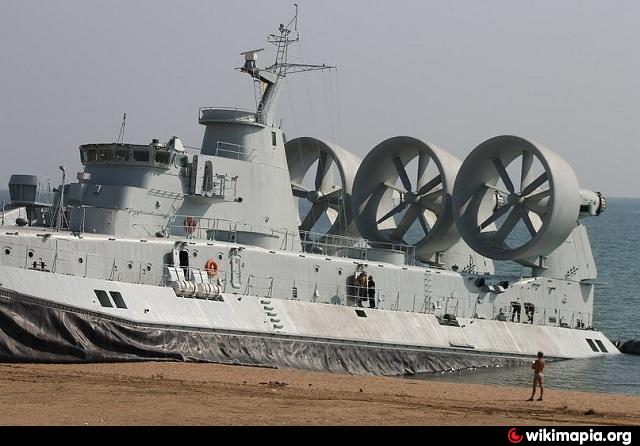
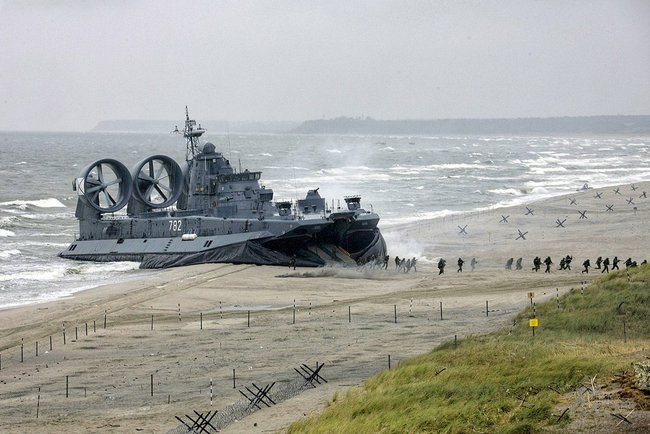
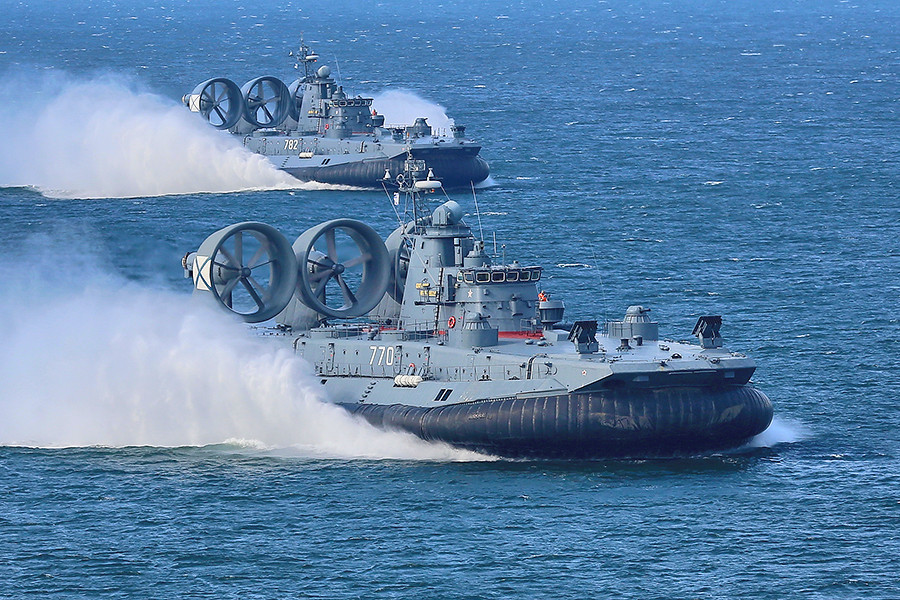
The Zubr class (Project 1232.2, NATO reporting name "Pomornik") is a class of Soviet-designed air-cushioned landing craft (LCAC). This class of military hovercraft is, as of 2012, the world's largest, with a standard full load displacement of 555 tons. The hovercraft was designed to sealift amphibious assault units (such as marines and tanks) from equipped/non-equipped vessels to non-equipped shores, as well as to transport and plant naval mines. Ten Zubr-class hovercraft remain in service. There are two vessels in the Russian Navy and four in the Hellenic Navy. In 2009 China placed an order for four vessels from Ukraine as part of a deal worth 315 million USD. Two updated versions of the vessels were built by Crimea's Feodosia Shipbuilding Company, followed by two advanced models of the surface warship. The purchase of HS Cephalonia (L 180) for the Hellenic Navy marked the first time a Soviet-designed naval craft had been built for a NATO member. In June 2017 Russia announced the restarting of production of Zubr-class craft. Representatives from the Russian shipbuilding industry soon after responded by stating production could not possibly resume in 2018 and would only be possible by 2019–2021, refuting the government's position. Representatives cited the lack of availability and inability to mass-produce components, notably gas-turbine engines and reduction gears as the main obstacles. NPO Saturn (ODK GT) and Turboros developed marine gas turbine engines M70FRU (D090), FR RU, M70FRU2 (DP/DM71) along M90FR, M75RU, E70RD8, and Elektrosila, AO Zvezda, Metallist, Samara, and others developed redactors and gears. High strength and buoyancy are provided by a rectangular pontoon, the main load-carrying part of the ship's hull. The superstructure built on the pontoon is divided into three compartments with two longitudinal bulkheads: combat material compartment in the midsection fitted with tank ramps, and outboard sections housing main and auxiliary propulsion units, troop compartments, living quarters, and NBC protection systems. To improve working conditions in the battle stations, troop compartments and living quarters are fitted with air-conditioning and heating systems, sound/heat-insulating coatings, and structures made of vibration damping materials. The ship provides normal conditions for the crew to make meals and rest. Personnel is protected against the effects of weapons of mass destruction by airtight sealing of combat stations, crew and troop compartments, augmented with individual gas masks and protective suits. The ship is also protected from magnetic influence mines with an active system to compensate for the magnetic fields generated by the ship and transported materials. The central command post and MS-227 device compartments are strengthened with alloy armor.