F-4E Phantom II American Interceptor Aircraft
F-4E


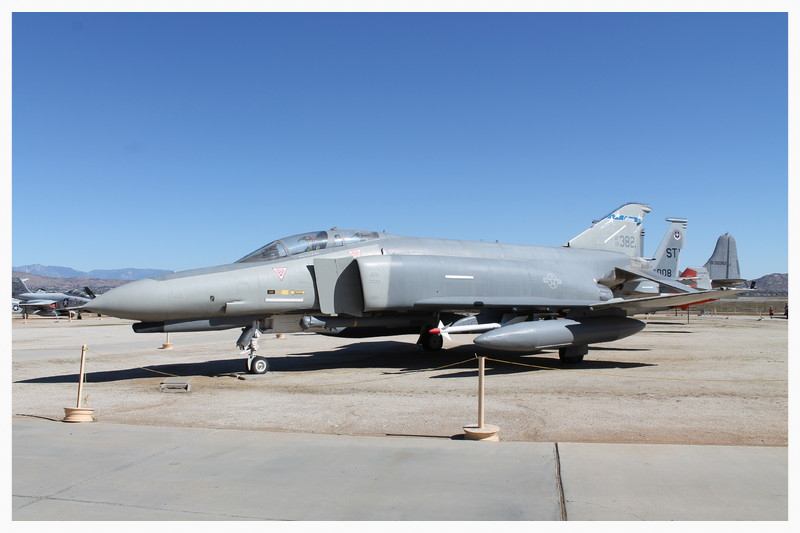
The McDonnell Douglas F-4 Phantom II is a tandem two-seat, twin-engine, all-weather, long-range supersonic jet interceptor and fighter bomber originally developed for the United States Navy by McDonnell Aircraft. It first entered service in 1961 with the Navy. Proving highly adaptable, it was also adopted by the United States Marine Corps and the United States Air Force, and by the mid-1960s had become a major part of their air arms. The Phantom is a large fighter with a top speed of over Mach 2.2. It can carry more than 18,000 pounds (8,400 kg) of weapons on nine external hardpoints, including air-to-air missiles, air-to-ground missiles, and various bombs. The F-4, like other interceptors of its time, was initially designed without an internal cannon. Later models incorporated an M61 Vulcan rotary cannon. Beginning in 1959, it set 15 world records for in-flight performance, including an absolute speed record and an absolute altitude record. The F-4 was a two-seat, twin-engine tactical fighter designed to cover the entire tactical mission – close air support, interdiction, and air superiority. Originally developed in 1953 by McDonnell Aircraft Corp. for the U.S. Navy, the aircraft was delivered modified to Air Force requirements in 1963. The first F-4E was delivered to the Air Force in October 1967. This model, with an additional fuselage fuel tank, leading-edge slats for increased maneuverability, and an improved engine, also has an internally mounted 20mm multi-barrel gun with an improved fire-control system. The F-4E, which was equipped with leading-edge maneuvering slats and weapons and radar controls that were optimized for dogfighting, vastly improved the Phantom's air-to-air capabilities. The F-4E changes in avionics, new wings (more forgiving in stalls and spins caused by harsh maneuvers with heavy bomb loads), and the addition of the M61 20mm cannon remained the basic airframe for the follow-on version in the Phantom production. The F-4E was flown by the U.S. Air Force Demonstration Team, the Thunderbirds, from 1969 through 1974. The large and noisy Phantom was an excellent aircraft that performed and thrilled crowds all over the world. Due to the fuel shortage in the 70s, the Thunderbirds traded the fabulous Phantom for the smaller T-38 Talon. The museum F-4E, serial number 68-0382, was delivered in 1969 and assigned to the 36th Tactical Fighter Wing, then the 86th TFW, the 347th TFW, and finally was last flown here at March AFB by the 163rd Tactical Fighter Group, California Air National Guard. Retired in 1993 due to structural damage to the right engine nacelle with over 5,000 flying, hours, the plane is substantially intact, including avionics, ejection seats, and engines, and was towed to the museum area. This aircraft is on loan from the NMUSAF The F-4 was used extensively during the Vietnam War. It served as the principal air superiority fighter for the U.S. Air Force, Navy, and Marine Corps and became important in the ground attack and aerial reconnaissance roles late in the war. During the Vietnam War, one U.S. Air Force pilot, two weapon systems officers (WSOs), one U.S. Navy pilot, and one radar intercept officer (RIO) became aces by achieving five aerial kills against enemy fighter aircraft.[8] The F-4 continued to form a major part of U.S. military airpower throughout the 1970s and 1980s, being gradually replaced by more modern aircraft such as the F-15 Eagle and F-16 Fighting Falcon in the U.S. Air Force, the F-14 Tomcat in the U.S. Navy, and the F/A-18 Hornet in the U.S. Navy and U.S. Marine Corps. The F-4 Phantom II remained in use by the U.S. in the reconnaissance and Wild Weasel (Suppression of Enemy Air Defenses) roles in the 1991 Gulf War, finally leaving service in 1996. It was also the only aircraft used by both U.S. flight demonstration teams: the United States Air Force Thunderbirds (F-4E) and the United States Navy Blue Angels (F-4J). The F-4 was also operated by the armed forces of 11 other nations. Israeli Phantoms saw extensive combat in several Arab–Israeli conflicts, while Iran used its large fleet of Phantoms, acquired before the fall of the Shah, in the Iran–Iraq War. Phantom production ran from 1958 to 1981, with a total of 5,195 built, making it the most-produced American supersonic military aircraft. As of 2020, 62 years after its first flight, the F-4 remains in service with Iran, Japan, South Korea, Greece, and Turkey. The aircraft has most recently been in service against the Islamic State group in the Middle East.