K-16 Bumerang Russian 8x8 Amphibious Armored Personnel Carrier (APC)
Boomerang, VPK-7829 Bumerang
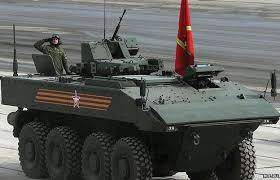
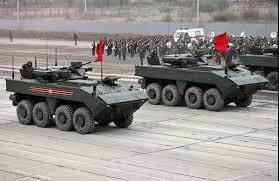
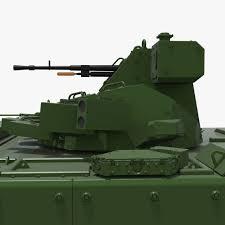
In the early 1990s, the BTR-90 was developed as a replacement for the BTR-80 in the Russian Army. While it was a moderate improvement in armament, protection, mobility, and internal space over its predecessor, it all came at the cost of greatly increased unit price. It wasn't accepted into service (except in small numbers) as the modest increase in performance wasn't seen as enough justification for its cost and complexity. Purchases of the BTR-80 stopped in 2010 and the improved BTR-82 was obtained as a stop-gap measure. In mid-2011, the Russian Ministry of Defense issued a requirement for a new modular wheeled family of armored vehicles instead of buying the BTR-90. Development of a new wheeled APC is being done alongside the new and similarly armed and armored but tracked Kurganets-25 infantry fighting vehicle, the Kurganets-25 armored personnel carrier, and heavy T-15 Armata IFV. The Boomerang vehicle is based on Armata Universal Combat Platform. It is amphibious and is able to negotiate and overcome water obstacles using two waterjets. In a departure with the previous BTR (Like BTR-70) series of vehicles, the engine will be located in the front instead of the rear. Engine location was a significant drawback of BTR vehicles, where soldiers had to exit the vehicles through cramped side doors. The Boomerang has rear doors and roof hatches for troop entry and exit. It has a crew of three consisting of the driver, gunner, and commander and holds eight troops. Protection comes from ceramic armor and technologies to prevent shell splinters. Like BTRs, the Boomerang is an 8×8 wheeled vehicle, and is equipped with a 750 hp turbocharged diesel engine. Several components and subsystems will be interchangeable between the Boomerang and Kurganets-25 APC, and it is hoped that both vehicles will be powered by the same engine though that is not the case to date. The K-16 Boomerang armored personnel carrier (APC), is lightly armed with a remote controlled turret and a 12.7mm heavy machine gun. In November 2011, media reports said the new project had been approved. In February 2012, a high ranking Russian general officer said that the Russian Army would be taking the first deliveries of the Boomerang prototype in 2013. Large-scale deliveries were to begun in 2015. At least 2,000 Boomerang vehicles are to replace the BTR-80 and BTR-82/A in Russian service.