P-35/P-37 (Bar Lock) Russian towed Two-Dimensional Target Acquisition and Ground Control Intercept (GCI) Radar
P-35/P-37
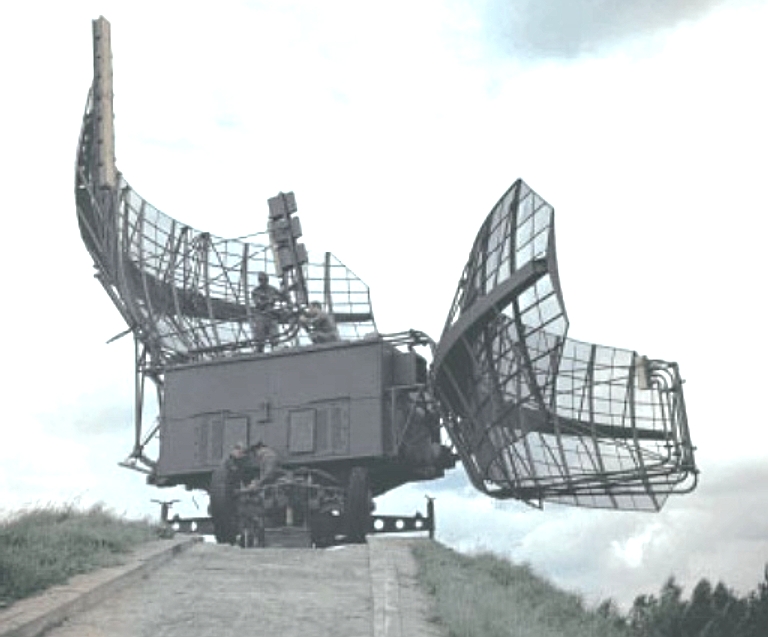
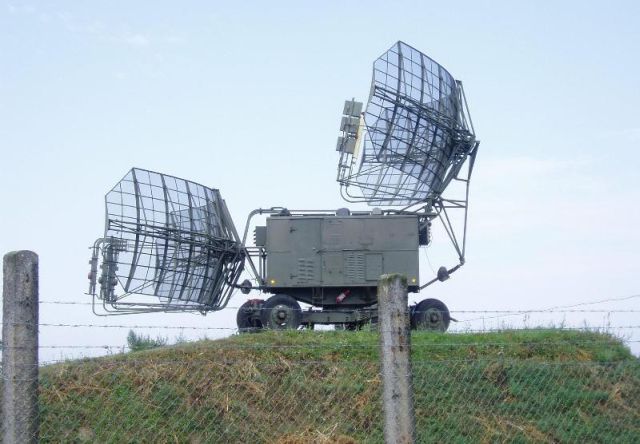
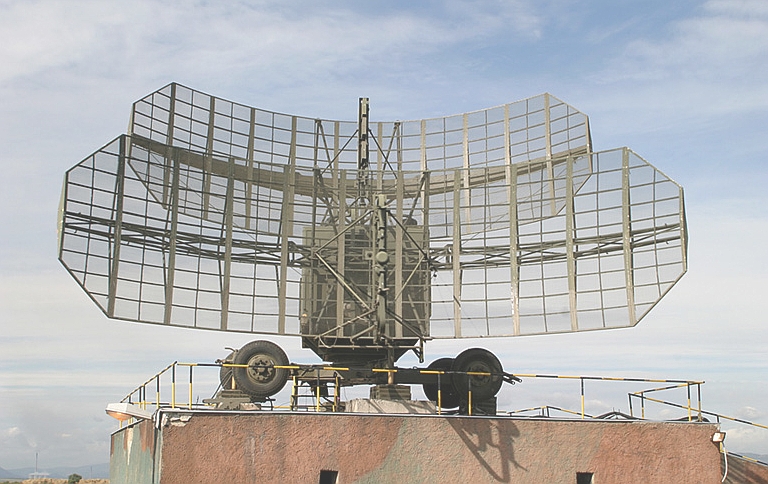
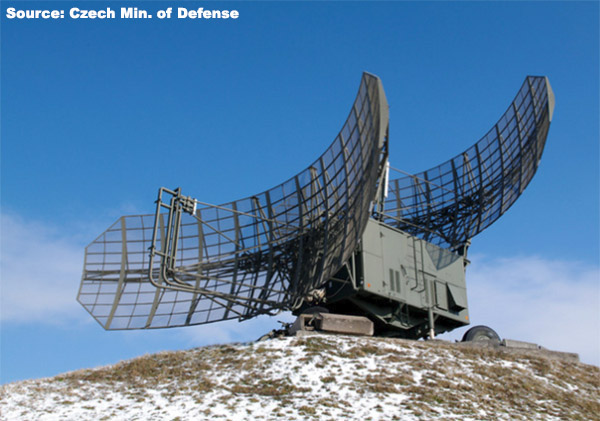
P-35/37 / BAR LOCK Radar Station or Radio-location Station (RLS) P-35 has a large tactical radius. It insures a circular scanning of the air space, detects the planes which are located in its operational zone and calculates their coordinates. The station P-35 has the following basic tactical and technical characteristics: Maximum range, depending on the type of plane and height of the flight-from 150 to 350 km. For example, the plane TU-104 which flies at an altitude of from 8,000 to 10,000 meters is detected at a distance of 350 km; the scanning zone: in altitude-up to 25,000m, in angle of location-up to 30 degrees; errors while determining the coordinates: in distance plus of minus 500m, in azimuth plus of minus 0.5 degrees; partitioning ability: in distance-500m, in azimuth-1.5 degrees; time for one circular scanning of the space is 20 or ten seconds, in accordance with a speed of rotation of the antenna-3 or 6 turns per minute. RLS P-35 has 6 channels. The 6 channels have frequencies in the the centimeter range. At the end of the 1950s, a circular review station (range finder) was developed and put into service - P-35 radar with enhanced power characteristics, with a smaller number of failures in the detection zone, with increased accuracy in determining the elevation angle (height) of the target. Just like the P-30 radar, the station was used in the country's Air Defense Forces, in the Air Force, in the air defense units of the Navy and in the radio engineering formations of the air defense forces of the Air Force. The station was developed at the plant number 37 GKRE. In contrast to the P-30 radar, in the P-35 station, the upper antenna mirror was installed horizontally with a certain inclination in the elevation plane, the available decimeter channel was replaced by a centimeter channel. The first serious Western attempt to measure the radiated power of a radar for intelligence purposes was made by CIA in 1958 on the Soviet early-warning radar known as BAR LOCK. The BAR LOCK was a new version of the Soviet multi-beam S-band family of radars which had undergone a rapid and widespread deployment in East Germany and other areas peripheral to the USSR. Intelligence indicated this new radar was deployed to detect and track the U-2 aircraft which were just beginning to make deep penetrations over the Soviet Union. Estimates of the BAR LOCK's radiated power output, based largely upon photographic evidence, ranged as high as 5 megawatts peak pulse power from each of its 5 transmitters. With 5 megawatts in each beam the BAR LOCK would have had ten times the power of previous similar radars and would have significantly improved the detection and tracking capabilities of the Soviet air defense system. To meet this threat to the U-2, those responsible for the reconnaissance program demanded firmer information on the BAR LOCK's power output and radiation pattern coverage. A laboratory that provided scientific back-up to the U-2 program assembled power-measurement equipment, crude by present-day standards, and installed it in a C-119 aircraft. With little advance testing, a series of flights was made through the air corridors to Berlin, where BAR LOCK signals were easily intercepted. The resulting power measurements at various vertical angles in the antenna pattern were not of high accuracy because of uncontrolled errors in the equipment. The data did indicate, however, somewhat less than one megawatt of peak power for each BAR LOCK transmitter, and this was later confirmed by other sources. Although not entirely successful in power measurement, this project suggested solutions to many technical problems and opened the way for follow-on developments. BAR LOCK, first sighted in late 1958, represented a major modification in Soviet early warning/GCI radar. The early multi-frequency, multi-beam Token was the forerunner for Big Bar in 1959. BAR LOCK was found to have evolved away from these radars. BAR LOCK is similar to Cross Out and Strike Out in that it has two horizontal reflectors, but the structural details were found to be entirely different. The power is believed to have been much higher than that for previously developed Soviet radars and it apparently had better capabilities for aircraft detection and tracking than previous Soviet EW/GCI radars. The introduction of BAR LOCK again evidenced that the Soviets were continuously increasing their ECCM capability with each new member of the GCI family. BAR LOCK provided the capability to shut off individual beams in order to overcome the effects of spot jamming and retained all ECCM circuitry incorporated in Big Mesh. BAR LOCK proved to be the primary, long range, high performance radar in use by the Soviets at GCI sites. BAR LOCK’s van mounted antennas were comprised of truncated parabolic mesh reflectors with clipped corners measuring 10 x 32 feet. These reflectors were also used in configuring the Big Bar radar system in 1959. Four beams emanated from the lower reflector and two from the upper. BAR LOCK was one of the more capable EW radars in the Soviet inventory and when collocated with height finders such as Side Net it was highly functional in a GCI role. It was put to wide spread use and was most likely the primary EW component at EW/GCI sites. --- Additional Data (TRADOC ODIN WEG) --- Frequency: 2.7–3.1 GHz (S, NATO Band E) Antenna Dimensions: 14 x 4 m Associated Weapon Systems: С-75 (S-75): В-750 / V-750; С-125 (S-125): 5В24 / 5V24 Role: 2D Early Warning/GCI Remarks: Main GCI for S-75/S-125 --- From Radartutorial.eu (https://www.radartutorial.eu/19.kartei/11.ancient/karte051.en.html) --- The P-37 “Metch” (1RL139, Cyrillic: 1РЛ139 «Меч» = “Sword”, NATO designation: “Bar Lock”) is a transportable 2D radar for air surveillance, fighter guidance, and target assignment for air defense missile systems. The radar can be coupled with the PRW-11 and PRW-13 highfinder radars to measure the third spatial coordinate. The radar entered service in 1961. On top of the antenna, the beacon, is the antenna of the secondary radar Siemens 1990 in version D1, a modification, which was introduced in the new German states only after 1991 and replaced the old Russian identification system (here: NRZ-20). During its very long service life, several versions of the P-37 were built. These ranged from the early days with an additional trailer 8, which mainly contained the tube-based SBZ system, to the most modern station, the so-called 90-version, which had the entire reception path transistorized and equipped with circuits (up to medium integration rate). Starting in 1990, the P-37s in Germany were upgraded to new safety standards and equipped with the new IFF/SIF D1/D9 . From 1998 on, the last P-37s in Mecklenburg/ Western Pomerania were replaced by the RRP-117 .