ARMSNET
Military Equipment Database
Initializing 0%

AS 565 Panther French Medium Utility Helicopter

AS565 Panther
Utility Helicopter
Spotted an error? Sign in to suggest an edit.
Basic Information
Name
AS 565 Panther French Medium Utility Helicopter
Designation
AS565 Panther
Alternate Designation
AS565 Panther
Equipment Type
Utility Helicopter
Manufacturer
Aérospatiale Eurocopter Airbus Helicopters
Date of Introduction
1986
Description

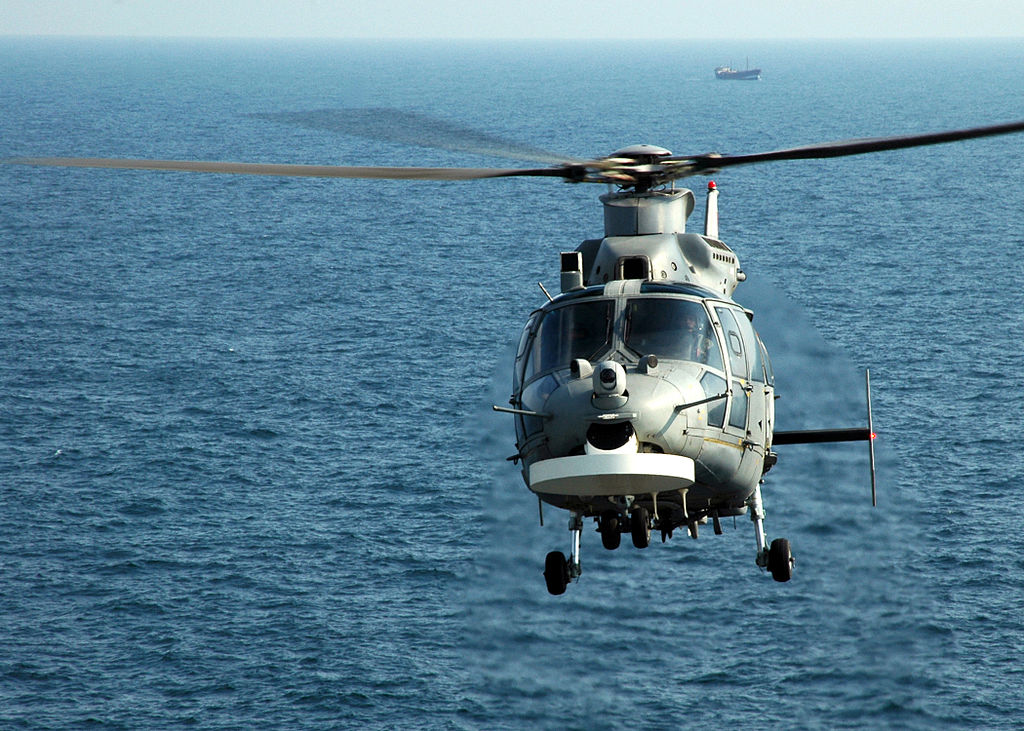
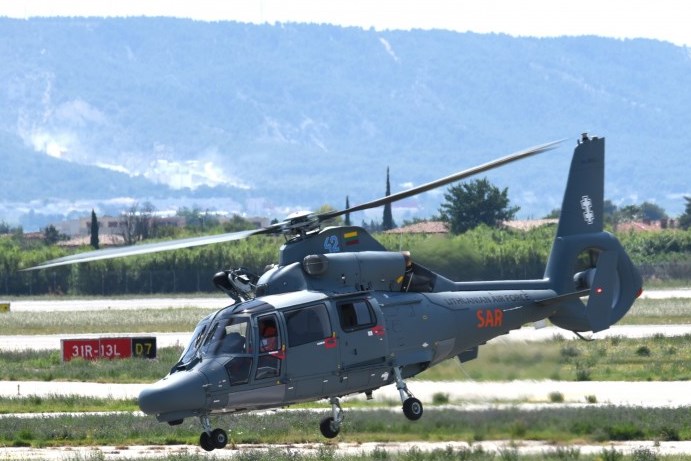
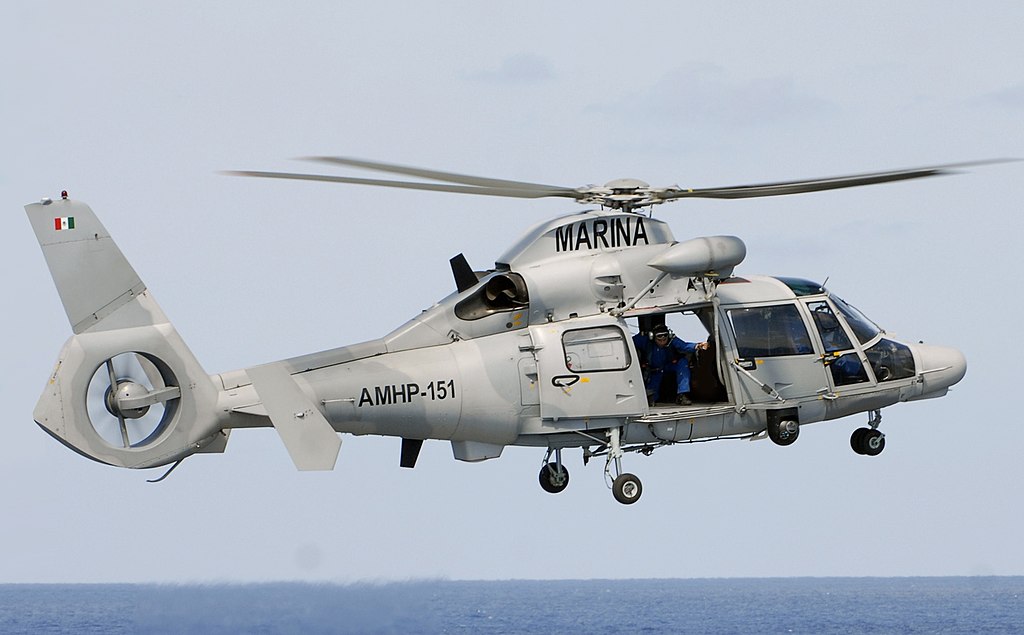
The Eurocopter (now Airbus Helicopters) AS565 Panther is the military version of the Eurocopter AS365 Dauphin medium-weight multi-purpose twin-engine helicopter. The Panther is used for a wide range of military roles, including combat assault, fire support, anti-submarine warfare, anti-surface warfare, search and rescue, and medical evacuation (MEDEVAC). The AS565 Panther is a twin-engine medium-sized multi-mission rotorcraft. It is capable of performing various naval and land-based missions, such as maritime security, search and rescue (SAR), casualty evacuation (CASEVAC), vertical replenishment, surveillance, special forces operations, anti-submarine warfare (ASW) and Anti-surface warfare (ASuW). The Panther is powered by a pair of Turbomeca Arriel turboshaft engines, which drives the rotorcraft's main rotor as well as the fenestron anti-torque tail rotor device. The flight profile of the Panther has been described as being easy to manoeuver, possessing generous g-force limitations and a high level of stability. In the commando-transport configuration, the Panther may carry up to 10 fully armed soldiers on board at a time in addition to the two pilots flying the aircraft. The main cabin can be rapidly reconfigured to conduct various roles, such as troop-transport, SAR, and MEDIVAC missions; optional equipment includes a full medical suite, forward-looking infrared (FLIR) camera, emergency flotation, loudspeaker, variable-speed hoist, cargo sling, search light, and a stretcher-support structure. Various avionics are present upon the Panther; some variants are fitted with the advanced human-machine interface (HMI) glass cockpit. It features the vehicle and engine multifunction display (VEMD), integrated electronic standby instrument (ESI), usage monitoring system (UMS), traffic collision avoidance system (TCAS), terrain awareness and warning system (H-TAWS), and dedicated mission display coupled with a multi-sensor processor, a 4-axis automatic flight control system (AFCS), flight management system (FMS), and an advanced search radar. The design of the cockpit and avionics systems, such as the engine management system, provides a high level of automation as part of an effort to reduce workload upon the pilots. The cockpit was deliberately designed with extra panel space to accommodate future upgrades and additional instrumentation that may be installed. The principle element of ASW-configured Panthers is the Helicopter Long-Range Active Sonar (HELRAS), a dipping sonar equipped with a descending array of seven projection elements and a receiving array equipped with eight extending arms, which is capable of detecting submarines up to 500 meters below the water's surface. According to Airbus Helicopters, the Panther family has been qualified to operate from the flight decks of over 100 classes of NATO vessels, and complies with NATO standardization agreements. The compact size of the Panther has enabled the type to be operated from smaller ocean-going vessels such as corvettes. To aid in shipboard landings under rough sea conditions and high winds, some variants can be furnished with the hydraulic Harpoon deck-lock securing device. The Panther can be armed with several different sets of munitions and armaments, dependent upon the intended role. Munitions include 20mm pod-mounted cannons, 68mm rocket pods, a maximum of eight Mistral air-to-air missiles, or a maximum of eight HOT anti-tank missiles; all of which can be mounted onto a universal weapon support beam. The weapon systems are integrated with a Crouzet HDH-2A electronic sight and the autopilot, the latter of which provides automatic flight handling assistance during weapons deployment to avoid negative tendencies such as nose droop. For improved survivability, the radar signature is reduced due to the use of composite materials across the airframe and the use of the fenestron tail rather than a conventional tail rotor; low infrared paints are also typically applied to the exterior surfaces and jet exhaust dilution devices are installed on the engines to reduce the Panther's infrared signature. Damage resistance is increased by the adoption of self-sealing fuel tanks and armor-plated crew seating.

Air & Air Defense Specifications
Crew 2
Engine Turboshaft (650 hp)
Max Speed 372.0 km/h
Cruise Speed 285.0 km/h
Rotor Diameter 11.94 m
Variants
SA 365 C A twin-engined version of the Dauphin, designated as the Dauphin 2, was announced in early 1973. The first prototype's first flight took place on 24 January 1975; production model deliveries began in December 1978. In comparison with the earlier model, the SA 365 C featured twin 470 kW (630 shp) Arriel 1 turboshafts in a new engine fairing, a Starflex main rotor hub and a higher maximum take-off weight (3,400 kg (7,496 lb) or 7,495 lb). Its Fenestron anti-torque device featured 13 metal blades. Production of both the SA 360 and SA 365 C ceased in 1981, by which time approximately 40 SA 360s and 50 SA 365 C/C1s had been built; both were replaced by the SA 365 N.
SA 365 C1 Variant powered by Arriel 1A1 certified in March 1979.
SA 365 C2 Variant powered by Arriel 1A2 certified in February 1980.
SA 365 C3 Variant powered by Arriel 1C certified in January 1982.
SA 365 N A much improved version of the SA 365 C Dauphin 2, the first prototype flying on 31 March 1979. This version introduced the uprated 492 kW (660 shp) Arriel 1C turboshafts, a retractable tricycle undercarriage, enlarged tail surfaces, and revised transmission, main rotor, rotor mast fairing and engine cowlings. The aircraft's initial M.T.O.W. of 3,850 kg (8,490 lb) was later raised to 4,000 kg (8,800 lb). Deliveries of the production model began in 1982.
SA 365 N1 Incorporating many of the improvements developed for the SA 366 G1 (HH-65 Dolphin), this version introduced upgraded 526 kW (705 shp) Arriel 1C1 turboshafts, an improved 11-blade Fenestron with wider-chord blades (which reduced the AS365 N1's noise signature), movable undercarriage doors replaced by simplified fairings and a higher gross weight of 4,100 kg (9,000 lb).
AS 365 N2 This version – designated AS365 N2 from the outset – introduced the upgraded 549 kW (737 shp) Arriel 1C2 turboshafts, an uprated gearbox, increased maximum take-off weight of 4,250 kg (9,370 lb), redesigned cabin doors and revised interior, enlarged tail fin with all composite Fenestron. Deliveries of this version started in 1990. Licensed versions were assembled in China as the Z-9, Z-19 and AVIC AC312.
AS365 N3 The high-performance AS365 N3 was developed for operations in 'hot and high' climates, and introduced 635 kW (851 shp) Arriel 2C turboshafts equipped with a single channel DECU (Digital Engine Control Unit) with manual reversion, mated to an uprated main transmission for better single engine performance. The AS365 N3 also features a redesigned ten blade composite Fenestron anti-torque device with asymmetric blade distribution, offering a further reduction in noise signature. The AS365 N3's gross weight is 4,300 kg (9,500 lb). Production deliveries began in December 1998.
AS365 N3+ This version was presented at the 2009 Paris Air Show and differs mainly in new avionics including 4-axis auto-pilot This version is currently still in production.
AS365 N4 Produced as the EC155.
AS365 X Better known as the DGV 200 or Dauphin Grand Vitesse (High Speed Dauphin), the AS365 X was developed from the X-380 DTP (Developpement Technique Probatoire or Probatory Technical Development) testbed, first flown on 20 March 1989. The aircraft was first flown in the AS365 X configuration two years later in March 1991, and featured a smaller Fenestron, a new main rotor with five high-inertia blades with swept tips, a composite rotor hub/mast and 624 kW (837 shp) Turbomeca Arriel IX turboshafts. On 19 November 1991, this aircraft set a Class E1e (3,000 to 4,500 kg) speed record of 201 knots (372 km/h; 231 mph) over a 3 km (1.9 mi) triangular course.
EC155 B/B1 This version was originally to follow the N3 as the AS365 N4, and was announced at the 1997 Paris Airshow before being redesignated as the EC155 B. As with the N3 version, it has two Arriel 2C/2C2 turboshafts equipped with FADEC as well as a five blade Spheriflex main rotor (derived from the AS365 X DGV). It also features a 30% larger main cabin (achieved with bulged doors and cabin plugs). The first flight of the first prototype took place on 17 June 1997 and this version is currently in production (as the EC155 B1).
SA 366 G1 Dauphin The SA 366 G1 Dauphin version was selected by the US Coast Guard (USCG) in 1979 as its new air-sea rescue helicopter and given the designation HH-65A Dolphin. In total 99 helicopters, optimized for the USCG's short-range recovery (SRR) search and rescue role, were initially acquired, with additional aircraft later procured.
SA 365 N Dauphin A much improved version of the SA 365 C Dauphin 2, the first prototype flying on 31 March 1979. This version introduced the upgraded 492 kW (660 shp) Arriel 1C turbo-shafts, a retractable tricycle undercarriage, enlarged tail surfaces, and revised transmission, main rotor, rotor mast fairing and engine cowlings. The aircraft's initial M.T.O.W. of 3,850 kg (8,490 lb) was later raised to 4,000 kg (8,800 lb). Deliveries of the production model began in 1982.
SA 365 F Dauphin The SA 365 F is a variant of the SA 365 N for the French Navy. It has been used since 1991 for general duties and for backup purposes aboard an aircraft carrier. A helicopter with rescue divers is always in the air during flight operations to be able to assist the pilot in case of an accident. First experiments were successfully carried out in 1990 on board the Clemenceau. The variant 365F is used since 1999 with Flottille 35F called AS365F Dauphin Pedro.
AS365 N3 Dauphin The high-performance AS365 N3 was developed for operations in 'hot and high' climates, and introduced 635 kW (851 shp) Arriel 2C turbo-shafts equipped with a single channel DECU (Digital Engine Control Unit) with manual reversion, mated to an upgraded main transmission for better single engine performance. The AS365 N3 also features a redesigned ten blade composite Fenestron anti-torque device with asymmetric blade distribution, offering a further reduction in noise signature. The AS365 N3's gross weight is 4,300 kg (9,500 lb). Production deliveries began in December 1998.
AS365 N3+ This version was presented by Eurocopter at the 2009 Paris Air Show and differs mainly in new avionics including 4-axis auto-pilot
System
Alternative Designation AS565 Panther
Type Medium Utility Helicopter
Manufacturer Aérospatiale Eurocopter Airbus Helicopters
Crew 2 (pilot, co-pilot)
Blades, Main Rotor 4 ea
Blades, Tail Rotor INA
Number of Engines 2 ea
Number of Hard Points INA
Dimensions
Length, Rotors Turning 13.74 m
Fuselage Length 12.11 m
Rotor Diameter 11.94 m
Disc Area 112 sq m
Height 3.50 m
Empty Weight 2,249 kg
Sling Load Weight 1,600 kg
Maximum Takeoff Weight 4,100 kg
Automotive
Engine Name 2 x Turbomeca Arriel
Engine Type Turboshaft
Engine Power 650 shaft hp each
Internal Fuel Capacity 1,135 liters
Cruise Speed 285 kph
Economical Speed 259 kph
Ceiling 6,000 m
Hovering Ceiling in Ground Effect 2,150 m
Hovering Ceiling out of Ground Effect 1,200 m
Maximum Range with Internal Fuel 865 km
Maximum Range with Auxiliary Fuel Tanks 1,067 km
Main Gun System
Note 20-mm or 7.62-mm General-Purpose Machine Guns.
Missile Weapon Systems
Missile System #1
Name AS15TT Anti-Ship Missile
Type Anti-Ship Missile
Length 2.30 m
Diameter 190 mm
Wingspan 0.56 m
Warhead 30 kg derived from OP3C APHE
Fuze impact
Weight 98 kg
Maximum Range 15 km
Maximum Speed 1,007 kph
Guidance System SACLOS by Thomson-CSF Agrion 15 chin-mounted I/J-band radar
Basic Load INA
Anti-Tank Guided Missile System
Name HOT-1
Type Air-to-Ground Anti-Tank Missile
Length 1.27 m
Diameter, Launcher 175 mm
Diameter, Missile 136 mm
Launcher Weight 23.5 kg
Launcher and Missile Weight 32.0 kg
Warhead Weight 5.0 kg
Warhead Octol hollow-charge high-explosive anti-tank or multi-purpose penetration of rolled homogeneous armor (RHA). Penetrates up to 47 in (1,200 mm) of armor.
Engine 1 x two-stage solid-propellant rocket; Bugeat booster with a burn of 0.9 sec; Epictete sustainer, 53 lb (24 kg) static thrust with a burn of 17.4 sec
Maximum Speed Mach 0.74
Maximum Range 4,000 m
Minimum Range 400 m
Flight Time to 2,000 m 9 sec
Flight Time to 3,000 m 13 sec
Flight Time to 4,000 m 17 sec
Guidance System SACLOS wire-guided
Tracking System optical or IR tracking of target; IR tracking of missile.
Basic Load INA
Fire Control and Avionics
Fire Control Radar INA
Navigation Radar INA
Protection
Add on Armor INA
Stealth Properties None
Heat Signature Reduction No
NBC Protection INA
EW Counter Measures/CCM INA
Counter Measures (Chaff/Flares) Yes
Details
Country of Origin France
Category Utility Helicopter
Air > Utility Helicopter
Filter Label
A
Classification
Domain
Air & Air Defense
Equipment Status
Active
Dimensions
Length
Width
Height
3.5 m
Weight
4100 kg
Operators (10)
France
South Korea
Brazil
Bulgaria
Indonesia
Mexico
Morocco
Saudi Arabia
Turkmenistan
United Arab Emirates
Something went wrong. Please reload the page. Reload