M2010 North Korean Amphibious Armored Personnel Carrier (APC)
M2010
Amphibious Armored Personnel Carrier (APC)
Spotted an error? Sign in to suggest an edit.
Other
Basic Information
Name
M2010 North Korean Amphibious Armored Personnel Carrier (APC)
Designation
M2010
Alternate Designation
M2010
Equipment Type
Amphibious Armored Personnel Carrier (APC)
Manufacturer
—
Date of Introduction
2010
Description
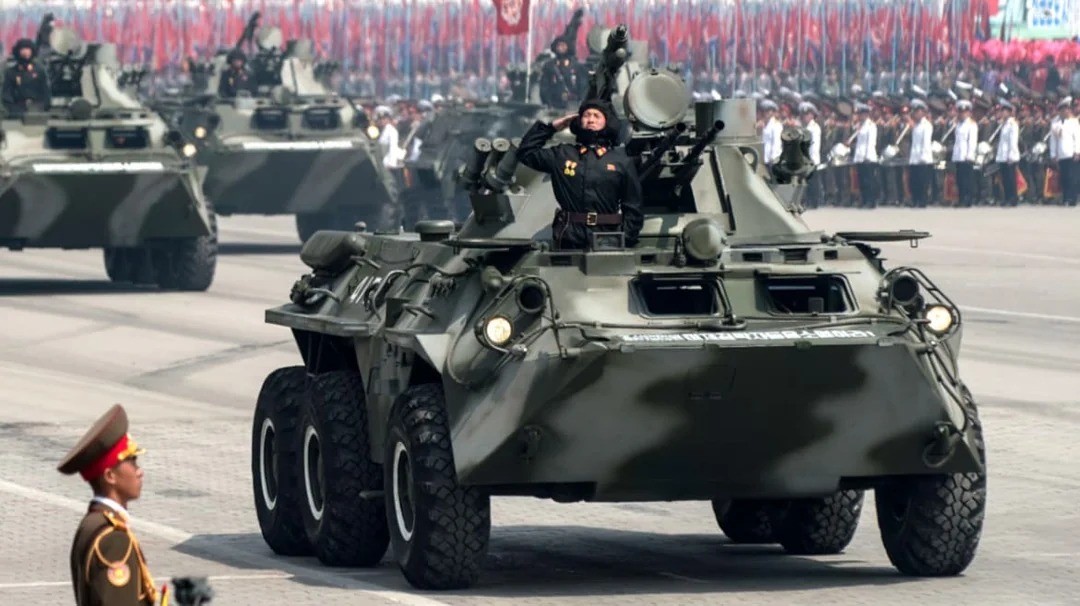
The M2010 North Korean Amphibious Armored Personnel Carrier (APC) is a derivative of the BTR-80A with major modifications made to suit the needs of the Korean People’s Army – Ground Force. The BTR-80 is a light and fast amphibious wheeled 8×8 armored personnel carrier produced by the Soviet Union since 1984, based on the earlier BTR-60 and BTR-70.
Ground Specifications
Crew
3
Mobility Type
Wheeled (8x8)
Main Weapon
pair of heavy machine guns produced in DPRK based on the Soviet KPVT machine guns, 14.5 x 114 mm
Engine
Diesel (260 hp)
NBC Protection
Yes
Amphibious
Yes
Max Speed
80.0 km/h
Range
600.0 km
Variants
M2010 II
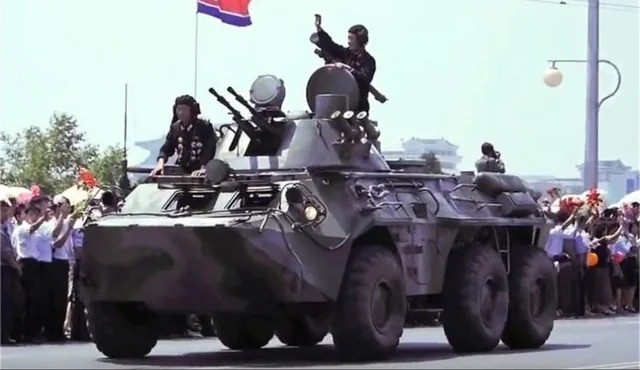
The M2010 II is a version with some upgrades that has been seen in some later parades. This vehicle, with an unknown official designation, is nicknamed M2010 II 8×8. This vehicle has a modified engine bay and exhaust system and it can be assumed that it also has improvements in the firing systems and interior layout, but this is just speculation.
It seems that the more modern M2010 II 8×8 has reached a level very similar, if not identical, to that of the BTR-80A in terms of quality of raw materials for production, production finish, protection, propulsion system, and amphibious capabilities. On the M2010 II 8×8, the engine compartment and the exhaust system have been modified, making analysts speculate that, given the progress of the Korean heavy industry, the KPA may have decided to incorporate new technologies, including a licensed copy of the KamAZ 7403 diesel engine of the BTR-80A.
M2018
There is an ATGM carrier version, known by the US DoD as the M2018. These are M2010 6x6s equipped with a giant turret armed with 8 ATGMs. This anti-tank system is similar to the Chinese AFT-10 or the Israeli Pereh. Analysts suspect that these are armed with eight Bulsae-4 Anti-Tank Guided Missiles (ATGMs) of the Non Line Of Sight (NLOS) type, a model new to the KPA.
M2020 ATGM
Presented at the 75th Anniversary of the foundation of the Workers’ Party of Korea on 10th November 2020.
M2020 Mobile Gun System (MGS)
Presented at the 75th Anniversary of the foundation of the Workers’ Party of Korea on 10th November 2020.
System
Alternative Designation
M2010
Type
Amphibious Armored Personnel Carrier (APC)
Manufacturer
INA
Configuration
6x6
Crew
3 ea
Passenger Capacity
6 ea
Camouflage
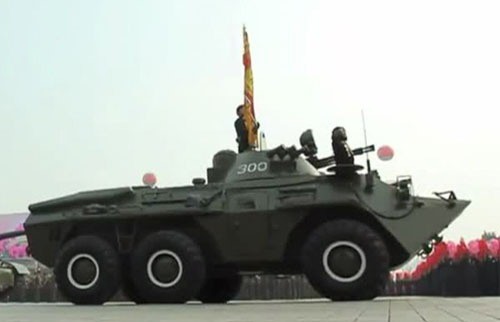
The M2010s have been seen in a variety of camouflage schemes over the more than a decade of service with the KPA. In 2010, they appeared in the standard livery on Korean People’s Army – Ground Force vehicles, green khaki. An ID number is written in white on the turret, just like on the BTR-80As that had appeared in parades up to that point. In 2013, the vehicles had a new three tone camouflage, rarely seen on Korean vehicles. They had a light green base with slight dark green shades within the light green and patches of light silver gray. The wheels and tires also received some paint, something uncommon on vehicles, especially military, which tend to get dirty very quickly.
Dimensions
Length
6.5 m
Width
2.95 m
Height
INA
Weight, Combat
12 tons
Automotive
Engine Name
KamAZ 7403
Engine Type
Diesel
Engine Power
260 hp at 2,400 RPM
Maximum Range
600 km
Maximum Land Speed
80 km/h
Amphibious
Yes
Maximum Water Speed
8-10 km/h
Communications
Note
The radio antenna is mounted on the right side, next to the commander’s position, instead of behind the turret, as on Soviet BTRs. The antenna is fixed on a support that can rotate about 80° backwards to allow the opening of the commander’s hatch and also not to hinder the turret rotation.
Main Weapon System
Note
The main armament of the M2010 is represented by a pair of heavy machine guns produced in DPRK based on the Soviet KPVT machine guns. The large caliber machine guns, 14.5 x 114 mm, guarantee firepower, with a rate of 600 rounds per minute each and a maximum practical range of 2,000-3,000 m.
The maximum elevation also ensures the vehicle can engage targets on hillsides, very useful in the Korean hilly environment, but also targets on the upper floors of buildings or enemy helicopters at low speed, allowing the vehicle to support infantry against most types of targets, terrestrial, or aerial. The penetration of the Soviet Armor Piercing projectiles (from which the Korean Armor Piercing rounds certainly derive) is 30 mm angled at 90° at a distance of 500 m.
Coaxial Weapon System
Note
The secondary armament consists of a 7.62 mm coaxial machine gun. This is a tank version of the Type 82, a licensed variant of the PKMT, itself derived from the PKM general-purpose machine gun. Very little is known about this 7.62 x 54 R mm caliber machine gun. It was developed in 1982 from the Soviet PKM and the tank version probably has a firing rate decreased to 500 rounds per minute instead to 700 rpm of the standard Type 82 and PKM. It has a heavier barrel to avoid overheating and is mounted on the right side of the PKVTs.
Man-Portable Air Defense Systems (MANPADS)
Note
Mounted on a pedestal support on the turret rear is a MANPADS, probably the indigenous HT-16PGJ, derived from the Soviet 9K310 Igla-1E (NATO code name SA-16 ‘Gimlet’). If the characteristics are identical to those of the Soviet model, the Korean HG-16 IR-guided missile fired from that MANPADS is capable of hitting aerial targets up to a maximum range of 5 km, a maximum altitude of 2.5 km at a maximum speed of 1.9 Mach (2,350 km/h).
The MANPADS does not appear to be connected to the Fire-Control System (FCS) of the vehicle. To use the HT-16PGJ, the gunner is forced to exit through the hatch on the turret roof, exposing part of their body to enemy fire, although the hatch offers some protection.
Protection
Hull Armor
The hull is completely welded and its shape is almost identical to that of the BTR-80, from which it derives with rear engine compartment, central troop transport compartment, and front driving compartment. The differences that can be noted after a quick analysis are: Lack of pistol port for the vehicle’s commander;
Modification of the engine compartment;
Modification of the exhaust system;
Modification of the engine cooling grids;
Different side access doors;
Different hatches for the commander and driver.
Turret Armor
As far as protection is concerned, the hull and turret are made of laminated steel plates welded together and the resistance is roughly comparable to that of the original BTR-80A, with protection from 12.7 mm bullets fired at 100 meters on the front arc, while on the flanks, the armor resists to 7.62 mm bullets fired at 100 meter range.
Applique Armor
Available
NBC Protection
Yes
Smoke Equipment
3 x smoke launchers per side. These are mounted on supports welded to the sides of the turret and used to mask the vehicle from the enemy.
Details
Country of Origin
North Korea
Category
Land
Land
Filter Label
M
Classification
Domain
Ground
Equipment Status
Active
Dimensions
Length
6.5 m
Width
2.95 m
Height
—
Weight
12000 kg
Operators (1)
North Korea
Something went wrong. Please reload the page.
Reload