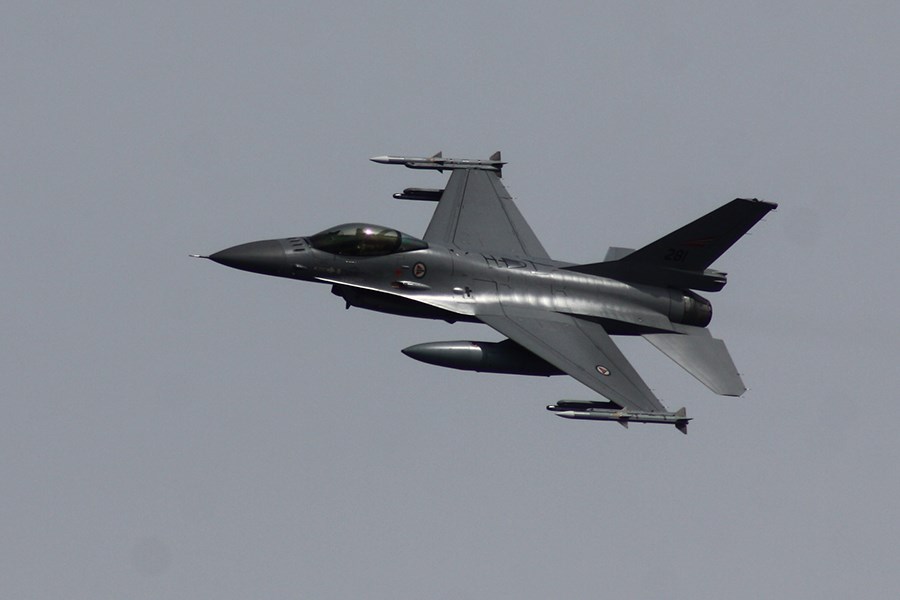
F-16C Block 50
F-16C Block 50
The single seat Block 50 F-16C, also known as F-16CJ, is a Block 40 follow-on with more powerful engine models and new weapon options. The US Air Force has integrated the HTS pod in some F-16CJs for suppression of enemy air defenses using the HARM missile. The Block 50 F-16C was deployed in 1991. The US Air Force Block 50 F-16C will receive the advanced Sniper XR targeting/navigation pod replacing older systems currently in the US inventory, as well as software updates for integration of smart munitions such as AGM-154, JDAM bombs, and AGM-158. The US Air Force expects the F-16CJ to remain in service until 2025. Beginning Summer 2004, US Air Force and five European Participating Air Forces (EPAFs) - Belgium, Denmark, the Netherlands, Norway and Portugal - operating the F-16 aircraft received the a new software packages called M3+ by the US Air Force and the corresponding EPAF version designated M3. The most notable new capabilities added to F-16s thru the M3/M3+ software packages were Link 16 data link and the helmet mounted cueing system (HMCS). USAF F-16 capabilities under M3+ encompassed AGM-158 long-range attack missile and Sniper XR targeting pod, while European F-16s gained the capability to deliver JDAM bombs. More than 200 USAF Block 50 F-16C/Ds modified thru the Common Configuration Implementation Program (CCIP) were scheduled to receive the M3+ software package at the Ogden Air Logistics Center, Utah. Approximately 400 USAF Block 40 F-16C/Ds were scheduled to follow the same upgrade beginning in 2006. By the way, about 350 European F-16A/Bs will receive hardware and M3 software upgrades at depot facilities in each participating country. In addition to the M3/M3+ update initiated in March 2000, the F-16 software updates roadmap the M4/M4+ to be released in 2007 and the M5/M5+ to be released in 2009. F-16 Block 50 Common Configuration program focuses on five major components: a new mission computer for increased processor power; color displays improving pilot-aircraft communication; an air-to-air interrogator to allow communication of the F-16 with other aircraft that appear on its radar; internet-like system to enhance communication with coalition aircraft; and helmet-mounted display to better visualize information and to allow the pilot lock on a given target by looking at it. The scope of the program is to modify 650 US Air Force and National Guard F-16s through 2010 with a total estimated cost in excess of $2 billion. Falcon STAR, F-16 Structure Augmentation Roadmap, program will see US Air Force F-16 fleet receiving parts kits to strengthen their structure. This measure will enable the F-16 aircraft to attain its projected 8,000-hours of service life through 2025 for the US Air Force, when the entire fleet should be dismantled. Falcon STAR program is valued at $1 billion. The parts kits involved in this program number 79,000. Ogden Air Logistics Center at Hill Air Force Base, Utah, is where modification work is taking place. Starting in 2006, F-16s for European countries will undergo Falcon STAR modification. All in all, more than 2,000 F-16s belonging to the United States, Belgium, Denmark, the Netherlands, Norway, Portugal, Israel, Greece, Singapore, Thailand and Bahrain will be modified through 2014. Lockheed-Martin delivered the last F-16 aircraft produced for the US Air Force at Lockheed-Martin Aero Plant in Fort Worth, Texas, on March 18, 2005. Since 1978 the US Air Force received 2,231 F-16s of which 1,300 were in the USAF inventory as of 2005. The last F-16 aircraft is scheduled for retirement in 2025. In February 2002, Chile signed an agreement with the US government on the purchase of 10 advanced Block 50 F-16C/D (6 single-seat and 4 twin-seat) aircraft which translated into Peace Puma foreign military sales program. The agreement included the F110-GE-129 engine. The first aircraft was completed in early April 2005 with the first flight expected summer 2005. The first two F-16 Peace Puma aircraft were delivered to the Chilean Air Force January 24, 2006. Peace Puma program was valued at $547 million including aircraft and a weapons package consisting of AIM-9, AMRAAM and JDAM. In May 2002, the Sultanate of Oman signed an agreement with Lockheed-Martin for 12 Advanced Block 50+ F-16C/D aircraft to be delivered beginning in 2005 through 2006. Under Peace A’sama A’safiya (Clear Skies) Foreign Military Sales program eight single seater F-16Cs and four tow-seat F-16Ds powered by the General Electric F110-GE-129 engine will be delivered to the Royal Air Force of Oman (RAFO).
deagel.com: https://www.deagel.com/x/x/a000540