BL755 British Cluster Bomb
BL755
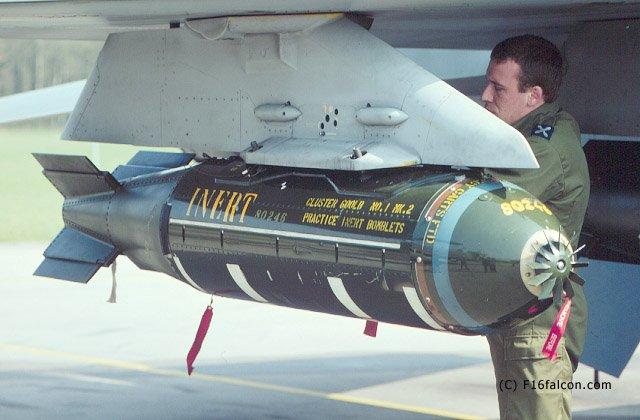
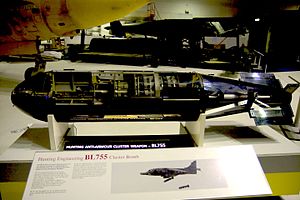
BL755 is a cluster bomb. Its primary targets are armoured vehicles and tanks with secondary soft target (anti personnel) capabilities. The BL755 looks like a standard 450-kilogram (1,000 lb) general-purpose bomb but with a hard "saddle" on the spine for ejector release and crutching pad loads and a distinctive large turbine-like air arming vane on the nose. The four rear fins are squared off in appearance, but on closer inspection can be seen to be hollow and telescopic. A central extruded aluminum skeleton is divided into seven bays, each containing 21 submunitions (147 total). The submunitions are ejected by means of a central cartridge and individual inflatable bladders for each bay, operating in a similar manner to a car airbag. Ejection on the original BL755 bomb is triggered by the rotation of the arming vane, driven by the airflow. Each submunition is contained within its own SAFU (safety and arming unit) and is telescoped shut. Upon release, the submunition is expanded by a spring. A focal distance stand off and detonating device deploys at the front and a fan of stabilising fins at the rear. Each has a shaped charge HEAT warhead for armour penetration, the casing of which is constructed from wound tessellated square wire, which produces around 1,400 anti-personnel fragments. A single cluster bomb produces a total of more than two hundred thousand fragments. The weapon was developed in the early 1970s by Hunting Engineering, Ltd. of Ampthill, Bedfordshire but manufactured elsewhere at their production facility. The original BL755 has been updated twice. IBL755 is a bomblet update, increasing its reliability and armour penetration. RBL755 is the BL755 weapon fitted with a radar altimeter that acts as a proximity fuze, triggering bomblet ejection at the optimum altitude whilst allowing the bomb to be released from a safe height and distance. This was in response to the dangers illustrated by low-level Panavia Tornado missions in the 1991 Gulf War; the original vane-armed BL755 had to be released at a predetermined low altitude, with the attacking aircraft exposed to ground fire and shoulder-launched surface-to-air missiles such as the 9K34 Strela-3 and its variants.