ARMSNET
Military Equipment Database
Initializing 0%

MX-10 DAMOCLES French Unmanned Aerial Vehicle (UAV)

MX-10 DAMOCLES
Tactical Unmanned Aerial Vehicle (UAV)
Spotted an error? Sign in to suggest an edit.
Basic Information
Name
MX-10 DAMOCLES French Unmanned Aerial Vehicle (UAV)
Designation
MX-10 DAMOCLES
Alternate Designation
MX-10 DAMOCLES
Equipment Type
Tactical Unmanned Aerial Vehicle (UAV)
Manufacturer
KNDS
Date of Introduction
2025
Description

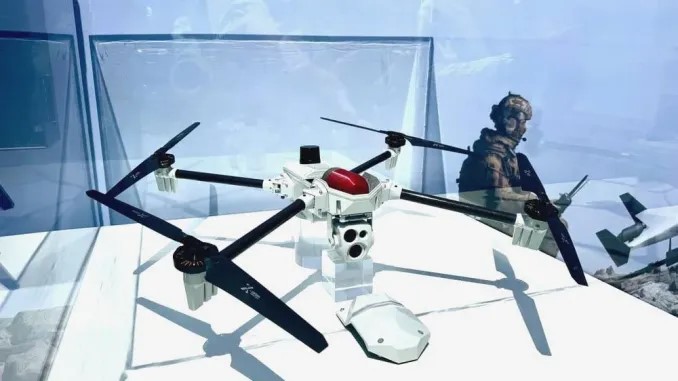
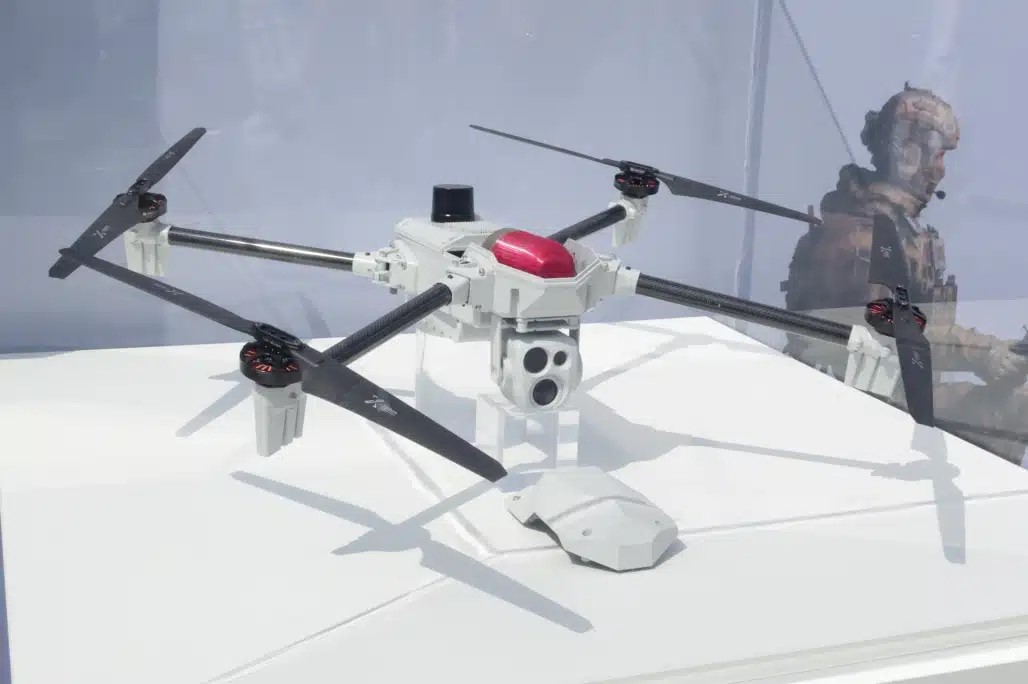
The MX-10 DAMOCLES French Unmanned Aerial Vehicle (UAV) represents France's first industrialized remotely operated munition, marking a significant shift in the French military's operational doctrine toward organic unmanned strike capabilities. Developed by KNDS France and Delair in partnership under the accelerated COLIBRI program, the system achieved development, qualification, and initial production in just 12 months—a compressed timeline reflecting operational urgency following lessons learned from conflicts in Ukraine and the Caucasus. With initial deliveries commencing in December 2025 and 460 units committed for delivery by July 2026, the MX-10 DAMOCLES establishes France as a domestic producer of short-range loitering munitions while maintaining strict sovereign control over design, production, and employment. The system addresses a critical capability gap identified in contemporary conflict scenarios: the need for rapid, precise, unit-level strike capabilities that operate independently of contested satellite communications and navigate through GPS-denied environments. Rather than importing foreign systems, France chose to industrialize a domestic quadcopter platform, demonstrating both technological competence and strategic determination to maintain autonomous military capability. The airframe uses composite materials and incorporates four spikes that carry electric motors and rotors, enabling assembly and disassembly in minimal time. The system's vertical takeoff and landing (VTOL) capability eliminates the need for prepared terrain or runways, enabling operators to establish firing positions with minimal site preparation. The MX-10 DAMOCLES's setup time of less than 5 minutes means it can transition from transport configuration to launch-ready status faster than most unit-level fire support assets, a critical advantage in dynamic tactical environments where decision cycles are compressed.

Air & Air Defense Specifications
Engine Electric
Range 10.0 km
Endurance 40.00 hrs
Wingspan 80.00 m
Payload Capacity 550 kg
System
Alternate Designation MX-10 DAMOCLES
Type Unmanned Aerial Vehicle (UAV)
Manufacturer KNDS
Payload Capacity 550 g
Warhead The 550-gram explosive incendiary fragmentation warhead developed by KNDS France (KNDS Ammo) demonstrates the company's established expertise in munitions for this platform. This warhead features a point-detonating (impact) fuse mechanism that ensures detonation only upon direct contact with the target. The designation "incendiary fragmentation" refers to a dual-effect mechanism: fragmentation delivers anti-personnel lethality within a limited radius, while incendiary components extend thermal effects and improve engagement of personnel in trenches or behind light cover. This calibrated effect profile intentionally limits collateral damage in populated areas relative to conventional high-explosive warheads, reflecting a doctrinal shift toward precision munitions in complex operational environments. The system incorporates a new-generation Safety Armament Device (SAD), enabling operators to abort attacks after launch if tactical circumstances change or target identification becomes uncertain. Unlike first-generation kamikaze drones that commit to an engagement upon launch, the MX-10 DAMOCLES can disengage from an engagement, return to loitering mode, and re-target later in the mission. This abort capability materially enhances targeting discipline and reduces fratricide risk in fluid tactical situations.
Navigation and Contested Environment Operations The system demonstrates effective operation in Global Navigation Satellite System (GNSS)-denied environments, a capability not present in earlier French unmanned systems but essential for deployment in contested airspace. The navigation architecture likely integrates inertial measurement units (IMUs) with terrain reference navigation (TRN) or comparable alternative positioning methods, thereby enabling autonomous flight in the absence of GPS or GLONASS signals. The data link architecture is designed for resilience within contested electromagnetic environments. Jam-resistant communications ensure operator control throughout all engagement phases, which is critical in contemporary conflicts where adversary electronic warfare assets frequently disrupt the radio frequency spectrum. Although the specific modulation and frequency-hopping techniques remain classified, the system’s stated jam-resistance capability underscores its foundational design priorities for contested operational environments.
Sensor Suite and Target Acquisition The optoelectronic payload combines electro-optical (day/color) and infrared (thermal) cameras, enabling operations during both day and night under various visibility conditions. Real-time video transmission is sustained until impact, providing continuous situational awareness to the operator and permitting attack abort decisions if tactical circumstances change or target identification becomes uncertain. This sensor suite supports the identification and tracking of personnel and light vehicles, including those partially concealed by terrain or infrastructure. Such targeting capability is critical in urban environments or complex terrain where clear target geometry may be absent. The integrated infrared camera improves target discrimination in degraded visual environments and enables thermal signature identification for specific vehicle categories. The real-time video feed system utilizes a human-in-the-loop control model, ensuring that operators maintain decision authority over engagement and receive visual confirmation before attack authorization. This design deliberately preserves human agency in lethal targeting decisions, aligns with evolving international humanitarian law principles regarding autonomous weapons systems, and upholds operational accountability.
Dimensions
Length INA
Height INA
Wingspan 80 cm
Maximum Takeoff Weight 3.5 kg
Automotive
Engine Name INA
Engine Type Electric
Engine Power INA
Maximum Speed INA
Cruise Speed INA
Maximum Range 10 km
Service Ceiling INA
Endurance 40 min
Details
Country of Origin France
Category UAVs
Air > UAVs
Filter Label
M
Classification
Domain
Air & Air Defense
Equipment Status
Active
Dimensions
Length
Width
Height
Weight
3.5 kg
Operators (1)
France
Something went wrong. Please reload the page. Reload