Atlas V
Atlas V
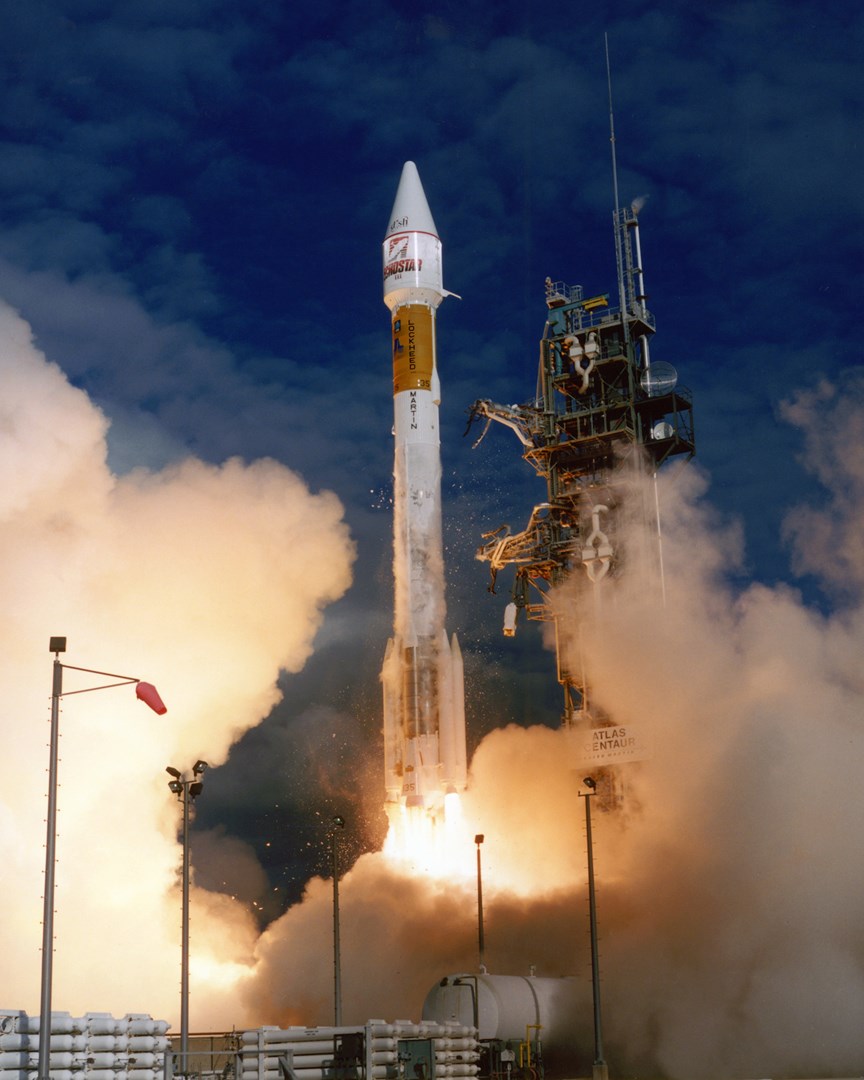
The Atlas V launch vehicle takes Lockheed-Martin expertise gained with Atlas and Titan programs. It can lift greater payloads (19,114-lb/8670 kg to GTO) than its predecessors (Atlas II and Atlas III). It uses the single-stage RD-180 engine and the new solid rocket booster known as the Common Core Booster. Lockheed-Martin designed the Atlas V to lift into orbit the heaviest satellites. The Atlas V consists of 400 and 500 series models. As of 2004, the US Air Force EELV program comprising the Delta IV and Atlas V launch vehicles was valued at $31.79 billion. As of early 2005, the Atlas V launch system had flown four successful commercial missions since its debut in August 2002. The fifth commercial launch was planned for March 2005 and the first US government launch was scheduled for April 2006. International Launch Services (ILS) had 16 EELV assignments. In early February 2005, ILS, a Lockheed-Martin joint venture, received green light from the US Air Force to launch a national security payload (NROL-24) on an Atlas V vehicle in mid-2007 from Cape Canaveral, Florida. This was one of seven launch services assigned to ILS and Atlas V vehicle under EELV program. As of March 2005, Atlas V had executed five flight missions. The fifth launch was carrying the Inmarsat 4-F1 6-ton satellite on March 11, 2005, through an Atlas V configured 431 meaning 4-meter-diameter fairing, three solid rocket boosters and a single-engine Centaur upper stage. In early June 2005, Aerojet and Lockheed-Martin were testing the Aerojet Solid Rocket Booster (SRB) Block B developed to provide enhanced performance and reliability to the Atlas V launch system. The Aerojet Block A SRBs were qualified in 2003 and had flown three successful missions. In January 2006, an Atlas V space launch system successfully propelled out of the atmosphere NASA's New Horizons spacecraft. This was the seventh flight assigned to Atlas V and the model involved was the Atlas V-551 which is powered by the Russian-built RD-180 main engine plus five solid rocket boosters. This Atlas commercial launch vehicle was provided by International Launch Services (ILS). Atlas V-551 model features more than 2 million pounds of thrust at the first stage. The ninth Atlas V rocket was launched from Cape Canaveral Air Force Station, Florida, on March 8, 2007. The space launch vehicle launched into orbit six satellites including: NextSat and ASTRO for DARPA; Space Test Program's STPSat-1; Los Alamos National Laboratory's CFESat; US Naval Academy's MidSTAR; and US Air Force Academy's FalconSat-3. The United States plans call for another 17 launches between 2024 and 2030 totaling 116 launches.
deagel.com: https://www.deagel.com/x/x/a000237