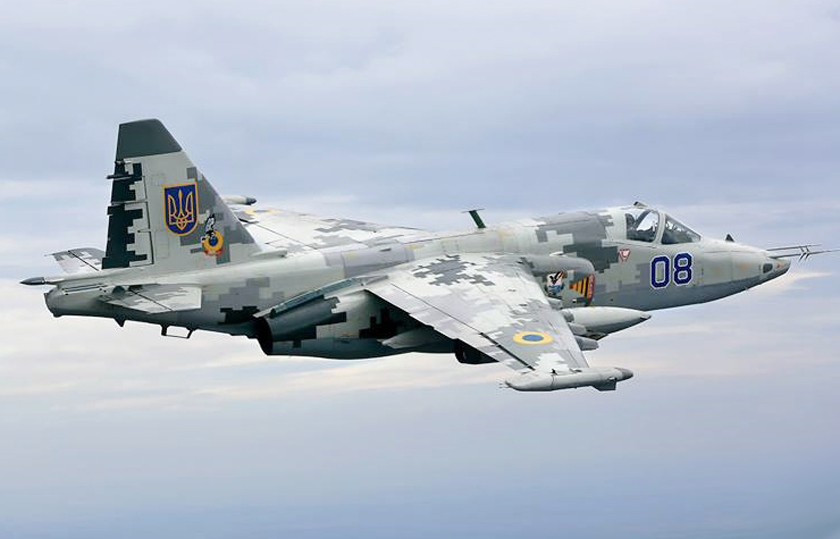
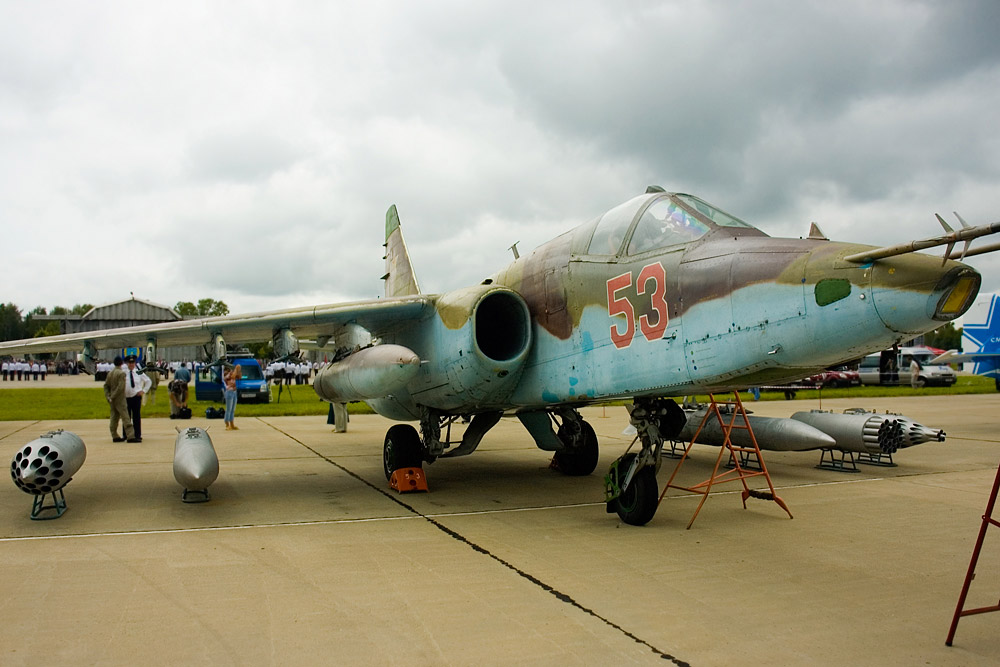
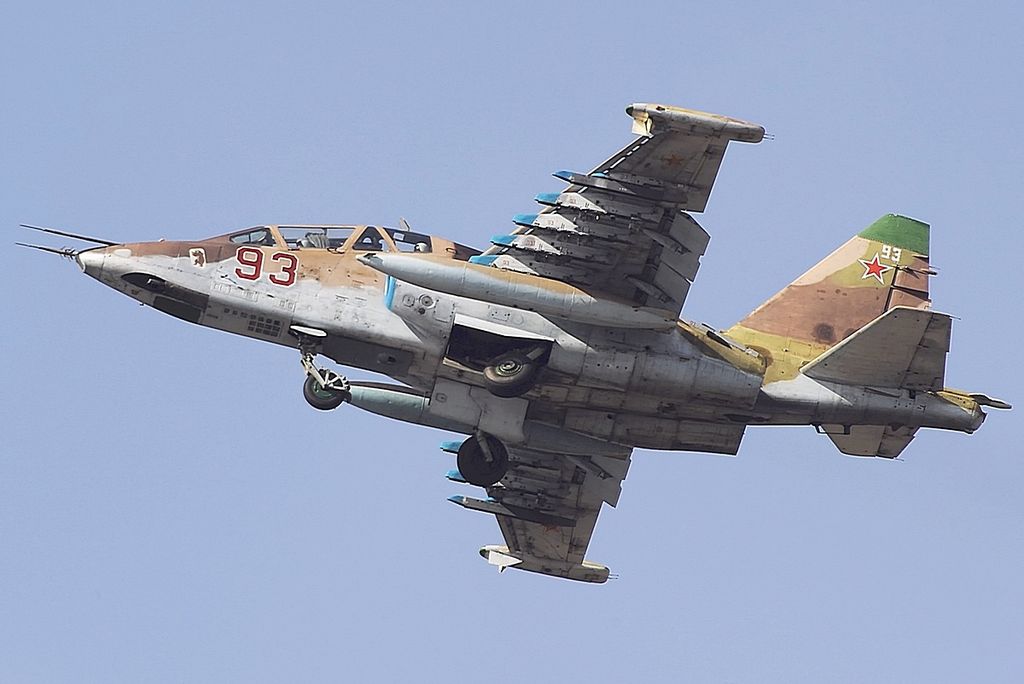
Su-25 Grach (Frogfoot) Russian Close Air Support Aircraft
Spotted an error? Sign in to suggest an edit.
Other
Basic Information
Name
Su-25 Grach (Frogfoot) Russian Close Air Support Aircraft
Designation
—
Alternate Designation
—
Equipment Type
—
Manufacturer
Sukhoi
Date of Introduction
1981
Description
The Su-25, which is no longer in serial production, made its first flight in 1979. This single-seat ground-attack aircraft is a very durable airplane - it is fairly heavily armored -- and easy to service - all service equipment can be stored in a container and transported by the airplane itself. It is armed with one twin barrel 30mm gun in the bottom of the fuselage with 250 rounds. There are 8 pylons under the wings that can carry about 4,000 kg of air-to-ground weapons, including 57mm to 330mm rockets. There are two small outboard pylons for AA-2D/ATOLL or AA-8/APHID AAMs.
Air & Air Defense Specifications
Crew
1
Engine
Turbojet (9039 hp)
Wingspan
14.36 m
Variants
Su-25
The basic version of the aircraft was produced at Factory 31, in Tbilisi, in the Soviet Republic of Georgia. Between 1978 and 1989, 582 single-seat Su-25s were produced in Georgia, not including aircraft produced under the Su-25K export program. This variant of the aircraft represents the backbone of the Russian Air Force's Su-25 fleet, currently the largest in the world. The aircraft experienced a number of accidents in operational service caused by system failures attributed to the salvo firing of weapons. In the wake of these incidents, the use of its main armament, the 240 mm S-24 rocket, was prohibited. In its place, the FAB-500 500 kg (1,100 lb) general-purpose high-explosive bomb became the primary armament.
Su-25K
The basic Su-25 model was used as the basis for a commercial export variant, known as the Su-25K (Komercheskiy). This model was also built at Factory 31 in Tbilisi, Georgia. The aircraft differed from the Soviet Air Force version in certain minor details concerning internal equipment. A total of 180 Su-25K aircraft were built between 1984 and 1989.
Su-25UB
The Su-25UB trainer (Uchebno-Boyevoy) was drawn up in 1977. The first prototype, called "T-8UB-1", was rolled out in July 1985 and its maiden flight was carried out at the Ulan-Ude factory airfield on 12 August of that year. By the end of 1986, 25 Su-25UBs had been produced at Ulan-Ude before the twin-seater completed its State trials and was officially cleared for service with the Soviet Air Force.
It was intended for training and evaluation flights of active-duty pilots, and for training pilot cadets at Soviet Air Force flying schools. The performance did not differ substantially from that of the single-seater. The navigation, attack, sighting devices, and weapons-control systems of the two-seater enabled it to be used for both routine training and weapons-training missions.
Su-25UBK
From 1986 to 1989, in parallel with the construction of the main Su-25UB combat training variant, the Ulan-Ude plant produced the so-called "commercial" Su-25UBK, intended for export to countries that bought the Su-25K, and with similar modifications to that aircraft.
Su-25UBM
The Su-25UBM is a twin-seat variant that can be used as an operational trainer, but also has attack capabilities, and can be used for reconnaissance, target designation, and airborne control. Its first flight was on 6 December 2008 and it was certified in December 2010. It will enter operational use with the Russian Air Force later. The variant has a Phazotron NIIR Kopyo radar and Bars-2 equipment on board. Su-25UBM's range is believed to be 1,300 km (810 mi) and it may have protection against infra-red guided missiles (IRGM), a minimal requirement on today's battlefields where IRGMs proliferate.
Su-25UTG
The Su-25UTG (Uchebno-Trenirovochnyy s Gakom) is a variant of the Su-25UB designed to train pilots in takeoff and landing on a land-based simulated carrier deck, with a sloping ski-jump section and arrester wires. The first one flew in September 1988, and approximately 10 were produced. About half remained in Russian service after 1991; they were used on Russia's sole aircraft carrier, Admiral Kuznetsov. This small number of aircraft was insufficient to meet the training needs of Russia's carrier air group, so a number of Su-25UBs were converted into Su-25UTGs. These aircraft are distinguished by the alternative designation Su-25UBP (Uchebno-Boyevoy Palubny)—the adjective palubnyy meaning "deck", indicating that these aircraft have a naval function. Approximately 10 of these aircraft are currently operational in the Russian Navy as part of the 279th Naval Aviation Regiment.
Su-25BM
The Su-25BM (Buksirovshchik Misheney) is a target-towing variant of the Su-25 whose development began in 1986. The prototype, designated T-8BM1, successfully flew for the first time on 22 March 1990, at Tbilisi. After completion of the test phase, the aircraft was put into production.
The Su-25BM target-tower was designed to provide towed target facilities for training ground forces and naval personnel in ground-to-air or naval surface-to-air missile systems. It is powered by an R-195 engine and equipped with an RSDN-10 long-range navigation system, an analog of the Western LORAN system.
Su-25T
The Su-25T (Tankovy) is a dedicated antitank version, which has been combat-tested with notable success in Chechnya. The design of the aircraft is similar to the Su-25UB. The variant was converted to a one-seater, with the rear seat replaced by additional avionics. It has all-weather and night attack capability. In addition to the full arsenal of weapons of the standard Su-25, the Su-25T can employ the KAB-500Kr TV-guided bomb and the semi-active laser-guided Kh-25ML. Its enlarged nosecone houses the Shkval optical TV and aiming system with the Prichal laser rangefinder and target designator. It can also carry Vikhr laser-guided, tube-launched missiles, which is its main antitank armament. For night operations, the low-light TV Merkuriy pod system can be carried under the fuselage. Three Su-25Ts prototypes were built in 1983–86 and 8 production aircraft were built in 1990. With the introduction of a definitive Russian Air Force Su-25 upgrade program, in the form of Stroyevoy Modernizirovannyi, the Su-25T program was officially canceled in 2000.
Su-25TM (Su-39)
A second-generation Su-25T, the Su-25TM (also designated Su-39), has been developed with improved navigation and attack systems, and better survivability. While retaining the built-in Shkval of Su-25T, it may carry Kopyo (rus. "Spear") radar in the container under the fuselage, which is used for engaging air targets (with RVV-AE/R-77 missiles) as well as ships (with Kh-31 and Kh-35 anti-ship missiles). The Russian Air Force has received 8 aircraft as of 2008. Some of the improved avionics systems designed for T and TM variants have been included in the Su-25SM, an interim upgrade of the operational Russian Air Force Su-25, for improved survivability and combat capability. The Su-25TM, as an all-inclusive upgrade program has been replaced with the "affordable" Su-25SM program.
Su-25SM
The Su-25SM (Stroyevoy Modernizirovannyi) is an "affordable" upgrade program for the Su-25, conceived by the Russian Air Force in 2000. The program stems from the attempted Su-25T and Su-25TM upgrades, which were evaluated and labeled as over-sophisticated and expensive. The SM upgrade incorporates avionics enhancements and airframe refurbishment to extend the Frogfoot's service life by up to 500 flight hours or 5 years.
The Su-25SM's all-new PRnK-25SM "Bars" navigation/attack suite is built around the BTsVM-90 digital computer system, originally planned for the Su-25TM upgrade program. Navigation and attack precision provided by the new suite is three times better than the baseline Su-25 and is reported to be within 15 m (49 ft) using satellite correction and 200 m (660 ft) without it.
Su-25KM
The Su-25KM (Kommercheskiy Modernizirovannyy), nicknamed "Scorpion", is a Su-25 upgrade program announced in early 2001 by the original manufacturer, Tbilisi Aircraft Manufacturing in Georgia, in partnership with Elbit Systems of Israel. The prototype aircraft made its maiden flight on 18 April 2001 at Tbilisi in full Georgian Air Force markings.
The aircraft uses a standard Su-25 airframe, enhanced with advanced avionics including a glass cockpit, digital map generator, helmet-mounted display, computerized weapons system, complete mission pre-plan capability, and fully redundant backup modes. Performance enhancements include a highly accurate navigation system, pinpoint weapon delivery systems, all-weather and day/night performance, NATO compatibility, state-of-the-art safety, and survivability features, and advanced onboard debriefing capabilities complying with international requirements. It has the ability to use Mark 82 and Mark 83 laser-guided bombs and air-to-air missiles, the short-range Vympel R-73.
Su-28
The Sukhoi Su-28 (also designated Su-25UT – Uchebno-Trenirovochnyy) is an advanced basic jet trainer, built on the basis of the Su-25UB as a private initiative by the Sukhoi Design Bureau. The Su-28 is a light aircraft designed to replace the Czechoslovak Aero L-39 Albatros. Unlike the basic Su-25UB, it lacks a weapons-control system, built-in cannon, weapons hardpoints, and engine armor.
Su-25R (Razvedchik)
a tactical reconnaissance variant designed in 1978, but never built.
Su-25U3
also known as the "Russian Troika", was a three-seat basic trainer aircraft. The project was suspended in 1991 due to a lack of funding.
Su-25U (Uchebnyy)
a trainer variant of Su-25s produced in Georgia between 1996 and 1998. Three aircraft were built in total, all for the Georgian Air Force.
Su-25M1/Su-25UBM1
Su-25 and Su-25UB exemplars slightly modernized by Ukrainian Air Force, at least nine modernized (eight single-seat and one two-seat). Upgrades include a new navigation system, enhanced survivability, more accurate weapon delivery, and other minor changes
Ge-31
is an ongoing Georgian program of Tbilisi Aircraft Manufacturing aiming at producing a renewed version of Su-25 without Russian components and parts.
System
Alternate Designation(s)
Su-25 Grach; NATO: Frogfoot
Primary Function / Type
Close Air Support Attack Aircraft
Manufacturer
Sukhoi
Crew
1 ea
Number of Engines
2 ea
Number of Hard Points
11 hardpoints with a capacity of up to 4,400 kg (9,700 lb) of stores
Dimensions
Length
15.53 m
Height
4.80 m
Wingspan
14.36 m
Wing Area
33.70 m sq
Weight, Empty
9,500 kg
Weight, Normal Takeoff
14,600 kg
Weight, Maximum Takeoff
17,600 kg
Weight, Maximum Overload
19,200 kg
Maximum Weapon Load
4,400 kg
Automotive
Engine Name
2 x Ryzhov (Tumansky) R-95
Engine Type
Turbojet
Engine Power
9,039 lb (4,100 kg) static thrust each
Fuel Capacity
6,415 liters
Speed, Maximum Low Level
970 km/h
Speed, Landing
220 km/h
Takeoff Roll
930 m with max payload
Landing Roll
600 m
Rate of Climb
4,320 m/min
Ceiling
7,000 m
Turn Radius
570 m with 3,307-lb (1,500-kg) payload at 4,921 ft (1,500 m) at 248 knots (286 mph, 460 km/h)
Maximum Range at Low Level
405 nm (466 mi, 740 km) with 9,700-lb (4,400-kg) weapons load
Maximum Range at Altitude
675 nm (777 mi, 1,250 km) with same load as above
Main Gun System
System
Name
1 x Gryazev-Shipunov GSh-30-2
Type
Autocannon
Caliber
30 mm
Quantity
1 ea
Length
2,044 mm
Weight
105 kg
Barrels
2 ea
Action
Recoil operated
Rate of Fire
1,000-3,000 rpm
Muzzle Velocity
870 m/s
Maximum Firing Range
1,800m
Ammunition
Type
Rifle
Caliber
30 mm
Shell
30×165mm
Basic Load
250 rounds
Main Missile Systems
Maximum Weapons Load
4,400 kg
Main Missile System #1
Name
Kh-23 Grom; NATO: A S-7 Kerry
Type
Air-to-Air Missile
Manufacturer
Zvezda-Strela
Length
3.525 m
Diameter
27.5 cm
Wingspan
78.5 cm
Weight
287 kg
Warhead Weight
111 kg
Engine
Solid fuel rocket
Operational Range
2–10 km
Maximum Speed
2,160–2,700 km/h
Guidance System
Radio command guidance
Main Missile System #2
Name
Kh-25; NATO: AS-10 Karen
Type
Air-to-Ground Missile
Manufacturer
Zvezda-Strela
Length
370.5 cm
Diameter
27.5 cm
Wingspan
75.5 cm
Warhead
High explosive, shell-forming
Warhead Weight
89.6 kg
Operational Range
11 km
Maximum Speed
1,370–2,410 km/h
Guidance System
Laser guidance, passive radar, TV guidance, IIR, Satellite guidance, active radar homing depending on varian
Rocket Weapon Systems
Rocket Weapon System #1
Name
S-8
Type
HEAT Rocket
Manufacturer
INA
Length
1.56 m
Diameter
INA
Weight
11.5 kg
Warhead Weight
3.6 kg
(0.9 kg of Hecphol-5/A-IX-10 explosive)
Effective Range
1.3 to 4 km
Note
Basic variant. 350 mm versus RHA. Velocity 692 m/s. N-26A fuze. BIK-2D motor powder. During launch of this model may have black smoke.
Bomb Weapon Systems
Bomb #1
Name
BETAB-500
Type
Concrete-Piercing Bomb
Length
2,200 mm
Diameter
350 mm
Weight
477 kg
Explosive Weight
98 kg
Release Altitude
30–5,000 m
Release Speed
600–1,200 km/h
Fire Control / Avionics
Fire Control System Type
INA
Fire Control Radar
INA
Laser Desingator
INA
IFF
Yes
Protection
Stealth Properties
No
Heat Signature Reduction
INA
Add on Armor
INA
NBC Protection
INA
EW Counter Measures
INA
Chaffs/Flares
INA
Image Sources
Notes
https://en.m.wikipedia.org/wiki/File:Sukhoi_Su-25_in_Ukrainian_service_269_n_%28cropped%29.jpg; https://www.quora.com/What-are-Russia-and-Chinas-equivalent-of-the-A-10-Thunderbolt-II-close-air-support-aircraft-of-America; https://www.armyrecognition.com/news/aerospace-news/2020/belarus-receives-four-repaired-su-25-cas-aircraft;
Details
Country of Origin
Russia
Category
Fixed Wing Aircraft
Air > Fixed Wing Aircraft
Filter Label
S
Classification
Domain
Air & Air Defense
Equipment Status
Active
Dimensions
Length
15.53 m
Width
—
Height
4.8 m
Weight
14600 kg
Operators (25)
Russia
Ukraine
Iran
North Korea
Czech Republic
Belarus
Angola
Armenia
Azerbaijan
Bulgaria
Chad
Congo, Republic of the
Côte d'Ivoire
Croatia
Ethiopia
Gambia
Georgia
Iraq
Malaysia
Niger
Peru
Sudan
Turkmenistan
Uzbekistan
CFE Treaty
Something went wrong. Please reload the page.
Reload