Tu-95 (Bear) Russian Strategic Bomber Aircraft
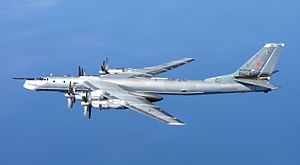


The Tupolev Tu-95 (Russian: Туполев Ту-95; NATO reporting name: "Bear") is a large, four-engine turboprop-powered strategic bomber and missile platform. First flown in 1952, the Tu-95 entered service with the Soviet Union in 1956 and is expected to serve the Russian Aerospace Forces until at least 2040. A development of the bomber for maritime patrol is designated Tu-142, while a passenger airliner derivative was called Tu-114. The aircraft has four Kuznetsov NK-12 engines with contra-rotating propellers. It is the only propeller-powered strategic bomber still in operational use today. The Tu-95 is one of the loudest military aircraft, particularly because the tips of the propeller blades move faster than the speed of sound. Its distinctive swept-back wings are set at an angle of 35°. The Tu-95 is unique as a propeller-driven aircraft with swept wings that has been built in large numbers. The design bureau, led by Andrei Tupolev, designed the Soviet Union's first intercontinental bomber, the 1949 Tu-85, a scaled-up version of the Tu-4, a Boeing B-29 Superfortress copy. A new requirement was issued to both Tupolev and Myasishchev design bureaus in 1950: the proposed bomber had to have an un-refueled range of 8,000 km (4,970 mi)—far enough to threaten key targets in the United States. Other goals included the ability to carry an 11,000 kg (24,200 pounds) load over the target. Tupolev was faced with selecting a suitable type of powerplant: the Tu-4 showed that piston engines were not powerful enough for such a large aircraft, and the AM-3 jet engines for the proposed T-4 intercontinental jet bomber used too much fuel to give the required range. Turboprop engines were more powerful than piston engines and gave better range than the turbojets available at the time, and gave a top speed between the two. Turboprops were also initially selected for the Boeing B-52 Stratofortress to meet its long range requirement,[6] and for the British long-range transport aircraft, the Saunders-Roe Princess, the Bristol Brabazon and the Bristol Britannia. Tupolev proposed a turboprop installation and Tu-95 design with this configuration was officially approved by the government on 11 July 1951. It used four Kuznetsov coupled turboprops, each fitted with two contra-rotating propellers with four blades each, with a nominal 8,948 kW (12,000 effective shaft horse power [eshp]) power rating. The engine, advanced for its time, was designed by a German team of ex-Junkers prisoner-engineers under Ferdinand Brandner. The fuselage was conventional with a mid-mounted wing with 35 degrees of sweep, an angle which ensured that the main wing spar passed through the fuselage in front of the bomb bay. Retractable tricycle landing gear was fitted, with all three gear strut units retracting rearwards, with the main gear units retracting rearwards into extensions of the inner engine nacelles. The Tu-95/I, with 2TV-2F engines, first flew in November 1952 with test pilot Alexey Perelet at the controls.After six months of test flights this aircraft suffered a propeller gearbox failure and crashed, killing Perelet. The second aircraft, Tu-95/II used four 12,000 eshp Kuznetsov NK-12 turboprops which proved more reliable than the coupled 2TV-2F. After a successful flight testing phase, series production of the Tu-95 started in January 1956. For a long time, the Tu-95 was known to U.S./NATO intelligence as the Tu-20. While this was the original Soviet Air Force designation for the aircraft, by the time it was being supplied to operational units it was already better known under the Tu-95 designation used internally by Tupolev, and the Tu-20 designation quickly fell out of use in the USSR. Since the Tu-20 designation was used on many documents acquired by U.S. intelligence agents, the name continued to be used outside the Soviet Union. Initially the United States Department of Defense evaluated the Tu-95 as having a maximum speed of 644 km/h (400 mph) with a range of 12,500 km (7,800 mi). These numbers had to be revised upward numerous times. Like its American counterpart, the Boeing B-52 Stratofortress, the Tu-95 has continued to operate in the Russian Air Force while several subsequent iterations of bomber design have come and gone. Part of the reason for this longevity was its suitability, like the B-52, for modification to different missions. Whereas the Tu-95 was originally intended to drop free-falling nuclear weapons, it was subsequently modified to perform a wide range of roles, such as the deployment of cruise missiles, maritime patrol (Tu-142), and even civilian airliner (Tu-114). An AWACS platform (Tu-126) was developed from the Tu-114. An icon of the Cold War, the Tu-95 has served, not only as a weapons platform, but as a symbol of Soviet and later Russian national prestige. Russia's air force has received the first examples of a number of modernised strategic bombers in Tu-95MSs following upgrade work. Enhancements have been confined to the bomber's electronic weapons and targeting systems. Modernization Currently ongoing modernization of the Russia's Tu-95MS bombers is aimed primarily on the aircraft armament, namely adaptation of the new Kh-101/102 stealth cruise missile. The modernization includes installation of four underwing pylons for up to 8 Kh-101/102 cruise missiles as well as adjusting aircraft's main weapons bay for cruise missiles of size the Kh-101/102 (7.5 meters). Besides, the modernized Tu-95MS aircraft use radio-radar equipment and target-acquiring/navigation system based on GLONASS. The first Tu-95 modernized to carry the Kh-101/102 missiles was the Tu-95MS Saratov, rolled out at the Beriev aircraft plant in Taganrog in early 2015. It was transferred to the Russian Air Force in March 2015. Since 2015, the serial modernization is carried out also by the Aviakor aircraft plant in Samara at a rate of three aircraft per year. The first Tu-95 modernized by the Aviakor was the Tu-95MS Dubna, transferred to the Russian Air Force on 18 November 2015. In the future, Tu-95MSs are to be upgraded also with the new Kuznetsov NK-12MPM turboprop engines for increased flight range, combat load and reduced noise and vibrations and with the SVP-24 sighting and computing system from the Russian company Gefest & T. More complex modernization of the Tu-95MS16 bombers, known as "Tu-95MSM", is currently under development by Tupolev under a contract issued by the Russian Defence Ministry on 23 December 2009. This modernization is to include installation of the new Novella-NV1.021 radar, instead of the current Obzor-MS, installation of the SOI-021 information display system and the Meteor-NM2 airborne defense complex. In addition, the aircraft modernized to the "MSM" variant will be equipped with the upgraded Kuznetsov NK-12MPM turboprop engines. A contract for first modernized aircraft was signed in February 2018 with first flight scheduled for end of 2019.