ARMSNET
Military Equipment Database
Initializing 0%

JAS 39 Gripen Swedish Multirole Fighter Aircraft

JAS
Spotted an error? Sign in to suggest an edit.
Basic Information
Name
JAS 39 Gripen Swedish Multirole Fighter Aircraft
Designation
JAS
Alternate Designation
Equipment Type
Manufacturer
Saab
Date of Introduction
1996
Description

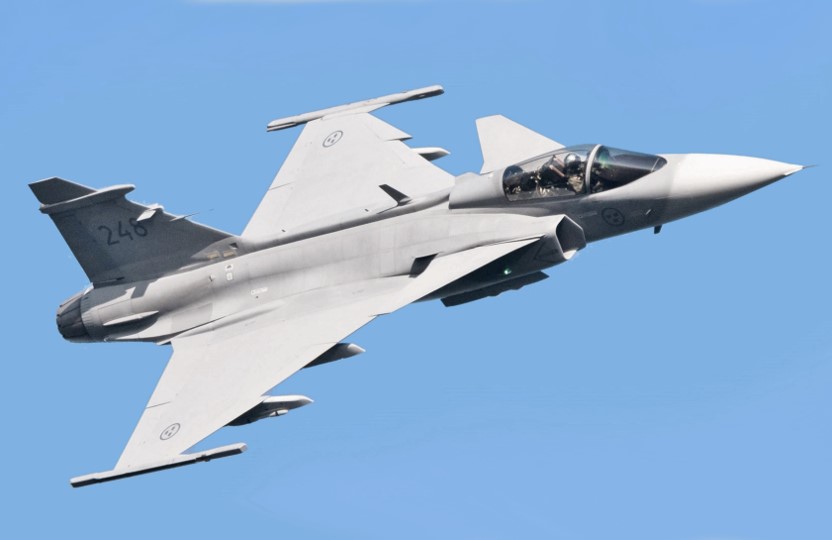
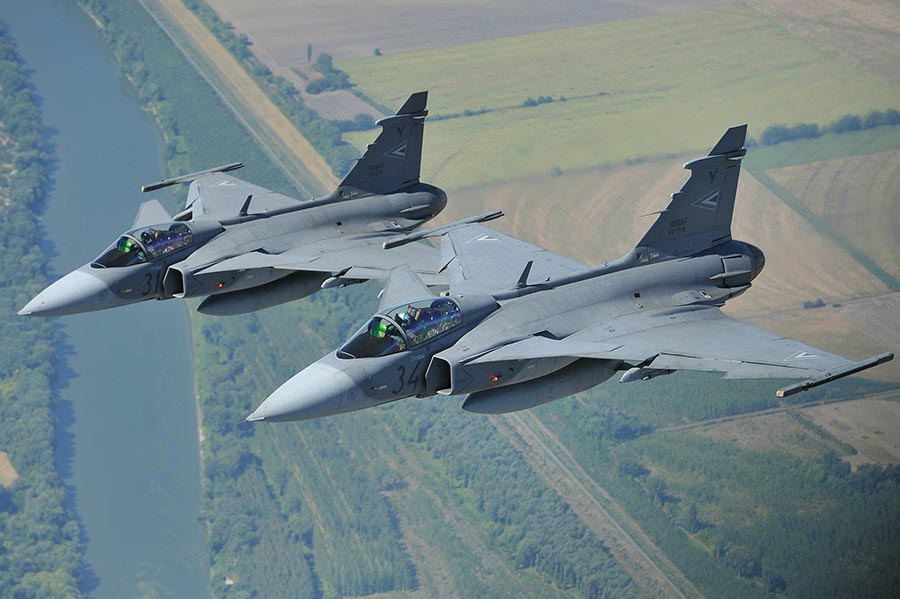
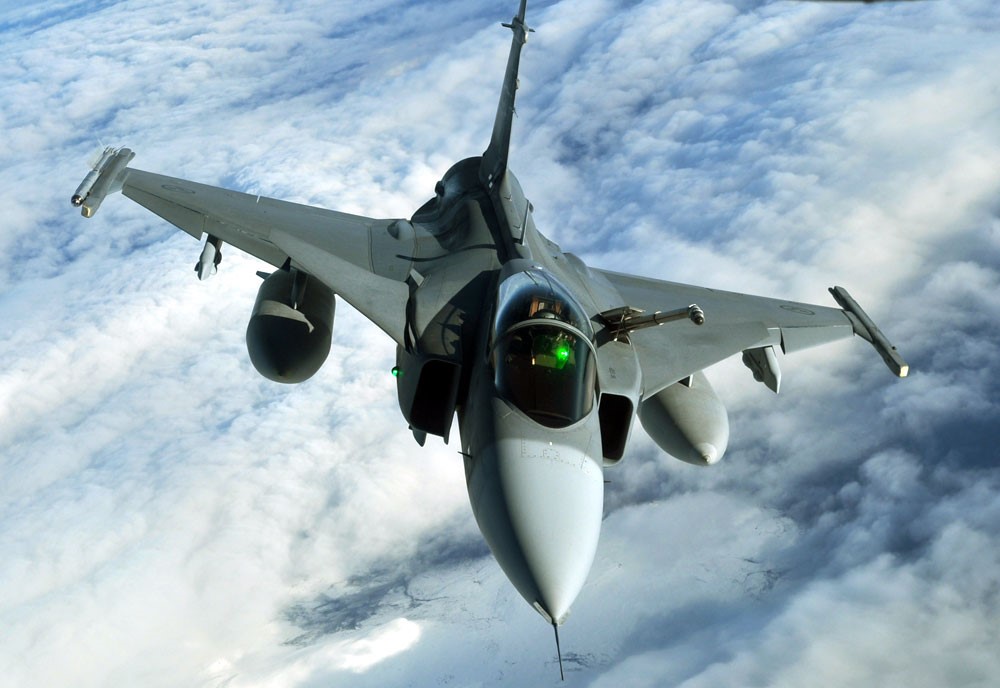
The Saab JAS 39 Gripen is a light single-engine multirole fighter aircraft manufactured by the Swedish aerospace company Saab. It was designed to replace the Saab 35 Draken and 37 Viggen in the Swedish Air Force (Flygvapnet). The Gripen has a delta wing and canard configuration with a relaxed stability design and fly-by-wire flight controls. It is powered by the Volvo RM12 and has a top speed of Mach 2. Later aircraft are modified for NATO interoperability standards and to undertake air to air refueling. In 1979, the Swedish government began development studies for aircraft capable of fighter, attack, and reconnaissance missions to replace the Saab 35 Draken and 37 Viggen. A new design from Saab was selected and developed as the JAS 39, first flying in 1988. Following two crashes during flight development and subsequent alterations to the aircraft's flight control software, the Gripen entered service with the Swedish Air Force in 1996. Upgraded variants, featuring more advanced avionics and adaptations for longer mission times, began entering service in 2003. o market the aircraft internationally, Saab formed partnerships and collaborative efforts with overseas aerospace companies. One example of such efforts was Gripen International, a joint partnership between Saab and BAE Systems formed in 2001. Gripen International was responsible for marketing the aircraft, and was heavily involved in the successful export of the type to South Africa; the organization was later dissolved amidst allegations of bribery being employed to secure foreign interest and sales. On the export market, the Gripen has achieved moderate success in sales to nations in Central Europe, South Africa, and Southeast Asia; bribery has been suspected in some of these procurements, but authorities closed the investigation in 2009. A further version designated Gripen JAS 39E/F, is beginning deliveries to the Swedish and Brazilian air forces as of 2019; it has previously been referred to as Gripen NG or Super-JAS. The changes include the adoption of a new power plant, the General Electric F414G, an active electronically scanned array radar and significantly increased internal fuel capacity. Saab has proposed other derivatives, including a navalized Gripen Maritime for carrier operations and an optionally manned aircraft for unmanned operations. Sweden and Brazil have ordered the Gripen E/F and Switzerland initially selected it for procurement. As of September 2019, 298 Gripens have been built. Gripen offers high agility, advanced target acquisition systems - including a powerful multi-role radar, modern weapons, low environmental signatures, and comprehensive electronic warfare (EW) suite. The JAS39 Gripen system is designed to counter all current and future threats. The aircraft has been developed for the Swedish Air Force by the Industry Group JAS (SAAB, Ericsson, Volvo Aero, and FFV Aerotech) in close cooperation with the Swedish Defence Material Administration (FMV). In partnership with Sweden’s Saab, British Aerospace is engaged in a number of marketing campaigns for the highly capable Gripen fourth-generation combat aircraft. Engineering activity associated with improving the operability of the aircraft in the export market is now underway. In 1995 Saab and British Aerospace (BAe) signed an agreement for the joint marketing of the Gripen. Hereby, Saab gained access to the global sales organization of British Aerospace, as well as to its governmental support in international marketing. British Aerospace will adapt the export version of the Gripen to NATO standards, and also produce certain subsystems for the aircraft. The agreement, which followed on more than a decade of cooperation between the two companies, became the basis for consolidation between Saab and British Aerospace. It also paves the way for SaabCs deepened integration with the European aerospace industry. Saab intends to be an active player along with British Aerospace, Aerospatiale (France), DASA (Germany), and CASA (Spain) in the creation of an integrated European defense and aerospace industry - Eurospace. In November 1998, South Africa announced that it will probably buy 28 Gripens. The value of the order is 12 billion SEK (1.5 billion USD) and the contract was expected to be signed in May or June of 1999. During the coming 10-15 years, Saab hopes to export at least 400 aircraft, on a total market for fighter aircraft estimated at 2,000 aircraft. The Gripen is currently being offered to Chile, the Philippines, the Czech Republic, Hungary, Austria, and Brazil. Another candidate, Poland, recently announced that it will choose the Boeing F 18 Hornet. An important factor when offering the Gripen for export is the aircraft missile system. Currently, the Gripens used by the Swedish Air Force are armed with AIM-120 AMRAAM, AIM-9 Sidewinder, the Saab Dynamics RBS 15 for ship targets, and the Maverick ground attack missile. Saab Dynamics cooperates with the major European missile manufacturers in the development of new air-to-air missiles for the Eurofighter, the Rafale, and the Gripen. The two main projects currently underway are the Meteor and the IRIS-T. The Meteor is a radar-guided, medium range (10-120 km.) air-to-air missile, which will compete with future versions of the Raytheon AIM-120 AMRAAM. The Meteor program features Matra BAe Dynamics, Saab Dynamics, Alenia Difesa, Marconi, and German LFK. The IRIS-T is an IR-guided, short-range air-to-air missile, primarily funded by Germany for the Eurofighter. The project group includes Bodenseewerk Geratechnik and Saab Dynamics.

Air & Air Defense Specifications
Crew 39
Max Speed 2450.0 km/h
Range 3000.0 km
Service Ceiling 16000 m
Variants
JAS 39A The initial version that entered service with the Swedish Air Force in 1996. A number have been upgraded to the C standard.
JAS 39B A two-seat version of the 39A for training, specialised missions and type conversion. To fit the second crew member and life support systems, the internal cannon and an internal fuel tank were removed and the airframe lengthened 0.66 m (2 ft 2 in).
JAS 39C A NATO-compatible version of Gripen with extended capabilities in terms of armament, electronics, etc. Can be refuelled in flight.
two-seat version of the 39C, with similar alterations as the 39B. A improved version following on from the Gripen Demo technology demonstrator. Changes from the JAS 39C/D include the more powerful F414G engine, Raven ES-05 AESA radar, increased fuel capacity and payload, two additional hardpoints, and other improvements. These improvements have reportedly increased the Gripen NG costs to an estimated 24,000 Swiss Francs (US$27,000) per hour,[390] and increased the flyaway cost to 100 million Swiss Francs (US$113M).
AS 39E A single-seat production version developed from the Gripen NG program, priced at US$85 million a unit. Sweden and Brazil have ordered the variant. Brazil's designation for this variant is F-39E
single-seat production version developed from the Gripen NG program, priced at US$85 million a unit.[392] Sweden and Brazil have ordered the variant.[84][173][235] Brazil's designation for this variant is F-39E A two-seat version of the E variant. Eight ordered by Brazil,[248] to be developed and assembled in São Bernardo do Campo, Brazil; planned for pilot training and combat, being optimised for back seat air battle management, with jamming, information warfare and network attack, besides weapon system officer and electronic warfare roles. Brazil's designation for the variant is F-39F.
System
Alternate Designation(s) JAS 39 Gripen
Primary Function / Type Fighter, attack, and reconnaissance aircraft
Manufacturer Saab Group
In Service 1996-Present
Crew JAS 39A/C 1 JAS 39B/D 2
Number of Engines 1
Day/Night Capable Yes
All Weather Capable Yes
Number of Pylons 5 (four wing, one centerline), 2 wingtip rails
Dimensions
Length JAS 39A/C: 14.1 m; JAS 39B/D: 14.8 m
Width (Wing Span) 8.4 m
Height 4.5 m
Wheelbase JAS 39A/C: 5.2 m; JAS 39B/D: 5.9 m
Weight, Empty JAS 39A: 6,500 kg; JAS 39B/D: 7,100 kg; JAS 39C: 6,800 kg
Weight, Maximum Takeoff JAS 39A: 12,500 kg; JAS 39B/D: 14,000 kg; JAS 39C: 14,000 kg
Weight, Total Load JAS 39B/D: 5,300 kg; JAS 39C: 5,300 kg
Automotive
Engine Name Volvo RM12 turbofan engine (now GKN Aerospace Engine Systems), a licence-manufactured derivative of General Electric F404, fed by a Y-duct with splitter plates; changes include increased performance and improved reliability to meet single engine use safety criteria, as well as a greater resistance to bird strike incidents.
Number of Engines 1 ea
Type The Volvo RM12 is a low-bypass afterburning turbofan jet engine developed for the Saab JAS 39 Gripen fighter.
Engine Power Maximum thrust: 54 kN (12,100 lbf) military thrust 80.5 kN (18,100 lbf) with afterburner
Maximum Range 3,000 km
Maximum Speed 2,450 km/h, Mach 2.0
Service Ceiling 16,000 m
Acceleration 30 sec Mach 0.5 to Mach 1.1
Climb Rate 100 sec, brake release to 32,084 ft (10,000 m) 180 sec, brake release to 45,932 ft (14,000 m)
Turn Rate 20 deg/sec sustained, 30 deg/sec instantaneous
Load 9 g/-3 g max
Cannon Weapon System
System
Name Mauser BK-27
Type Revolver Cannon
Caliber 27 mm
Manufacturer Mauser (now Rheinmetall)
In Service 1977-Present
Length 2.31 m
Barrel Length 1.73 m
Weight 100 kg
Barrel Single Barrel
Action Revolver
Rate of Fire 1,000–1,700 rpm
Muzzle Velocity 1,100 m/s
Ammunition
Type Rifle
Caliber 27 mm
Cartridge 27×145 mm
Basic Load 120 Rounds
Pylon Weapons System
Number of Pylons 5 (four wing, one centerline), 2 wingtip rails
Note The Gripen is compatible with a number of different armaments, beyond the aircraft's single 27 mm Mauser BK-27 cannon (omitted on the two-seat variants), including air-to-air missiles such as the AIM-9 Sidewinder, air-to-ground missiles such as the AGM-65 Maverick, and anti-ship missiles such as the RBS-15. In 2010, the Swedish Air Force's Gripen fleet completed the MS19 upgrade process, enabling compatibility with a range of weapons, including the long-range MBDA Meteor missile, the short-range IRIS-T missile and the GBU-49 laser-guided bomb.
Weapons Load 3,600 kg
Missile System (Option 1)
Name AIM-9 Sidewinder
Type Short-Range Air-to-Air Missile
In Service 1956-Present
Proliferation Widely Proliferated
Length 3.02 m
Diameter 127.0 mm
Warhead WDU-17/B annular blast-frag
Warhead Weight 9.4 kg
Detonation mechanism IR proximity fuze
Engine Hercules/Bermite Mk. 36 Solid-fuel rocket
Wingspan 279.4 mm
Operational Range 1.0 to 35.4 km
Speed Mach 2.5+
Guidance System Infrared homing (most models) semi-active radar homing (AIM-9C)
Launch Platform Aircraft, naval vessels, fixed launchers, and ground vehicles
Basic Load INA
Missile System (Option 2)
Name AGM-65 Maverick
Type Air-to-Ground Missile
Basic Load INA
Manufacturer Raytheon Missile Systems Raytheon
Proliferation 70,000+
Length 249 cm (8 ft 2 in)
Diameter 30 cm
Warhead 57 kg (126 lb) WDU-20/B shaped-charge (A/B/C/D/H models) 136 kg (300 lb) WDU-24/B penetrating blast-fragmentation (E/F/G/J/K models) E models utilize FMU-135/B delayed impact fuze
Weight 210–304 kg
Engine A/B:Thiokol SR109-TC-1 D/E/F/G/H/J/K: SR114-TC-1 (or Aerojet SR115-AJ-1) Solid propellant rocket motor via a WPU-4/B or WPU-8/B propulsion section
Wingspan 710 mm
Propellant Solid propellant
Operational Range Greater than 22 km
Speed 1,150 km/h
Guidance System system A/B/H/J/K:: Electro-optical guidance D/F/G: imaging infrared guidance E: Laser guidance
Missile System (Option 3)
Name RBS-15
Type Long-Range Fire-and-Forget Surface-to-Surface and Ar-to-Surface, Anti-Ship Missile.
Manufacturer Saab Bofors Dynamics, Diehl BGT Defence
In Service 1985-Present
Proliferation Widely Proliferated
Length 4.33 m
Diameter 50 cm
Wingspan 1.4 m
Warhead 200 kg HE blast and pre-fragmented warhead.
Detonation Mechanism impact or proximity
Engine Turbojet
Operational Range 70 km for RBS-15 Mk. I and II, 250 km for RBS-15 Mk. III, 300+km for RBS-15 MkV
Flight Altitude Sea skimming
Speed Subsonic
Guidance System inertial, GPS, terminal active radar homing (J band)
Launch Platform naval ships, aircraft and land-based missile launchers
Rockets
Note Bofors M70 rockets
Bombs
Note DWS 39 submunition dispenser, iron bombs
Fire Control / Avionics
Fire Control System Type INA
Fire Control Radar Saab PS-05A
PS-05A Radar The Gripen entered service using the PS-05/A pulse-Doppler X band multi-mode radar, developed by Ericsson and GEC-Marconi, which is based on the latter's advanced Blue Vixen radar for the Sea Harrier that also served as the basis for the Eurofighter's CAPTOR radar. The all-weather radar is capable of locating and identifying targets 120 km (74 mi) away,and automatically tracking multiple targets in the upper and lower spheres, on the ground and sea or in the air. It can guide several beyond visual range air-to-air missiles to multiple targets simultaneously. Saab stated the PS-05/A is able to handle all types of air defence, air-to-surface, and reconnaissance missions, and is developing a Mark 4 upgrade to it.The Mark 4 version has a 150% increase in high-altitude air-to-air detection ranges, detection and tracking of smaller targets at current ranges, 140% improvement in air-to-air mode at low altitude, and full integration of modern weapons such as the AIM-120C-7 AMRAAM, AIM-9X Sidewinder, and MBDA Meteor missiles.
Laser Desingator Yes
Reconnaissance Vinten Vicon 70 pod can be mounted on wingtip rails (to be replaced by MRPS)
Protection
Stealth Properties No
Heat Signature Reduction INA
Add on Armor INA
NBC Protection Yes
EW Counter Measures Yes, Rb 74 pod can be mounted on wingtip rails
Chaffs/Flares Yes
Details
Country of Origin Sweden
Category Fixed Wing Aircraft
Air > Fixed Wing Aircraft
Filter Label
J
Classification
Domain
Air & Air Defense
Equipment Status
Active
Dimensions
Length
39 m
Width
8.4 m
Height
4.5 m
Weight
39 kg
Operators (5)
United Kingdom
Sweden
Brazil
South Africa
Hungary
Something went wrong. Please reload the page. Reload