ARMSNET
Military Equipment Database
Initializing 0%

Herne British Extra Large Autonomous Underwater Vehicle (XLAUV)

Herne
French Autonomous Underwater Vehicle (AUV)
Spotted an error? Sign in to suggest an edit.
Basic Information
Name
Herne British Extra Large Autonomous Underwater Vehicle (XLAUV)
Designation
Herne
Alternate Designation
Herne
Equipment Type
French Autonomous Underwater Vehicle (AUV)
Manufacturer
BAE Systems
Date of Introduction
2024
Description

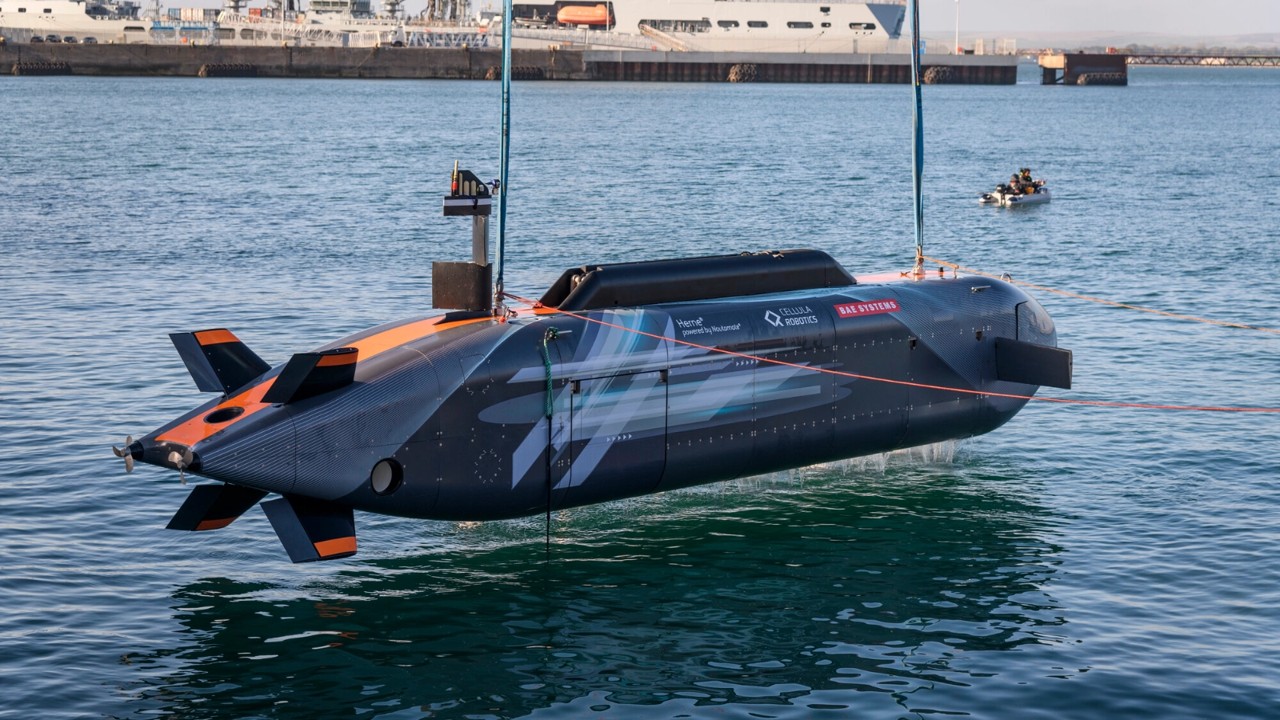
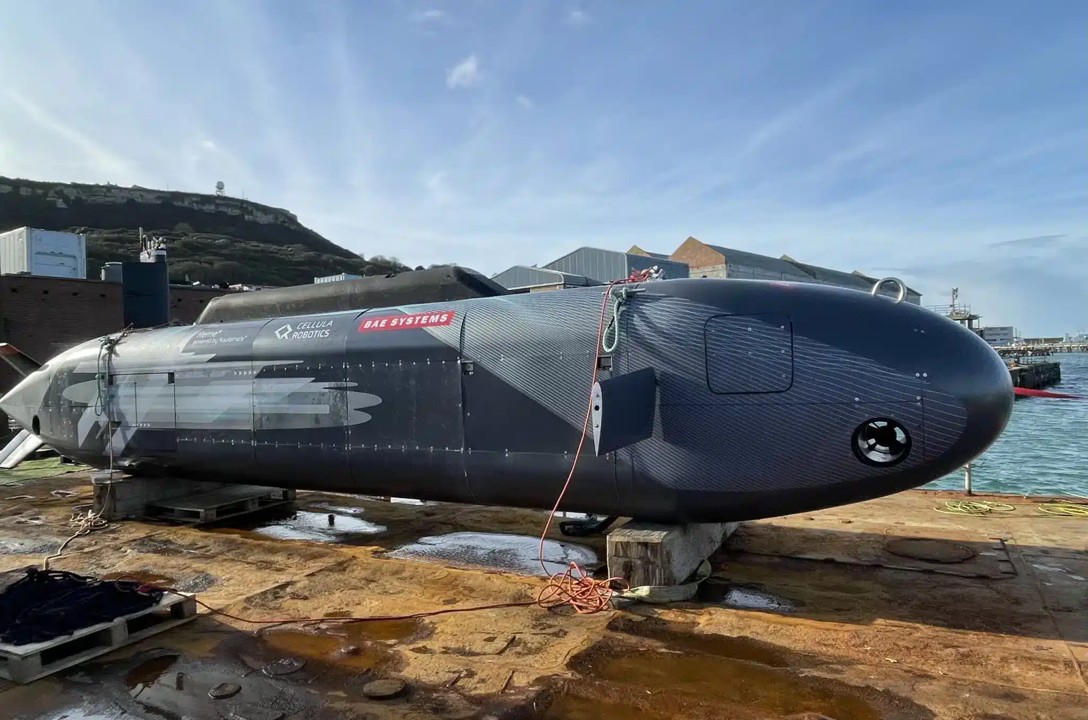
The Herne British Extra Large Autonomous Underwater Vehicle (XLAUV) marks a significant advancement in undersea warfare, integrating cost-effectiveness with advanced military capabilities. Developed by BAE Systems in collaboration with Cellula Robotics, Herne achieved operational demonstration status in November 2024 near Portsmouth, following an accelerated 11-month design-to-first-dive timeline. With a projected market-ready delivery by the end of 2026, Herne offers a viable alternative to traditional, high-cost platforms, while providing robust capabilities in intelligence, surveillance, reconnaissance (ISR), anti-submarine warfare (ASW), and critical infrastructure protection. The platform's importance extends beyond technical features, representing a strategic shift toward distributed maritime operations. This approach is particularly relevant for NATO and allied navies operating under fiscal constraints and within increasingly contested underwater environments. The demonstration, attended by representatives from over ten nations, including both NATO and non-NATO members, underscores the growing international demand for autonomous undersea systems. The vehicle is compatible with Type 26 Frigate mission bays and can be transported by heavy-lift aircraft such as the A400M. Herne aligns with the U.S. Navy's Distributed Maritime Operations framework and NATO's broader objectives for undersea battlespace superiority. Instead of relying solely on crewed platforms, navies can deploy Herne in coordinated networks, with each vehicle executing autonomous search patterns or maintaining persistent station-keeping while transmitting sensor data to command centers or surface vessels. The distributed ASW model envisions multiple Herne units patrolling extensive ocean areas ahead of crewed forces, providing early warning, enforcing area denial, and sustaining surveillance without endangering personnel. As threats to submarine cables, petroleum pipelines, and underwater communication systems from state and non-state actors increase, Herne's deep-diving capability, extended endurance, and autonomous surveillance facilitate continuous monitoring of critical infrastructure across large undersea regions. The vehicle's modular design supports integration of specialized detection systems for cable or pipeline monitoring. While traditional ASW depended on fixed sonar barriers (SOSUS) and crewed submarine patrols, Herne enables the deployment of distributed passive and active sonar arrays, each vehicle conducting acoustic surveillance and, with future weapons integration, delivering kinetic or non-kinetic ASW responses. The platform can accommodate towed-array or forward-looking sonar payloads, enhancing detection of adversary submarines at extended ranges while preserving stealth.

Naval & Littoral Specifications
Beam 1.70 m
System
Alternative Designation Herne
Type Extra Large Autonomous Underwater Vehicle (XLAUV)
Builder BAE Systems
Crew Unmanned
Autonomy and Mission Control Herne's operational independence derives from Nautomate, BAE Systems' platform-agnostic military-grade autonomy system. Developed over seven years primarily for autonomous surface platforms, Herne represents Nautomate's first underwater application. Nautomate manages mission planning, navigation, sensor data fusion, and secure communications without continuous human intervention. The system supports autonomous obstacle avoidance, terrain-following navigation, and independent target detection and classification. Critical to network-centric operations, Nautomate enables rapid mission re-tasking while the vehicle operates covertly.
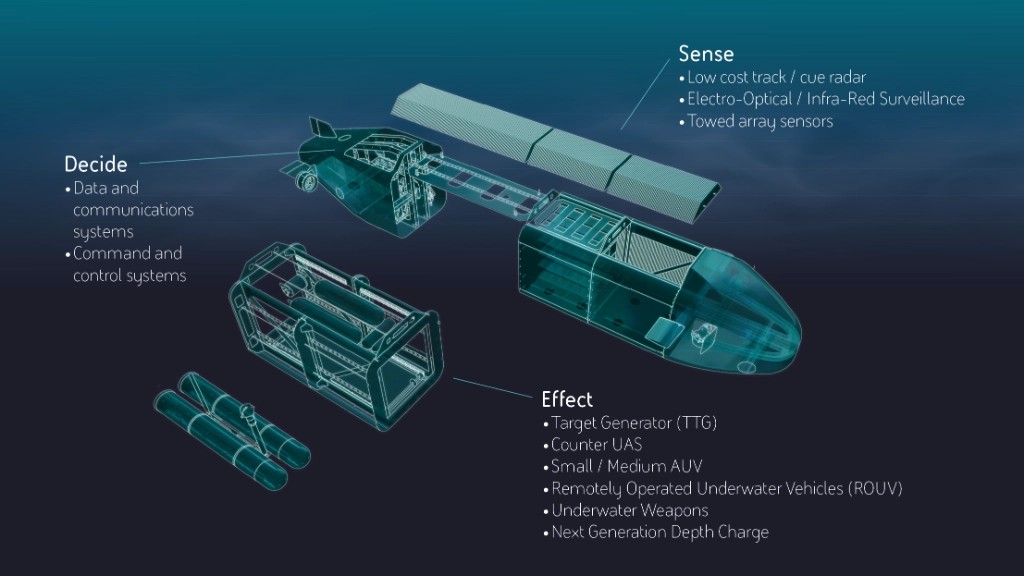
Payload Bay Configuration Herne's most operationally significant feature is its dual-payload architecture. Two modular payload bays, each offering 2,500-liter capacity, are located in fore and aft positions separated by the central battery and electronics housing. Critically, these bays can be reconfigured into a single 5,000-liter integrated bay to accommodate larger effectors such as lightweight torpedoes or extended sensor arrays.
Payload Swap Capability The vehicle is engineered for rapid mission reconfiguration. Payloads can be exchanged in as little as 50 minutes to 1.5 hours dockside through a simple mechanical interface requiring only four bolt disconnections and two electrical connector unplugs. This capability enables navies to repurpose the vehicle across multiple mission sets without extended downtime—a critical advantage in conflict scenarios or rapid response operations.
ISR Payload Integration nitial demonstrations featured an electro-optical ISR payload with onboard mast-mounted camera system. Significantly, Herne's machine vision system demonstrated autonomous target recognition, achieving 90% probability of identification for military cargo vessels through pattern matching against onboard databases. This autonomous classification capability represents a substantial advancement in reducing human-in-the-loop requirements for surveillance missions.
Dimensions
Length 12.0 m
Height INA
Beam 1.7 m
Displacement, Full Load 8–10 tons depending on power and payload configuration.
Note This compact footprint enables deployment from standard 40-foot shipping containers, a design constraint that dramatically enhances logistics and global deployability.
Propulsion System
Engine Name INA
Engine Type Herne utilizes two independently driven electric motors powering separate propellers, delivering redundancy critical for sustained autonomous operations.
Engine Power INA
Thrusters The vehicle is equipped with lateral and vertical thrusters enabling three-dimensional maneuvering essential for navigating complex undersea topography. This active control suite facilitates autonomous obstacle avoidance and enables precise positioning for sensor deployment or payload delivery.
Maximum Range 5,000 km
Maximum Speed 8 knots
Cruise Speed 3 knots. This seemingly modest cruise speed is operationally significant—it enables stealth operations while sufficient for deep-water deployment and transit in non-tidal environments.
Endurance The demonstrator configuration employs lithium-ion battery banks providing 7–10 days of endurance at typical cruise speeds. This endurance window is sufficient for littoral and near-coastal operations, limited submarine tracking missions, and infrastructure surveillance within defined operational areas. The transformative element of Herne's architecture lies in its scalable power approach. Hydrogen fuel cell integration—currently under development—will extend endurance to 45 days and operational range to 5,000 kilometers. This represents a fundamental shift in undersea persistence, enabling week-long transits to distant operational areas followed by multi-week station-keeping for surveillance or engagement operations. The hydrogen fuel cell upgrade, likely available in the 2027–2028 timeframe, positions Herne as competitive with Boeing's Orca in terms of strategic range while maintaining the cost and logistics advantages of the smaller platform.
Depth Capability Herne is rated to depths of 3,000 meters, placing it well beyond the operational envelope of most attack submarines (typically 300–600 meters for conventional designs) and matching or exceeding nuclear submarine depth ratings. This capability enables operations on continental shelves, abyssal plains, and other deep-sea environments inaccessible to crewed platforms, a strategic advantage in surveillance and infrastructure monitoring roles. Neutral buoyancy is maintained through a sophisticated combination of foam-filled buoyancy cells and active ballasting systems. The vehicle incorporates fail-safe programming enabling automatic surfacing or controlled sinking in the event of system malfunction.
Main Weapon System
Note BAE Systems has publicly announced integration of multiple advanced weapons and countermeasure systems planned for deployment within 18 months of trials conclusion: Stingray Lightweight Torpedo: Precision ASW weapon enabling autonomous torpedo delivery through reconfigured payload bay for anti-submarine operations. Archerfish Mine Disposal System: Proven mine countermeasure platform deployable from Herne for maritime area clearance operations. Next Generation Depth Charge: Compact anti-submarine ordnance optimized for shallow and near-coastal waters. Kingfisher Stand-Off ASW System: Naval gun-based depth charge and sonar deployment system designed for Type 26 integration, though tactical employment methodology from Herne remains to be clarified.
Protection
Hull Armor The construction employs a lightweight aluminum frame rather than traditional cylindrical pressure hulls, a significant departure from conventional submersible design. The fore and aft hull sections are sealed pressure vessels, while payload bays are free-flooding, requiring individual payload modules to be housed in smaller sealed pressure canisters. This modular architecture enables rapid reconfiguration for diverse mission profiles without requiring a complete vehicle redesign.
Countermeasures INA
NBC Water Washdown System No
Details
Country of Origin United Kingdom
Category Naval
Naval
Filter Label
H
Classification
Domain
Naval & Littoral
Equipment Status
Active
Dimensions
Length
12 m
Width
1.7 m
Height
Weight
Operators (2)
United States
United Kingdom
Something went wrong. Please reload the page. Reload