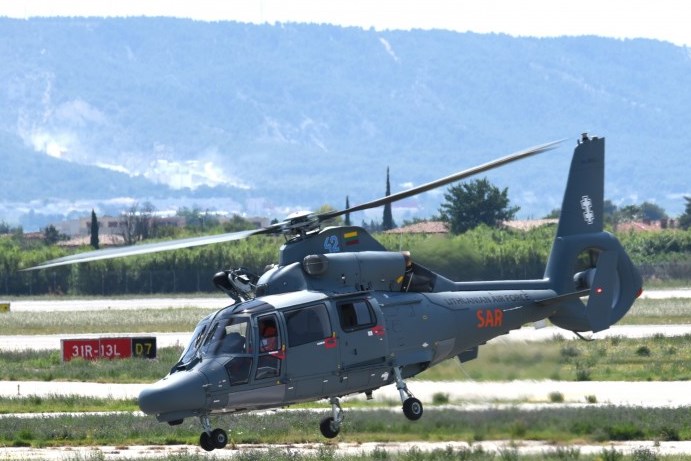
AS 565 Dauphin French Medium Utility Helicopter
AS365 Dauphin


The Eurocopter (now Airbus Helicopters) AS365 Dauphin (Dolphin), also formerly known as the Aérospatiale SA 365 Dauphin 2, is a medium-weight multipurpose twin-engine helicopter produced by Airbus Helicopters. It was originally developed and manufactured by French firm Aérospatiale, which was merged into the multinational Eurocopter company during the 1990s. Since entering production in 1975, the type has been in continuous production for more than 40 years. The intended successor to the Dauphin is the Airbus Helicopters H160, which is yet to enter operational service as of January 2020. The Dauphin 2 shares many similarities with the Aérospatiale SA 360, a commercially unsuccessful single-engine helicopter; however the twin-engine Dauphin 2 did meet with customer demand and has been operated by a wide variety of civil and military operators. Since the type's introduction in the 1970s, several major variations and specialised versions of the Dauphin 2 have been developed and entered production, including the military-oriented Eurocopter Panther, the air-sea rescue HH/MH-65 Dolphin, the Chinese-manufactured Harbin Z-9 and the modernised Eurocopter EC155. The AS365 Dauphin is a twin-engine helicopter capable of travelling long ranges, and well suited to operating in climates of a high ambient temperature or at locations of significant altitude. The Dauphin is typically powered by a pair of Turbomeca Arriel turboshaft engines; on later variants, these are equipped with FADEC units, which provide additional functionality such as an automated start-up sequence and a training mode. The engines drive the rotorcraft's foldable Starflex main rotor and its Fenestron anti-torque tail rotor via two separate transmissions; these gearboxes are also connected to two separate hydraulic systems as well as a stand-by hydraulic system for emergency use, such as deployment of the landing gear. Electrical power is provided by a pair of starter generators and a cadmium-nickel main battery, an emergency battery is also present. The main fuselage of the rotorcraft comprises the cabin area, a separate luggage compartment, and a retractable tricycle landing gear arrangement; a total of four conventional doors to access the main cabin are typically installed, which can be optionally replaced by a single clamshell air stair entrance instead. Various portions of the rotorcraft are made from composite materials, such as the rotor blades that made of carbon fiber, other materials are used in portions of the fuselage. The fuselage features anti-corrosion protection and is structurally reinforced for an optional hoist or cargo sling to be installed, various other mooring and gripping points are also fitted on the rotocraft's exterior surface. Various types and models of radar can be installed in the Dauphin's nose. The combination of the rotorcraft's Starflex main rotor and Fenestron tail provides a low-noise and low-vibration flight experience for those on board; Airbus Helicopters has claimed the sound emissions of the AS365 N3 to be 3.1 decibels below International Civil Aviation Organization (ICAO) standards, making it the quietest helicopter in its class. The Dauphin can take off under a full load from sea level under Category A conditions. The main cabin area is designed to be reconfigurable, a feature which is promoted to emergency medical service (EMS) and search and rescue (SAR) operators. In a regular passenger transport layout, the cabin can accommodate up to 12 passengers in addition to the two pilots; up to seven passengers can be accommodated in a VIP layout. Access to the cabin is via large sliding doors on either side of the helicopter, built-in boarding steps are typically installed to ease the boarding of passengers. While the cockpit is typically equipped with dual flight controls for two-man operations, the Dauphin can be readily flown by a single pilot while operating under instrument flight rules; this was achieved in part by avionics such as the 4-axis Dual Digital Automatic Flight Control System (older production aircraft use a 3-axis flight control system with integrated autopilot instead) to reduce crew workload. The principal flight control system are connected to a total of 3 dual-chamber primary servo-units for cyclical and collective pitch control, and a single dual-chamber rear servo-unit for tail rotor pitch control.[6] Other major avionics include 10.4-inch multi-mission touch screen displays, weather radar, global positioning system (GPS) receiver, traffic alert and collision avoidance system (TCAS), automatic voice alarm device (AVAD), health and usage monitoring system (HUMS), quick access records for helicopter flight data management, and digital audio communication system (DACS).
Missile System #1
deagel.com: https://www.deagel.com/x/x/a000772