Mistral Class French Amphibious Assault Ship
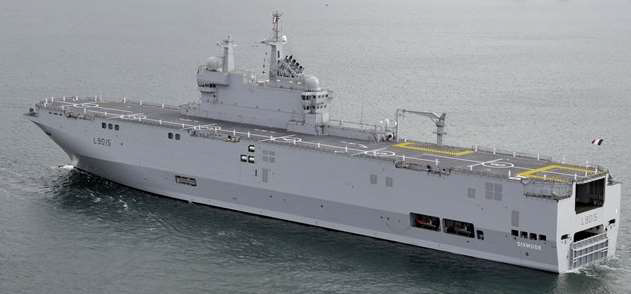

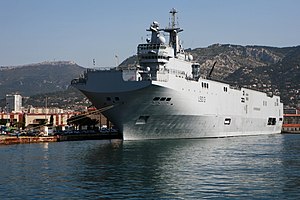
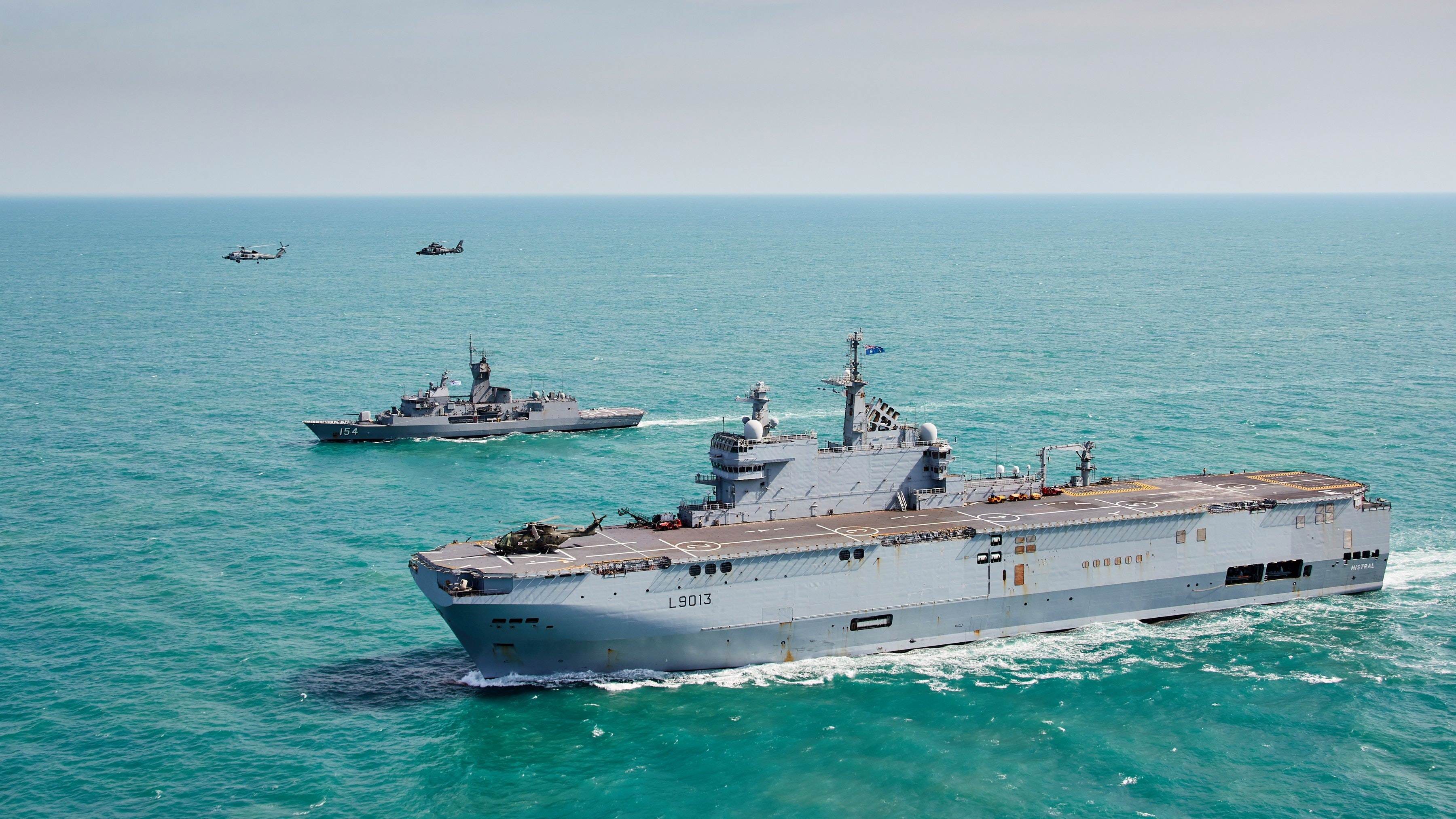
The Mistral-class is a class of five amphibious assault ships, also known as a helicopter carrier, of the French Navy. Referred to as "projection and command ships" (French: bâtiments de projection et de commandement or BPC), a Mistral-class ship is capable of transporting and deploying 16 NH90 or Tiger helicopters, four landing barges, up to 70 vehicles including 13 AMX Leclerc tanks, or a 40-strong Leclerc tank battalion, and 450 soldiers. The ships are equipped with a 69-bed hospital and are capable of serving as part of a NATO Response Force, or with United Nations or European Union peace-keeping forces. Three ships of the class are in service in the French Navy: Mistral, Tonnerre, and Dixmude. A deal for two ships for the Russian Navy was announced by then French President Nicolas Sarkozy on 24 December 2010, and signed by Russian Deputy Prime Minister Igor Sechin and French Defence Minister Alain Juppé in the presence of Sarkozy on 25 January 2011. On 3 September 2014, French President François Hollande announced the postponement of delivery of the first warship, Vladivostok, due to the Russia–Ukraine crisis. On 5 August 2015, President François Hollande and Russian President Vladimir Putin announced that France would pay back payments and keep the two ships initially produced for the Russian Navy; the two ships were later sold to Egypt. Based on displacement tonnage, Mistral and Tonnerre are the largest ships in the French Navy after the nuclear-powered aircraft carrier Charles de Gaulle, for roughly the same height above the water. Aviation The flight deck of each ship is approximately 6,400 square meters (69,000 sq ft). The deck has six helicopter landing spots, one of which is capable of supporting a 33-tonne helicopter. The 1,800-square-metre (19,000 sq ft) hangar deck can hold 16 helicopters and includes a maintenance area with an overhead crane. To aid launch and recovery, a DRBN-38A Decca Bridgemaster E250 landing radar and an Optical Landing System are used. The flight and hangar decks are connected by two aircraft lifts, each capable of lifting 13 tonnes. The 225-square-meter (2,420 sq ft) main lift is located near the stern of the ship, on the centreline, and is large enough for helicopters to be moved with their rotors in flight configuration. The 120 square meters (1,300 sq ft) auxiliary lift is located aft of the island superstructure. Every helicopter operated by the French military is capable of flying from these ships. On 8 February 2005, a Westland Lynx of the Navy and a Cougar landed on Mistral. The first landing of a NH90 took place on 9 March 2006. Half of the air group of the BPCs is to be constituted of NH-90s, the other half being composed of Tigre attack helicopters. On 19 April 2007, Puma, Écureuil, and Panther helicopters landed on Tonnerre. On 10 May 2007, a MH-53E Sea Dragon of the US Navy landed on her reinforced helicopter spot off the U.S. Naval Station Norfolk. According to Mistral's first commanding officer, Capitaine de vaisseau Gilles Humeau, the size of the flight and hangar decks would allow the operation of up to thirty helicopters. Mistral aviation capabilities approach those of the Wasp-class amphibious assault ships, for roughly 40% of the cost and crew requirements of the American ship. Amphibious transport Mistral-class ships can accommodate up to 450 soldiers, although this can be doubled for short-term deployments. The 2,650-square-metre (28,500 sq ft) vehicle hangar can carry a 40-strong Leclerc tank battalion, or a 13-strong Leclerc tank company, and 46 other vehicles. By comparison, Foudre-class ships can carry up to 100 vehicles, including 22 AMX-30 tanks, in the significantly smaller 1,000-square-metre (11,000 sq ft) deck. The 885-square-meter (9,530 sq ft) well deck can accommodate four landing craft. The ships are capable of operating two LCAC hovercraft, and although the French Navy appears to have no intention of purchasing any LCACs, this capability improves the class's ability to interoperate with the United States Marine Corps and the British Royal Navy. Instead, the DGA ordered eight French-designed 59-tonne EDA-R catamarans. Command and communications Mistral-class ships can be used as command and control ships, with an 850-square-meter (9,100 sq ft) command center which can host up to 150 personnel. Information from the ship's sensors is centralized in the SENIT system (Système d'Exploitation Navale des Informations Tactiques, "System for Naval Usage of Tactical Information"), a derivative of the US Navy's Naval Tactical Data System (NTDS). Problems in the development of the SENIT 9 revision contributed to the one-year delay in the delivery of the two ships. SENIT 9 is based around Thales' tri-dimensional MRR3D-NG Multi-Role Radar, which operates on the C band and incorporates IFF capabilities. SENIT 9 can also be connected to NATO data exchange formats through Link 11, Link 16, and Link 22. For communications, the Mistral-class ships use the SYRACUSE satellite system, based on French satellites SYRACUSE 3-A and SYRACUSE 3-B which provide 45% of the Super High Frequency secured communications of NATO. From 18 to 24 June 2007, a secure video conference was held twice a day between Tonnerre, then sailing from Brazil to South Africa, and VIP visitors at the Paris Air Show. Armament As of 2008, the two Mistral-class ships were armed with two Simbad launchers for Mistral missiles and four 12.7 mm M2-HB Browning machine guns. Two Breda-Mauser 30 mm/70 guns are also included in the design, though not installed as of 2009. Incidents such as the near-loss of the Israeli corvette INS Hanit to a Hezbollah-fired anti-ship missile during the 2006 Lebanon War have shown the vulnerability of modern warships to asymmetric threats, with the Mistral-class ships considered under-equipped for self-defense in such a situation. Consequently, Mistral and Tonnerre cannot be deployed into hostile waters without sufficient escorting ships. This problem is compounded by the small number of escort ships in the French Navy; there is a five-year gap between the decommissioning of the Suffren-class frigates and the commissioning of their replacements, the Horizon-class and FREMM frigates. Following the experiences of French naval commanders during Opération Baliste, the French deployment to aid European citizens in Lebanon during the 2006 war, proposals to improve the self-defense capabilities of the two Mistral-class ships were supported by one of the French chiefs of staff, and are under active consideration as of 2008. One suggestion is to upgrade the dual-launching, manual Simbad launchers to quadruple-launching, automatic Tetral launchers. In December 2014, the French Navy awarded a contract to Airbus to study the integration of the Multiple Launch Rocket System (MLRS) with Mistrals. This is an attempt to increase the ships' naval fire support capabilities, as current 76 mm and 100 mm guns have been determined to have insufficient range and lethality for the role. The MLRS is in service with the French Army, using a GPS-guided rocket with a range of 70 km (43 mi) and a unitary 90 kg (200 lb) high-explosive warhead. In late 2013 The French Navy equipped all three Mistral "BPC" ships with two M134 Miniguns each; intended for close-in self-defense against asymmetric threats faced during anti-piracy operations, such as speedboats and kamikaze boats. In late 2011, the French Navy selected the NARWHAL20 remote weapon station (RWS) to equip Mistral ships for close-in self-defense. Nexter Systems will deliver two NARWHAL20B guns for each ship, chambered in 20×139mm ammunition, with one gun covering the port bow and the other covering the starboard stern. The Dixmude was the first of the vessels outfitted with the cannons in March 2016. Hospital Each ship carries a NATO Role 3 medical facility, i.e., equivalent to the field hospital of an Army division or army corps, or to the hospital of a 25,000-inhabitant city, complete with dentistry, diagnostics, specialist surgical and medical capabilities, food hygiene, and psychological capabilities. A Syracuse-based telemedicine system allows complex specialized surgery to be performed. The 900 m2 hospital provides 20 rooms and 69 hospitalization beds, of which 7 are fit for intensive care. The two surgery blocks come complete with a radiology room providing digital radiography and ultrasonography, and that can be fitted with a mobile CT scanner. 50 medicalized beds are kept in reserve and can be installed in a helicopter hangar to extend the capacity of the hospital in case of emergency