ARMSNET
Military Equipment Database
Initializing 0%

Piranha-10 Russian Unmanned Aerial Vehicle (UAV)

Piranha-10
Tactical Unmanned Aerial Vehicle (UAV)
Spotted an error? Sign in to suggest an edit.
Basic Information
Name
Piranha-10 Russian Unmanned Aerial Vehicle (UAV)
Designation
Piranha-10
Alternate Designation
Piranha-10
Equipment Type
Tactical Unmanned Aerial Vehicle (UAV)
Manufacturer
Simbirsk Design Bureau (SKB) Piranha
Date of Introduction
2024
Description

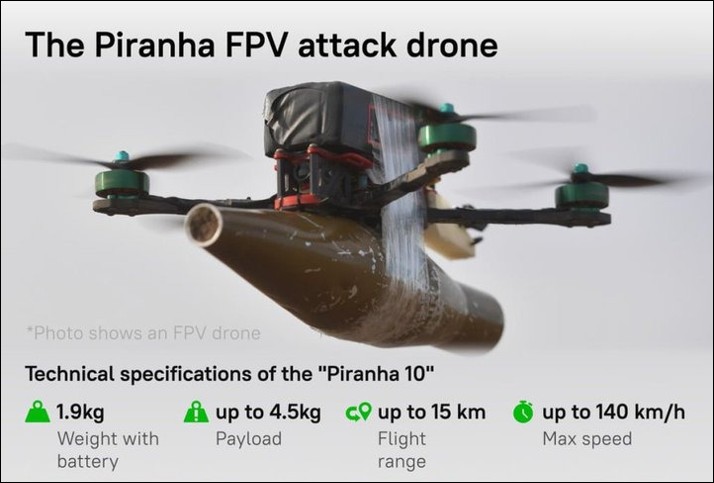
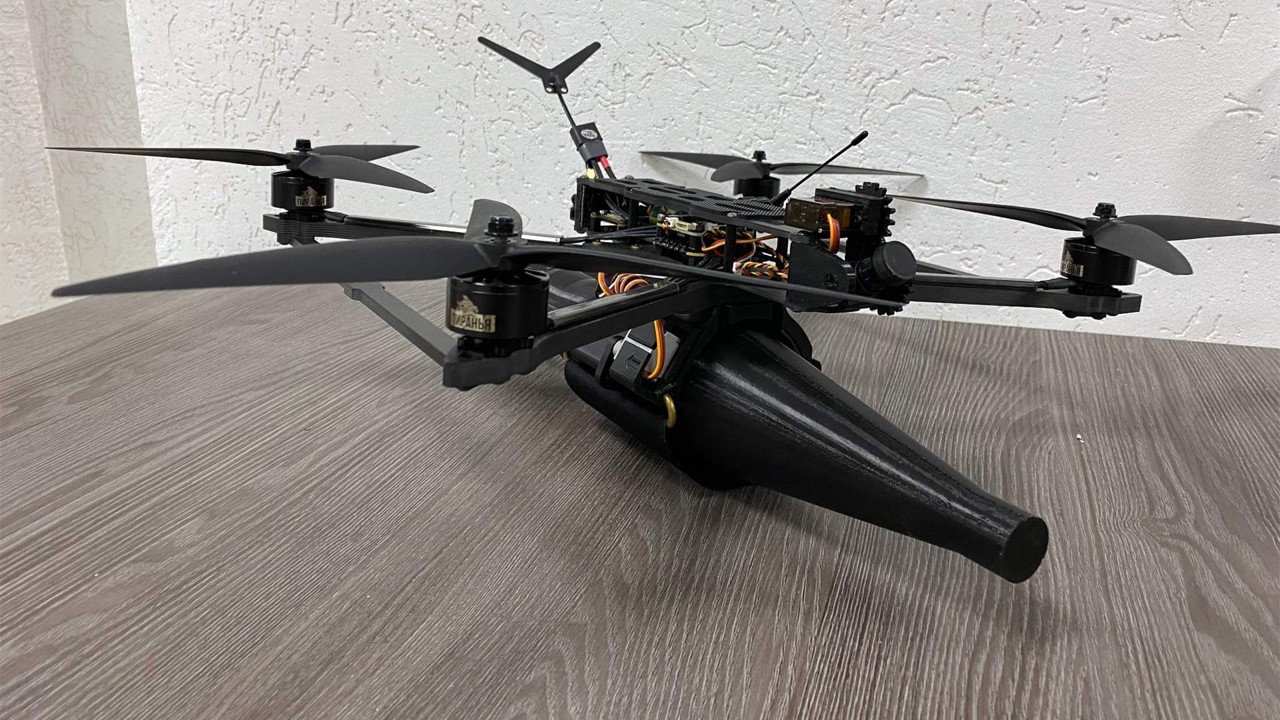
The Piranha-10 Russian Unmanned Aerial Vehicle (UAV) is the most well-known variant in the family and the model responsible for the destruction of the first M1A1 Abrams tank in Ukraine. The drone is tasked against personnel, light and heavy armored vehicles, strongpoints, dugouts, and other fortified positions. The tandem warhead capability is particularly significant because it can defeat explosive reactive armor (ERA), which is how the Piranha-10 was able to damage the M1A1 Abrams despite its reactive armor protection. The Piranha-10 represents the broader phenomenon of low-cost FPV drones reshaping ground combat in the Russia-Ukraine war. At roughly $500 per unit versus $6 million for an Abrams tank, the cost exchange ratio is approximately 12,000:1. While countermeasures (including active protection systems and improved EW) are expected to eventually reduce drone effectiveness, the current tactical environment heavily favors the proliferation of inexpensive strike UAVs capable of penetrating EW defenses.

Air & Air Defense Specifications
Engine Battery
Max Speed 140.0 km/h
Range 15.0 km
Endurance 35.00 hrs
Payload Capacity 4 kg
Variants
Available Configurations 64 (including night vision camera, thermal imager, reset/drop system, rotary camera).
System
Alternate Designation Piranha-10
Type Unmanned Aerial Vehicle (UAV)
Manufacturer Simbirsk Design Bureau (SKB) Piranha
Payload Capacity 4.5 kg
Electronic Warfare Resistance One of the Piranha-10's most touted features is its claimed resistance to electronic warfare (EW) jamming. The drone operates on proprietary, non-standard radio frequencies for both control and video links. According to a captured Russian military manual, the Piranha-10 uses 868 MHz and 915 MHz for aircraft control and 5.8 GHz for the video link. However, SKB Piranha has additionally developed a multi-frequency communication system that allows operators to switch radio channels in flight when jamming is detected. This means that if EW systems suppress one frequency, the operator can shift to another and continue the mission without losing control or video feed.
Dimensions
Length 525 mm
Width 570 mm
Height 60 mm
Weight with Battery 1.94 kg
Maximum Takeoff Weight 9.0 kg
Automotive
Engine Name INA
Engine Type Battery
Engine Power INA
Maximum Speed 140 km
Cruise Speed INA
Maximum Range 15 km
Service Ceiling INA
Endurance Flight time (no payload): 35 min; Flight time (max payload): 15 min
Armament
Warhead The Piranha-10 can carry the tandem cumulative warhead of the RPG-7VR reactive grenade at 8–10 km, or the lighter Monoblock cumulative PG-7VL grenades at 12–15 km.
Details
Country of Origin Russia
Category UAVs
Air > UAVs
Filter Label
P
Classification
Domain
Air & Air Defense
Equipment Status
Active
Dimensions
Length
0.53 m
Width
0.57 m
Height
0.06 m
Weight
9 kg
Operators (2)
Russia
Ukraine
Something went wrong. Please reload the page. Reload