ARMSNET
Military Equipment Database
Initializing 0%

F-5A Freedom Fighter American Supersonic Light Fighter Aircraft

F-5A
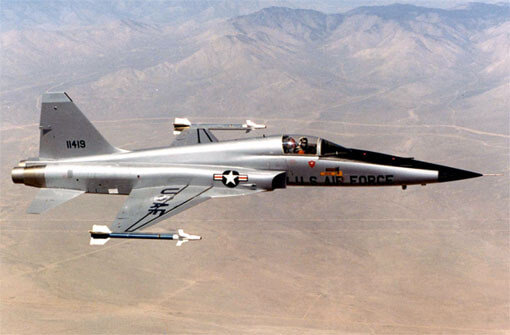
Supersonic Light Fighter Aircraft
Spotted an error? Sign in to suggest an edit.
Basic Information
Name
F-5A Freedom Fighter American Supersonic Light Fighter Aircraft
Designation
F-5A
Alternate Designation
Equipment Type
Supersonic Light Fighter Aircraft
Manufacturer
Northrop Grumman
Date of Introduction
1962
Description

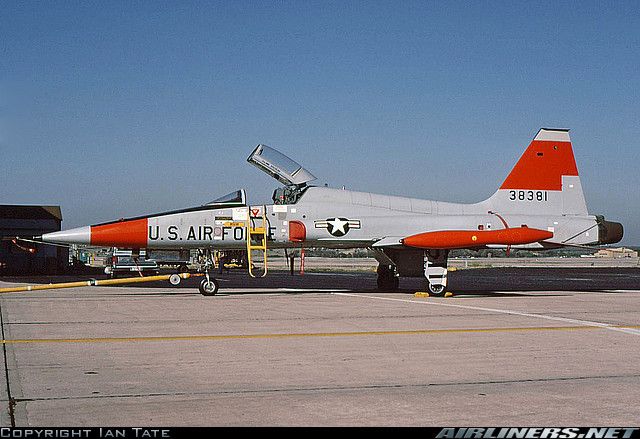
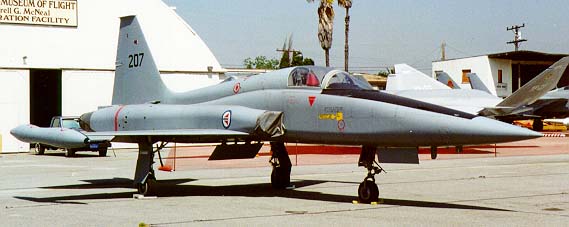
F-5A Single-seat fighter version of F-5, originally without radar, but was later equipped with AN/APQ-153 radar during upgrades. The Northrop F-5 is a family of supersonic light fighter aircraft initially designed as a privately funded project in the late 1950s by Northrop Corporation. There are two main models, the original F-5A and F-5B Freedom Fighter variants and the extensively updated F-5E and F-5F Tiger II variants. The design team wrapped a small, highly aerodynamic fighter around two compact and high-thrust General Electric J85 engines, focusing on performance and a low cost of maintenance. Smaller and simpler than contemporaries such as the McDonnell Douglas F-4 Phantom II, the F-5 cost less to procure and operate, making it a popular export aircraft. Though primarily designed for a day air superiority role, the aircraft is also a capable ground-attack platform. The F-5A entered service in the early 1960s. During the Cold War, over 800 were produced through 1972 for U.S. allies. Though at the time the United States Air Force (USAF) did not have a need for a light fighter, it did procure approximately 1,200 Northrop T-38 Talon trainer aircraft, which was based on Northrop's N-156 fighter design. After winning the International Fighter Aircraft Competition, a program aimed at providing effective low-cost fighters to American allies, in 1970 Northrop introduced the second-generation F-5E Tiger II in 1972. This upgrade included more powerful engines, larger fuel capacity, greater wing area and improved leading edge extensions for better turn rates, optional air-to-air refueling, and improved avionics including air-to-air radar. Primarily used by American allies, it remains in US service to support training exercises. It has served in a wide array of roles, being able to perform both air and ground attack duties; the type was used extensively in the Vietnam War. A total of 1,400 Tiger IIs were built before production ended in 1987. More than 3,800 F-5s and the closely related T-38 advanced trainer aircraft were produced in Hawthorne, California. The F-5N/F variants are in service with the United States Navy and United States Marine Corps as adversary trainers. Approximately 500 aircraft were in service as of 2014. The F-5 was also developed into a dedicated reconnaissance version, the RF-5 Tigereye. The F-5 also served as a starting point for a series of design studies which resulted in the Northrop YF-17 and the F/A-18 naval fighter aircraft. The Northrop F-20 Tigershark was an advanced variant to succeed the F-5E which was ultimately canceled when export customers did not emerge.

Air & Air Defense Specifications
Crew 1
Engine Turbojet
Max Speed 1489.0 km/h
Cruise Speed 904.0 km/h
Range 314.0 km
System
Alternate Designation(s) F-5A Freedom Fighter
Type Supersonic Light Fighter Aircraft
Manufacturer Northrop Corporation
Crew 1
Number of Engines 2
Number of Hard Points 7 total (only pylon stations 3, 4 and 5 are wet-plumbed): 2× wing-tip AAM launch rails, 4× under-wing & 1× under-fuselage pylon stations with a capacity of 3,200 kg.
Dimensions
Length 14.38 m
Width (Wing Span) 7.70 m
Wing Area 15.79 m sq
Height 4.06 m
Empty Weight 3,667 kg
Maximum Weapons Load 2,810 kg
Maximum Takeoff Weight 9,333 kg
Automotive
Engine Name 2 x General Electric J85-GE-13
Engine Type Turbojet
Engine Power, Dry 1,234 kg static thrust each
Engine Power, Afterburner 1,851 kg static thrust each
Fuel Capacity 2,207 liters
Maximum Speed 1,489 kph
Cruise Speed 904 kph
Stall Speed 237 kph
Climb Rate 8,748 m/min
Ceiling 15,789 m
Ferry Range 2,519 km tanks dropped
Radius 314 km hi-lo-hi with max payload and combat reserves
Main Gun System
System
Name 1 x M39 Autocannon
Type Single-Barrel Autocannon
Caliber 20 mm
Length 1.83 m
Weight 80.9 kg
Barrels Single barrel (progressive RH parabolic twist, 9 grooves)
Action Five-chamber revolver
Rate of Fire 1,500 rpm
Muzzle Velocity 1,030 m/s
Ammunition
Type Rifle
Caliber 20 mm
Cartridge 20×102 mm
Basic Load 280 Rounds
Main Missile Systems
Note 2 x AIM-9 Sidewinder AAM on wingtip launchers
Rocket Weapon Systems
Option 1 2× LAU-61/LAU-68 rocket pods (each with 19× /7× Hydra 70 mm rockets, respectively)
Option 2 2× LAU-5003 rocket pods (each with 19× CRV7 70 mm rockets)
Option 3 2× LAU-10 rocket pods (each with 4× Zuni 127 mm rockets)
Option 4 2× Matra rocket pods (each with 18× SNEB 68 mm rockets)
Bomb Weapon Systems
Note 9 x 500-lb (227-kg) bombs
Fire Control / Avionics
Fire Control Radar AN/APQ-153 Radar
Navigation Radar INA
Protection
Stealth Properties None
Heat Signature Reduction No
Add on Armor INA
NBC Protection INA
EW Counter Measures INA
Chaffs/Flares INA
Details
Country of Origin United States
Category Fixed Wing Aircraft
Air > Fixed Wing Aircraft
Filter Label
F
Classification
Domain
Air & Air Defense
Equipment Status
Active
Dimensions
Length
14.38 m
Width
7.7 m
Height
4.06 m
Weight
9333 kg
Operators (4)
United States
Turkey
Botswana
Yemen
Something went wrong. Please reload the page. Reload