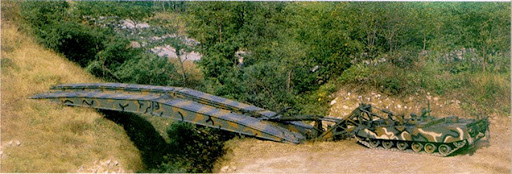
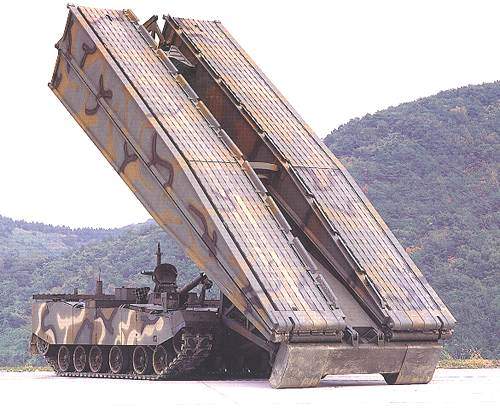
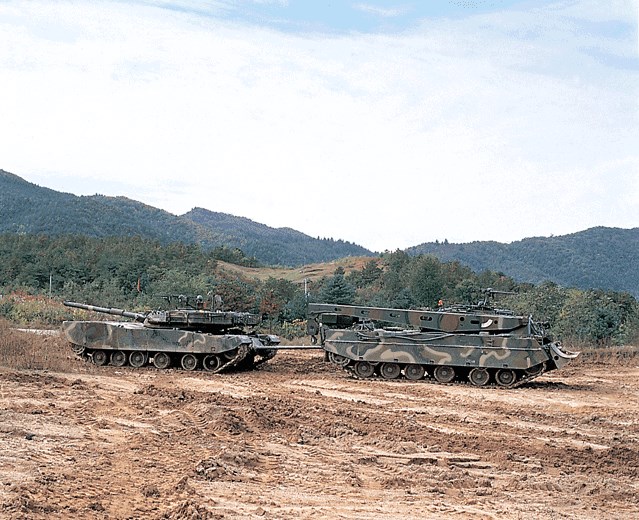
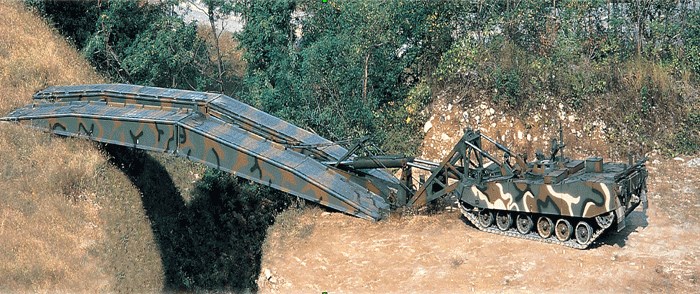
K1 AVLB South Korean Armored Vehicle-Launched Bridge
K1



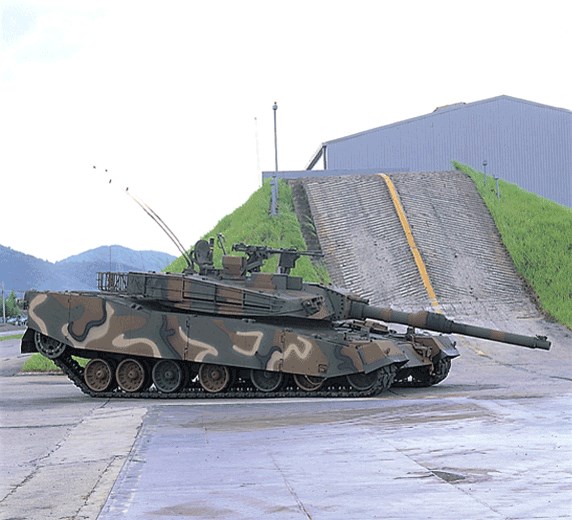
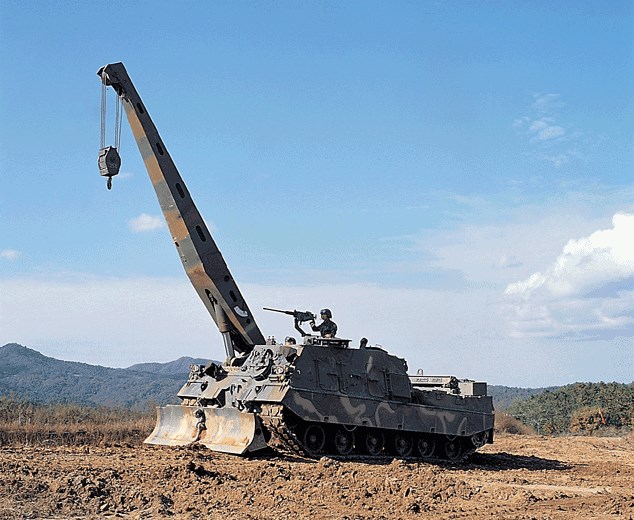


The K1 is a South Korean main battle tank in use with the Republic of Korea Armed Forces, developed by Hyundai Precision (later Hyundai Rotem). The vehicle's early design work was based on General Dynamics' M1 Abrams, with some noticeable differences including a combined system of hydropneumatics suspension and torsion bars, and a river-crossing fording kit, to meet the required operational capability that was specific to combat operations in the mountainous and swampy terrain of the Korean Peninsula. The K1A1 entered service in 1999, upgraded with a 120 mm smoothbore gun, and outfitted with more modern electronics, ballistic computers, and fire control systems developed by Samsung Electronics. Hyundai Rotem produced 1,511 K1 and K1A1 tanks between 1985 and 2010. In the 1970s, South Korea was desperately in need of additional main battle tanks. The M4A3E8 "Easy Eight" variant of Sherman tanks, dating back to World War II, had been retired from service by the South Korean army, and the backbone of the South Korean armored forces were M47 and M48 Patton tanks. Meanwhile, North Korea had both numerical and technological advantages over the South Korean armor with their T-62 main battle tanks. At first, attempts were made to obtain the United States' M60A1 Pattons, but they ended in failure. It was deemed that, even if the M60A1s were obtainable, there would not be enough of them to give the South Korean forces a significant advantage over existing North Korean tanks. A number of other plans were also devised, such as upgrading the existing M48 Pattons to the M48A3 and A5 standard, as well as obtaining the license to domestically produce Germany's Leopard 1 main battle tank. Only the upgrades to the Pattons were carried out, with the results being the M48A3K and M48A5K, while producing Leopard 1s was deemed counterproductive, as a newer generation of main battle tanks were already being developed and tested in both the U.S. and Germany, namely the M1 Abrams and Leopard 2. In light of this, the Park Chung-hee administration announced plans to domestically produce main battle tanks that were comparable to the newer generation of main battle tanks. However, having no experience in the design, development and manufacture of main battle tanks, the task assigned to South Korean industry was impossible without foreign assistance. Upon realization of this, foreign designs were considered and evaluated, on condition that the winning design be licensed and produced domestically. The winning design was based on the XM1, the prototype of M1 Abrams, by Chrysler Defense, the company which was later sold to General Dynamics and renamed General Dynamics Land Systems. Soon afterwards, South Korean officials were dispatched to General Dynamics Land Systems for supervision of the design, which would spawn the XK1. With its design being based on XM1, the XK1 shared various similarities with it. However, upon closer inspection, numerous differences can be found. The differences included the weight (55-ton XM1 versus 51-ton XK1), height (2.37 m versus 2.25 m), engine (1,500 hp Honeywell AGT1500C for XM1 versus 1,200 hp Teledyne Continental AVCR-1790, also used on Merkava 3, for XK1, although the XK1's engine will later be replaced with MTU MB Ka-501, a compact version of the 1,500 hp MB-873 Ka-503 used on Leopard 2), transmission (Allison DDA X-1100-3B for XM1 versus ZF LSG 3000 for XK1), and several other components used in the vehicles. The XK1 retained the XM1's M68E1 105 mm rifled main gun, which would also be domestically produced under license with the designation KM68, as well as a fire control system by Hughes Aircraft Company and the Nd:YAG laser rangefinder. One of the major differences was the addition of tank commander's independent panoramic sights on the XK1, which was missing on XM1, giving the XK1 the capability to utilize the FCS more effectively, notably by engaging in hunter-killer tactics, which the M1 series could not do until the introduction of the M1A2. The tank commander's panoramic sights were not, however, equipped with light amplification or thermal optics, which led to the tank commander having to rely on personal night vision goggles to operate his sights, while the gunner's sights were equipped with a thermal observation device, which meant that the XK1 had superior sensors until the introduction of the M1A2. XK1 tanks are also equipped with a hybrid suspension system consisting of hydropneumatics system on road wheels 1, 2 and 6, while 3, 4 and 5 are equipped with torsion bars, a feature not present on the XM1, granting the XK1 greater stability and ability to elevate and depress the main gun nearly twice as much as tanks equipped with torsion bars alone (+20 to -9.7 degrees for the XK1 versus +10 to -5 for the XM1). The development of the vehicle was completed in 1983, with a prototype being delivered to the South Korean government in the same year. As mentioned above, however, the AVCR-1790 used for the design was replaced by MTU MB Ka-501 just prior to mass production, which resulted in the K1's engine deck and exhaust grilles becoming cosmetically similar to the Leopard 2's. And officially, in 1984, the development of Korean K1 tanks was completed. For reference, K1 tanks and K1A1 tanks developed in 1997 were mentioned in the history of Hyundai Rotem. Hyundai Precision, now known as Hyundai Rotem, took responsibility for manufacturing the tanks, and the mass production began in 1985, with deployment lasting until 1987. The vehicle was not, however, unveiled until 1987 for security purposes. Foreign journalists were invited to the unveiling ceremony, and a massive training exercise using the new tanks took place during the event for publicity. After the production of approximately 450 K1s, the Gunner's Primary Sights (GPS) designed by Hughes was replaced by the Gunner's Primary Tank Thermal Sights (GPTTS) by Texas Instruments. The new system also replaced the Nd:YAG laser rangefinder used in the Hughes unit with a CO2-based one, which has proven to be safer to the users' eyes, although having less effective range than the former in foul weather.
System
Ammunition
deagel.com: https://www.deagel.com/x/x/a000387

