J-8F Chinese Interceptor Fighter Aircraft
J-8F

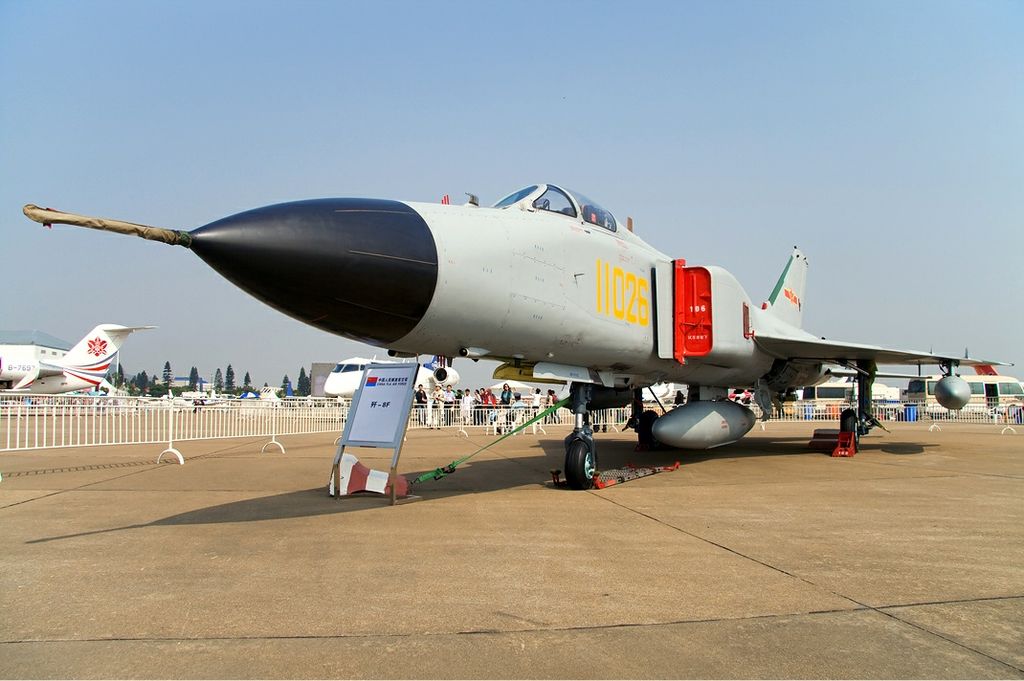
The J-8F Chinese Interceptor Fighter Aircraft is a model of the J-8II Series. This variant features the Type 1492 X-band fire-control radar, glass cockpit and more powerful WP-13BII engines. Plans called for the latter to be replaced by the WP-4 power plant. There is an additional pair of wing fences to improve handling. Some newer models are equipped with a new data link antenna behind the cockpit. The J-8F is armed with the newer PL-12 active radar-guided missile. The J-8F features a glass cockpit, in-flight refueling probe and a secondary air-to-ground capability. The BM/KZ900 electronic intelligence pod has been integrated with the aircraft's centerline station. Development began in 1997, followed by a first flight in 2000. Testing concluded in 2002. The J-8F entered service in 2003. Retrofitted models are designated J-8DF. The naval variant is the J-8FH. The J-8II series appear quite different from the original J-8, with a new forward fuselage, intake ramps with splitter plates and nose structure more reminiscent of the F-4 Phantom II or Sukhoi Su-15 to house a new, more powerful radar. The J-8II is powered by two Wopen-13A (WP-13A) engines. The design and development team was led by Gu Songfen, who is also a key member of J-8I design team. It was hoped to equip the production J-8B with an American AN/APG-66(V) radar (to be dubbed the J-8C), but this proved politically impossible after the Tiananmen Square protests of 1989 so the indigenous Type 208A monopulse radar fire-control radar initially was used. Although the Type 208A was an improvement over the original J-8I radar, the Type 208A did not have true beyond visual range capabilities (The detection range of the Type 208 was 40 km) nor look-down/shoot-up ground attack capabilities, thereby falling short of the PLAAFs initial requirements and the redesign of the airframe. The J-8B was the early production batch of the new J-8II series. In addition to receiving a new radar, new engine and redesigned noses, cockpit and intake, the J-8B also benefited from a new head-up display, integrated inertial navigation system/Global positioning satellite system and TACAN technology. Later J-8Bs were equipped with the more robust KLJ-1 pulse-Doppler radar fire-control radar and radar warning receiver, theoretically giving the later batch BVR capabilities. J-8B is the second Chinese aircraft to be equipped with a data link, the first being the Chengdu J-7III, and the data link is designated as Type 483 (developed from Type 481 data link used for J-7III), which enables ground-controlled interception centres to feed directions directly to the autopilots of J-8Bs to fly "hands off" to the interception. At least 30 J-8Bs have been converted by the PLA Navy to J-8D standard, with an aerial refuelling probe for use with Xian H-6DU tankers in addition to newly built J-8Ds. The most significant difference between the J-8B and J-8D is the use of the new Type-02 airframe that was heavier than the J-8B and featured uneven length wing fences. The heavier 'Type 02' airframe is able to carry a larger payload and can tolerate higher G-loadings. The new airframe also has a stiffer radome. A few minor differences between the later J-8B batches and the J-8D are the J-8Ds slightly improved avionics. The use of the KLJ-1 pulse-Doppler radar was used through the J-8Ds entire production run. The J-8B and J-8D both suffered from China's difficulty in developing a MRAAM. Although the Type 208A was theoretically capable of using semi-active radar homing missiles and the KLJ-1 was certainly capable; no such missile, semi-active or active, were available at the time. Both variants were only initially armed with SRAAMs such as the PL-2 and PL-5, and the more advanced infrared-homing PL-8 SRAAM. An early attempt to remedy these technological shortcomings still present after the redesign of the J-8 to the J-8II was the J-8C. The project began shortly after failure to obtain American cooperation for the J-8B, so Shenyang turned to Israel and Russia instead. The J-8C was considered a 'radical' upgrade of the original J-8II with a new radar based on the Israeli Elta EL/M 2035 multi-mode pulse Doppler radar, digital fire-control system, a new 'glass' cockpit, in-flight refuelling probe and equipped with a new WP-14 Kunlun engine. These upgrades were said to 'bring the fighter into the same league as modern Russian and Western fighters such as Mikoyan MiG-29 and Dassault Mirage 2000'. The project was cancelled in the late 1990s after two prototypes were built in favour of further development of the Shenyang J-11 fighter (which is based on the Sukhoi Su-27). The J-8IIM, first flown in 1996, is a further improved version. One major improvement over the J-8II is the capable Russian-made Zhuk-8II coherent pulse-Doppler radar, 100 of which have been delivered in the 1990s. Additionally, the J-8IIM carried new multifunction displays, integrated INS/GPS navigation system, new fire-control systems, new alternators and a new electronic countermeasures suite. The J-8IIM possessed true BVR capabilities with the use of the R-27 (air-to-air missile) semi-active infrared seeker medium-ranged missile. New WP-13B turbojet engines were adopted as well. The J-8IIM has had no new orders from China or the export market, where it is offered as the F-8IIM. It was heavily marketed to Iran but ultimately was not exported anywhere. However the experience and technological achievements gained from the J-8C and F-8IIM projects were later applied by Shenyang Aircraft Company to the later J-8H/F variants. It was also during this time that the Shanghai Academy of Spaceflight Technology certified the PL-11 in 2001 after successfully test firing five missiles from the J-8II. The J-8H configuration features the more powerful WP-13B turbojet engines, improved avionics and the improved Type 1471 pulse-doppler fire control radar with look-down/shoot-down capability and a range of new operating modes. With the radar upgrade comes the ability to fire the PL-11 and the PL-12/SD-10 MRAAM, which employs an Active radar homing (ARH) seeker. The J-8H also is equipped with IFR probe, INS/GPS, HOTAS, and an integrated ECM suite, with twin wing fences on each side of the wings that greatly increased handling ability. The J-8Ds heavier airframe is used but with modified wing fences. Production of the J-8H and the J-8D it had superseded has now ceased in favor of upgrading earlier J-8D aircraft to J-8H standards. It is uncertain if the older J-8B will be upgraded to J-8H standards given the difference in airframe. The J-8F is the most modern and capable J-8 variant currently in service and has been in production since 2003. The J-8H/F has inherited many of the improvements of the earlier J-8C and F-8IIM, and in some cases, has improved on them. The J-8F features a glass cockpit, a more powerful WP-13BII turbojet engine and enhanced Type 1492 radar for enhanced air-to-air capabilities with the PL-12 active radar homing medium range air-to-air missile, full air-to-ground and air-to-sea capabilities using the AS-17 'Krypton' anti-radar missile, and a variety of Chinese designed precision guided laser and satellite guided bombs, making it the first true Multirole combat aircraft variant of the J-8 series. The J-8F also possesses all the avionic and electronic upgrades the J-8H received. The earlier J-8B/Ds can be distinguished from later J-8H/Fs by their dark green radomes, compared to the latter's black radomes. Introduction of the more powerful WP-14 Kunlun turbojet engine for the J-8 series is planned to go under way in the coming years. The J-8F also serves in the People's Liberation Army Naval Air Force as well. A notable variant of the J-8F is the JZ-8F which has been introduced into the PLAAF in the tactical reconnaissance role. Little information has been released on the JZ-8F, other than the use of an internal camera compartment which replaces the twin 23 mm cannon, rather than a camera pod as used by the older JZ-8. In 1988, one J-8II airframe was converted into the J-8ACT an experimental fly-by-wire testbed for the J-10 programme. The J-8ACT had a shorter fuselage and a pair of canards were fixed to the side of each intake, and replaced older FBW technological demonstrators based on the older Shenyang J-6 and J-8I airframes. To date, no plans for a twin-seat J-8 design have been announced.