ARMSNET
Military Equipment Database
Initializing 0%

Tu-154 (Careless) Russian Jet Airliner
Spotted an error? Sign in to suggest an edit.
Basic Information
Name
Tu-154 (Careless) Russian Jet Airliner
Designation
Alternate Designation
Equipment Type
Manufacturer
Tupolev
Date of Introduction
1972
Description

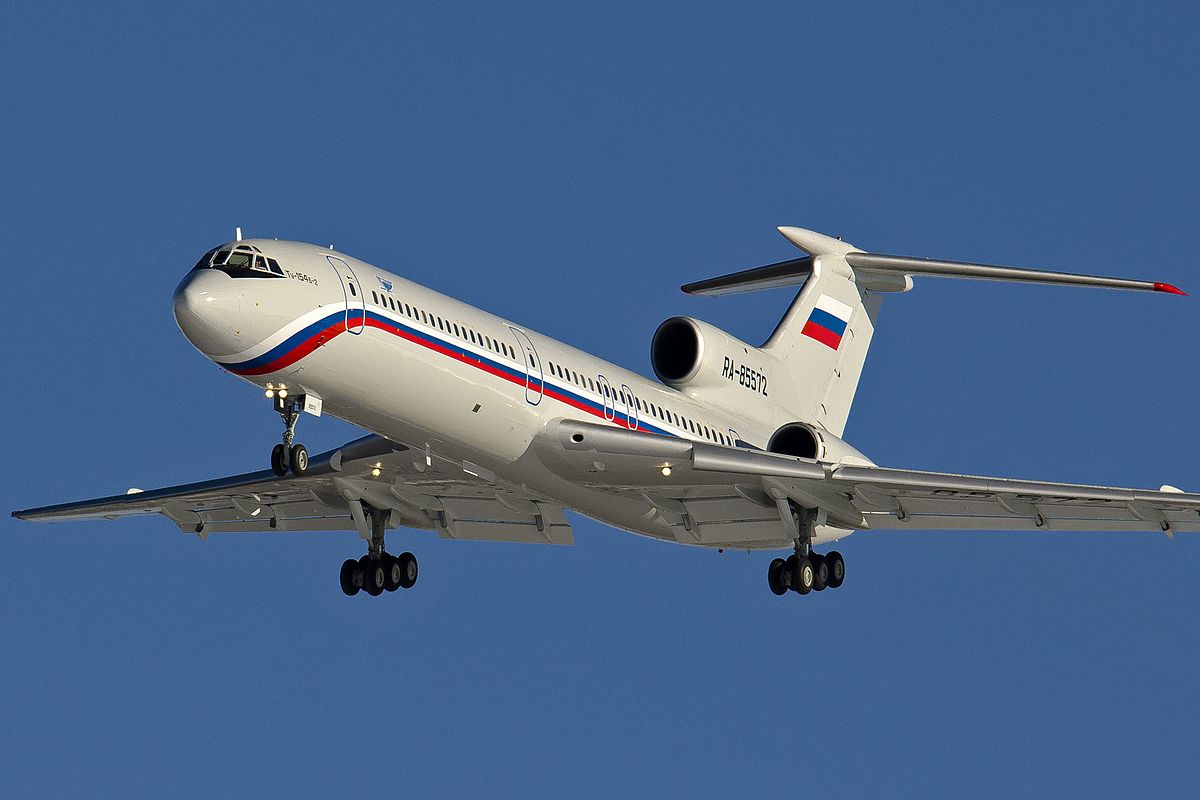
Tu-154 (Careless) Russian Jet Airlineris a three-engine medium-range narrow-body airliner designed in the mid-1960s and manufactured by Tupolev. A workhorse of Soviet and (subsequently) Russian airlines for several decades, it carried half of all passengers flown by Aeroflot and its subsidiaries (137.5 million/year or 243.8 billion passenger-km in 1990), remaining the standard domestic-route airliner of Russia and former Soviet states until the mid-2000s. It was exported to 17 non-Russian airlines and used as a head-of-state transport by the air forces of several countries. With a cruising speed of 850 kilometers per hour (530 mph) the Tu-154 is one of the fastest civilian aircraft in use and has a range of 5,280 kilometers (3,280 mi). Capable of operating from unpaved and gravel airfields with only basic facilities, it was widely used in the extreme Arctic conditions of Russia's northern/eastern regions where other airliners were unable to operate. Originally designed for a 45,000-hour service life (18,000 cycles) but capable of 80,000 hours with upgrades, it was expected to continue in service until 2016, although noise regulations have restricted flights to western Europe and other regions. Since 1968 there have been 39 fatal incidents involving the Tu-154, most of which were caused either by factors unrelated to the aircraft, incorrect maintenance or by its extensive use in demanding conditions. Few of the Tu-154 accidents appear to have involved technical failure. The Tu-154 is powered by three rear-mounted low-bypass turbofan engines arranged similarly to those of the Boeing 727, but it is slightly larger than its American counterpart. Both the 727 and the Tu-154 use an S-duct for the middle (Number 2) engine. The original model was equipped with Kuznetsov NK-8-2 engines, which were replaced with Soloviev D-30KU-154 in the Tu-154M. All Tu-154 aircraft models have a relatively high thrust-to-weight ratio which gives an excellent performance, at the expense of lower fuel efficiency. This became an important factor in later decades as fuel costs grew. The cockpit is fitted with conventional dual yoke control columns. Flight control surfaces are hydraulically operated. The cabin of the Tu-154, although of the same six-abreast seating layout, gives the impression of an oval interior, with a lower ceiling than is common on Boeing and Airbus airliners. The passenger cabin accommodates 128 passengers in a two-class layout and 164 passengers in a single-class layout, and up to 180 passengers in a high-density layout. The layout can be modified to what is called a winter version where some seats are taken out and a wardrobe is installed for passenger coats. The passenger doors are smaller than on its Boeing and Airbus counterparts. Luggage space in the overhead compartments is very limited. Like the Tupolev Tu-134, the Tu-154 has a wing swept back at 35° at the quarter-chord line. The British Hawker Siddeley Trident has the same sweepback angle, while the Boeing 727 has a slightly smaller sweepback angle of 32°. The wing also has anhedral (downward sweep) which is a distinguishing feature of Russian low-wing airliners designed during this era. Most Western low-wing airliners such as the contemporary Boeing 727 have dihedral (upward sweep). The anhedral means that Russian airliners have poor lateral stability compared to their Western counterparts, but also are more resistant to Dutch roll tendencies. Considerably heavier than its predecessor Soviet-built airliner the Ilyushin Il-18, the Tu-154 was equipped with oversized landing gear to reduce ground load, enabling it to operate from the same runways. The aircraft has two six-wheel main bogies fitted with large low-pressure tires that retract into pods extending from the trailing edges of the wings (a common Tupolev feature), plus a two-wheel nose gear unit. Soft oleo struts (shock absorbers) provide a much smoother ride on bumpy airfields than most airliners, which very rarely operate on such poor surfaces. The original requirement was to have a three-person flight crew – captain, first officer, and flight engineer – as opposed to a four- or five-person crew, as on other Soviet airliners. It became evident that a fourth crew member, a navigator, was still needed, and a seat was added on production aircraft, although their workstation was compromised due to the limitations of the original design. Navigators are no longer trained and this profession is becoming obsolete with the retirement of the oldest Soviet-era planes. The latest variant (Tu-154M-100, introduced 1998) includes an NVU-B3 Doppler navigation system, a triple autopilot, which provides an automatic ILS approach according to ICAO category II weather minima, an autothrottle, a Doppler drift, and speed measure system (DISS), and a "Kurs-MP" radio navigation suite. A stability and control augmentation system improve handling characteristics during manual flight. Modern upgrades normally include modernized TCAS, GPS, and other systems (mostly American-made or EU-made). Early versions of the Tu-154 cannot be modified to meet the current Stage III noise regulations and are no longer allowed to fly into airspace where such regulations are enforced, such as the European Union. However, the Tu-154M's D-30 engines can be fitted with hush kits, allowing them to meet noise regulations.

Air & Air Defense Specifications
Crew 8
Engine Turbofan (10500 hp)
Max Speed 950.0 km/h
Wingspan 37.55 m
Variants
Tu-154 Tu-154 production started in 1970, and the first passenger flight was performed on 9 February 1972. Powered by Kuznetsov NK-8-2 turbofans, it carried 164 passengers. About 42 were built.
Tu-154A The first upgraded version of the original Tu-154, the A model, in production since 1974, added center-section fuel tanks and more emergency exits, while engines were upgraded to higher-thrust Kuznetsov NK-8-2U. Other upgrades include automatic flaps/slats and stabilizer controls and modified avionics. Max. takeoff weight – 94,000 kg (207,235 lb). There were 15 different interior layouts for the different domestic and international customers, seating between 144 and 152 passengers. To discern the A model from the base model note the spike at the junction of the fin and tail. This is a fat bullet on the A model, and a slender spike on the base model.
Tu-154B As the original Tu-154 and Tu-154A suffered wing cracks after a few years in service, a version with a new, stronger wing, designated Tu-154B, went into production in 1975. It also had an additional fuselage fuel tank, additional emergency exits in the tail. Also, the maximum takeoff weight increased to 98,000 kg (216,053 lb). Important to Aeroflot was the increased passenger capacity, hence lower operating costs. With the NK-8-2U engines the only way to improve the economics of the airplane was to spread costs across more seats. The autopilot was certified for ICAO Category II automatic approaches. Most previously built Tu-154 and Tu-154A were also modified into this variant, with the replacement of the wing. Maximum takeoff weight increased to 96,000 kg (211,644 lb). 111 were built.
Tu-154B-1 Aeroflot wanted this version for increased revenue on domestic routes. It carried 160 passengers. This version also had some minor modifications to the fuel system, avionics, air conditioning, and landing gear. 64 were built from 1977 to 1978.
Tu-154B-2 A minor modernization of Tu-154B-1. The airplane was designed to be converted from the 160 passenger version to a 180 passenger version by removing the galley. The procedure took about 2 1/2 hours. Some of the earlier Tu-154Bs were modified to that standard. Maximum takeoff weight increased to 98,000 kg (216,053 lb), later to 100,000 kg (220,462 lb). Some 311 aircraft were built, including VIP versions. A few remain in service.
Tu-154S The Tu-154S is an all-cargo or freighter version of the Tu-154B, using a strengthened floor, and adding a forward cargo door on the port side of the fuselage. The aircraft could carry nine Soviet PAV-3 pallets. Maximum payload – 20,000 kg (44,092 lb). There were plans for 20 aircraft, but only nine were converted, two from Tu-154 models and seven from Tu-154B models. Trials were held in the early 1980s and the aircraft was authorized regular operations in 1984. By 1997 all had been retired.
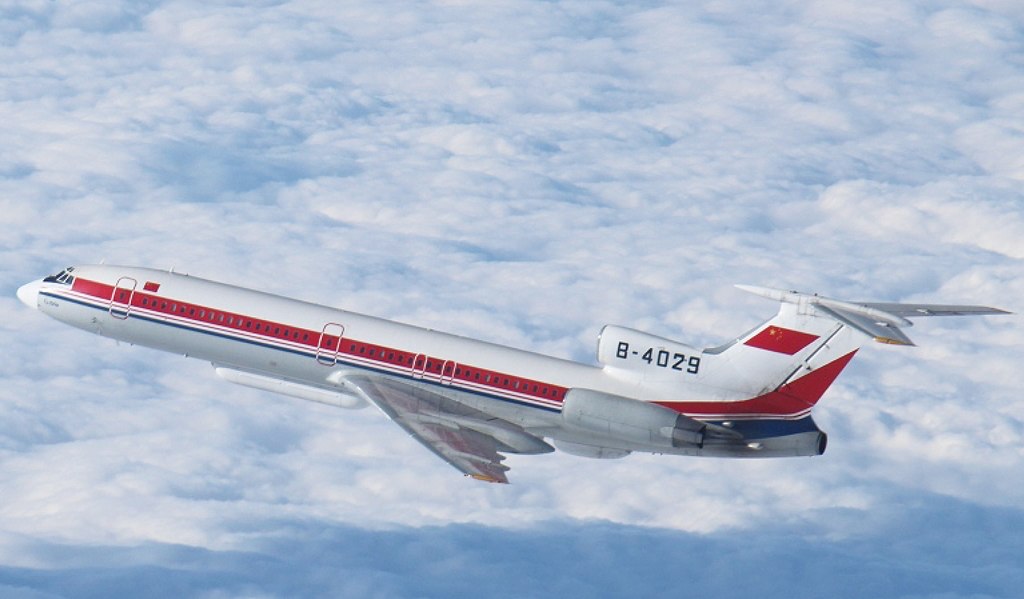
Tu-154M The Tu-154M and Tu-154M Lux are the most highly upgraded versions, which first flew in 1982 and entered mass production in 1984. It uses more fuel-efficient Soloviev D-30KU-154 turbofans. Together with significant aerodynamic refinement, this led to much lower fuel consumption hence longer range, as well as lower operating costs. The aircraft has new double-slotted (instead of triple-slotted) flaps, with an extra 36-degree position (in addition to existing 15, 28 and 45-degree positions on older versions), which allows reduction of noise on approach. It also has a relocated auxiliary power unit and numerous other improvements. Maximum takeoff weight increased first to 100,000 kg (220,462 lb), then to 102,000 kg (224,872 lb). Some aircraft are certified to 104,000 kg (229,281 lb). About 320 were manufactured. Mass production ended in 2006, though limited manufacturing continued as of January 2009. No new airframes have been built since the early 1990s, and production since then involved assembling aircraft from components on hand. Chinese Tu-154MD electronic intelligence aircraft carry a large-size synthetic aperture radar (SAR) under their mainframe.
Tu-154M-LK-1 Cosmonaut trainer. This was a salon VIP aircraft modified to train cosmonauts to fly the Buran reusable spacecraft, the Soviet equivalent of the US Space Shuttle. The Tu-154 was used because the Buran required a steep descent, which the Tu-154 was capable of replicating. The cabin featured trainee workstations, one of which was identical to the Buran's flightdeck. The forward baggage compartment was converted into a camera bay, as the aircraft was used to train cosmonauts in observation and photographic techniques.
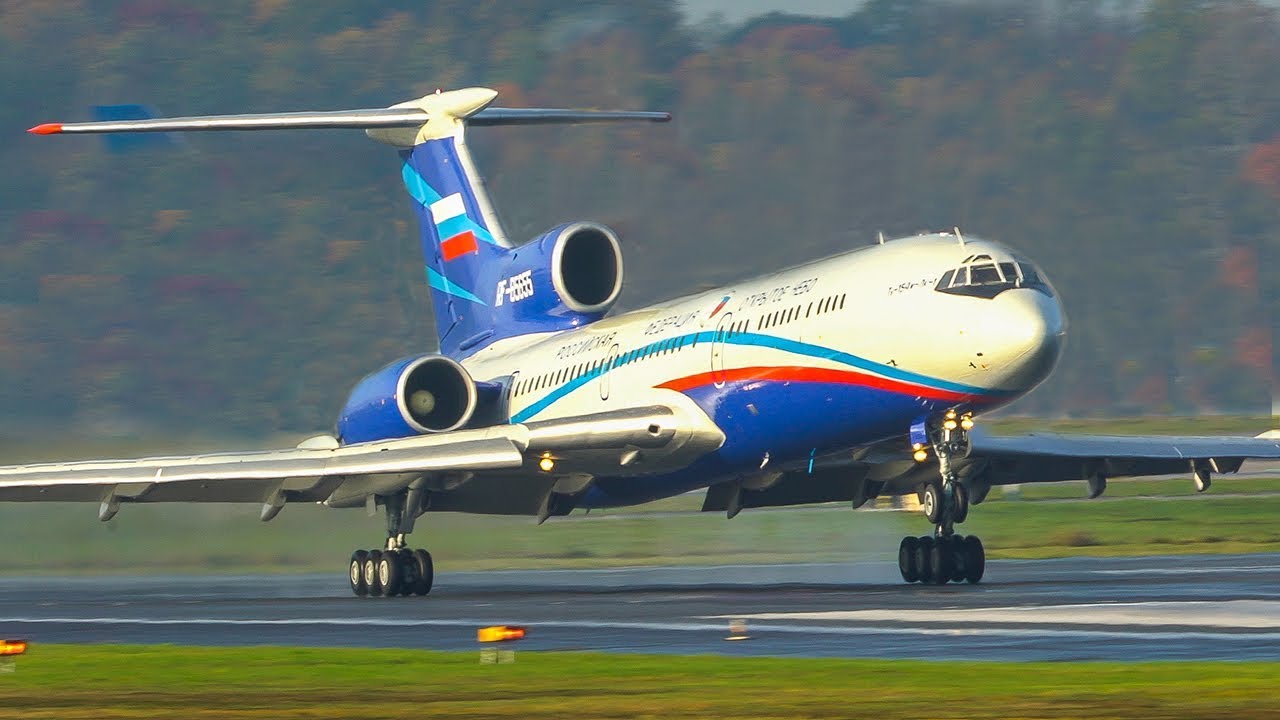
Tu-154M-ON monitoring aircraft Germany modified one of the Tu-154s it inherited from the former East German Air Force into an observation airplane. This aircraft was involved with the Open Skies inspection flights. It was converted at the Elbe Aircraft Plant (Elbe Flugzeugwerke) in Dresden, and flew in 1996. After 24 monitoring missions, it was lost in a mid-air collision in 1997. The Russians also converted a Tu-154M to serve as an Open Skies monitoring aircraft. They used the Tu-154M-LK-1, and converted it to a Tu-154M-ON. When not flying over North America, it is used to ferry cosmonauts. China is believed to have converted one Tu-154 to an electronic countermeasures aircraft.
Tu-154M-100 Design of this variant started in 1994, but the first aircraft were not delivered until 1998. It is an upgraded version with Western avionics, including the Flight Management Computer, GPS, EGPWS, TCAS, and other modern systems. The airplane could carry up to 157 passengers. The cabin featured an automatic oxygen system and larger overhead bins. Three were produced, as payment of debts owed by Russia to Slovakia. Three aircraft were delivered in 1998 to Slovak Airlines, and sold back to Russia in 2003.
Tu-155 A Tu-154 converted into a testbed for alternative fuels. It first flew in 1988 and was used until the fall of the Soviet Union, when it was placed in storage.
Tu-164 Initial designation of the Tu-154M.
Tu-174 Proposed stretched version of Tu-154.
Tu-194 Proposed shortened version of Tu-154.
System
Alternate Designation(s) Tu-154; NATO: Careless
Primary Function / Type Jet Airliner
Manufacturer Tupolev
Crew 8 (3 flight crew + 5 cabin crew)
Passengers 144-168 passengers
Number of Engines 3 ea
Number of Hard Points INA
Dimensions
Length 48.00 m
Height 11.40 m
Wingspan 37.55 m
Wing Area 201.45 sq m
Cabin Volume 163.2 cu m
Weight, Empty 55,300 kg
Weight, Maximum Takeoff 100,000 kg
Payload 18,000 kg
Automotive
Engine Name 3 x Kuznetsov NK-8-2
Engine Type Turbofan
Engine Power 10,500 kg static thrust each
Maximum Internal Fuel Capacity 47,000 liters
Maximum Speed 950 km/h
Economical Speed 900 km/h
Long-Range Speed 850 km/h
Takeoff Safety Speed 255 km/h
Landing at Threshold Speed 225 km/h
Fire Control / Avionics
Fire Control System Type INA
Fire Control Radar INA
Laser Desingator INA
Navigation Radar INA
Protection
Stealth Properties None
Heat Signature Reduction No
Add on Armor INA
NBC Protection INA
EW Counter Measures INA
Chaffs/Flares INA
Details
Country of Origin Russia
Category Fixed Wing Aircraft
Air > Fixed Wing Aircraft
Filter Label
T
Classification
Domain
Air & Air Defense
Equipment Status
Active
Dimensions
Length
48 m
Width
Height
11.4 m
Weight
100000 kg
Operators (15)
Russia
China
North Korea
Czech Republic
Belarus
Afghanistan
Albania
Armenia
Azerbaijan
Croatia
Cuba
Djibouti
Egypt
Estonia
Kazakhstan
Something went wrong. Please reload the page. Reload